
October 9, 2026
Modular Trolley Systems vs One-Off Carts: When a Shared Platform Pays Off
The decision in one question
Does the same base carry more than one purpose over its life, or does every cart in your facility do exactly one job? Modular trolley systems are not inherently better. They are better when the load-carrying structure is shared across several functions and the volume justifies carrying the complexity. They are worse when you pay for a platform you will use one way, and they are a mistake when the range is still changing every quarter.
Below is how that decision actually gets made on the shop floor, and how to tell whether your programme is a modular case or a one-off case.
What “modular” means in a trolley system
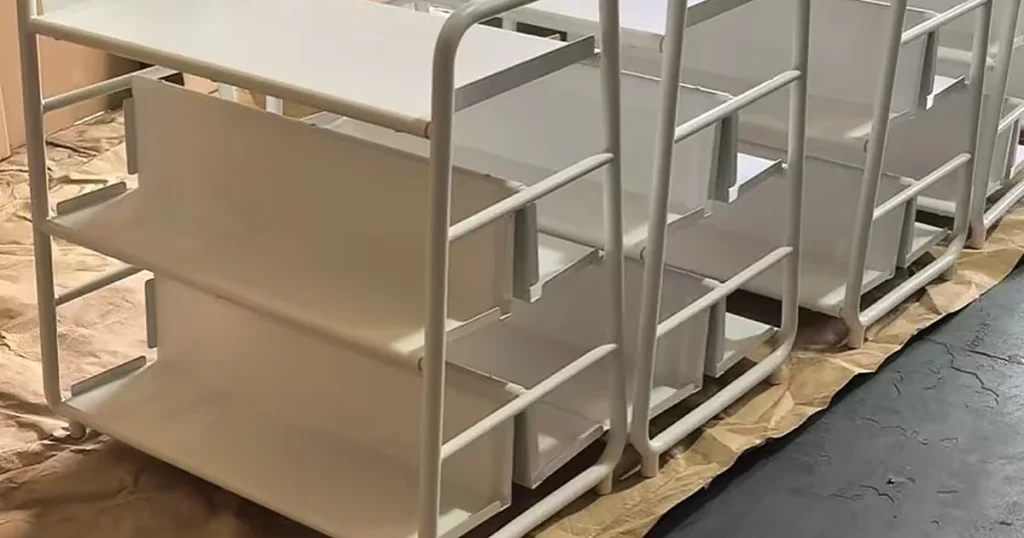
A modular trolley system is a set of standardised structural elements that recombine: a common chassis and handle geometry, a common caster pattern, a common top and shelf interface, and a set of modules that clip, bolt or hook into that structure. A classic layout is a frame with interchangeable decks — a flat deck, a shelf deck, a bin deck, a drawer deck, a scanner or printer deck, a laptop or screen riser — so the same base converts between picking, storage and presentation.
The value is not the catalogue. It is that the expensive, tolerance-critical parts of the trolley — tube size, caster positions, corner geometry, load paths — are designed once, verified once, and then reused. The modules that change are the cheap, light, fast-to-change ones.
Where the economics actually sit
The reason to go modular is cost and risk per variation, not tidiness. Break a trolley into two groups.
- Fixed structure: chassis tube, corner welds, caster pattern, handle, load-bearing deck geometry. This is where tooling, jigging, tolerance and verification live. You pay for it once per platform.
- Variable module: the part that changes per task — the upper deck, the bin insert, the drawer, the riser, the label holder. Low tooling, low verification cost, easy to change.
If most of your variations live in the variable group, a modular platform pays for itself. If a customer changes the chassis geometry every time — different caster spacing, different tube size, different handle height — then the “platform” is not a platform, and a modular programme costs you more in engineering and jigs than it saves.
This is also why modular and one-off are not opposites in practice. A one-off cart built on a proven standard chassis is a modular system being used for a single purpose. That is usually the best outcome: you inherit the verified structure and you only pay for what is genuinely different.
When modular is the right answer
Several tasks share one route
Pick to cart, replenish to line, return empties, deliver finished goods, set up a workstation, run a kitting operation. One cart family serving all of these replaces a fleet of single-use carts, and the fleet shrinks.
The fleet is large enough to justify jigs
A repeatable platform lets you build in jigs, fixtures and repeat inspection, which is what makes a repeat order match the first run. At low volume you cannot amortise that tooling and a simple weldment is cheaper.
Tasks change but structure does not
If a new process needs a different deck or a different bin, you have already absorbed the cost of designing the hard part. Adding a module is then a short job, not a new programme.
You ship to several sites with the same standard
A common platform lets you quote a whole site consistently, and lets the customer add units later without re-engineering.
When modular is the wrong answer
The range is still moving
Do not freeze a platform before the applications have settled. A platform built around assumptions that change twice is a platform you will rebuild twice.
Volume is low
Below a few dozen units a year across the whole family, modular engineering and jigs do not pay back. Ask for one-off carts on a proven standard frame instead.
The variation is in the structure
If every cart in your fleet has a different caster pattern, different tube size and different handle height, you are building custom trolleys, not a system. Say so honestly and price it as custom work.
Every module needs a unique design
Modules that each need bespoke tooling destroy the economics. A platform works when the modules are simple enough to be produced by the same methods as the base.
How to specify a modular programme so it can be quoted
- Start from the chassis. Give the overall dimensions, tube size and wall thickness, caster pattern, handle height and push orientation. This is the platform and it needs to be right first.
- List the modules by function, not by name. “Flat deck for tote transfer”, “two-tier shelf for consumables”, “drawer module with one drawer”, rather than product names that only mean something inside your company.
- State the interface. How a module attaches — bolt pattern, hook, rail — and what load it carries when mounted. This is the detail that turns a brochure into a manufacturable design.
- Give the load per module and the load for the whole cart. They are not the same number, and the frame is designed for the combination.
- Say how many of each variant you need. A platform quoted across six modules with no volumes tells us nothing about whether jigs are justified.
- Tell us what changes and what stays. If a module is likely to be revised, we would rather design a fixing that accepts a revision than one that does not.
What we build
We build the structure: laser-cut and bent platforms and decks, tube frames, handle geometry, welded modules, caster fitting and assembly, powder coating in our own line, and export packing. We do not supply castors as a standard item — we fit the ones you specify, which means the caster is chosen against your floor and load rather than against a catalogue. If you want a caster recommendation, tell us the floor type, the load and the push frequency and we will tell you what we have seen work.
On a modular programme we would expect a first article on the chassis and on one module before batch, so the interface is proven before you commit to a fleet.
Frequently asked questions
How many variants justify going modular?
There is no magic number — it depends on how much of the variation is in the interface rather than the structure. Send us the variants and the volumes and we will tell you whether one platform covers them or whether two platforms would be cleaner.
Can you build to our existing system?
If you send a sample or a set of drawings with the interface dimensions, we can often match it. Send a physical sample where possible — caster fixing patterns and module fit are much easier to read off a sample than off a drawing.
Do modules ship separately?
They can. We supply the base and modules separately for field configuration, or assembled, depending on your site. Tell us which and we will pack accordingly.
What if we only need one module changed?
That is the normal case for a working platform, and it is the cheapest thing to do once the interface exists. Send the revised module drawing and we will confirm the fit before you order.
Have a platform in mind, or a range you are still trying to organise? Send the chassis and the module list with the volumes and we will tell you honestly whether one platform covers it. You may also find it useful to see how a multi-model trolley range was actually run in the library trolley case study.
Related pages: Custom trolley manufacturer and all trolley product types. and stacking versus nesting for platform trolley fleets.
Have a Similar Trolley Project? Send It for Review
Send your trolley type, load capacity, size, wheel requirement, quantity, and drawings or reference photos. Our team will review the structure and reply within 24 hours on business days.
Urgent project? Email gao@doingmetal.com or WhatsApp +86 18158549983.