
October 23, 2026
Nestable Trolleys: 500 Units for Fresh Produce
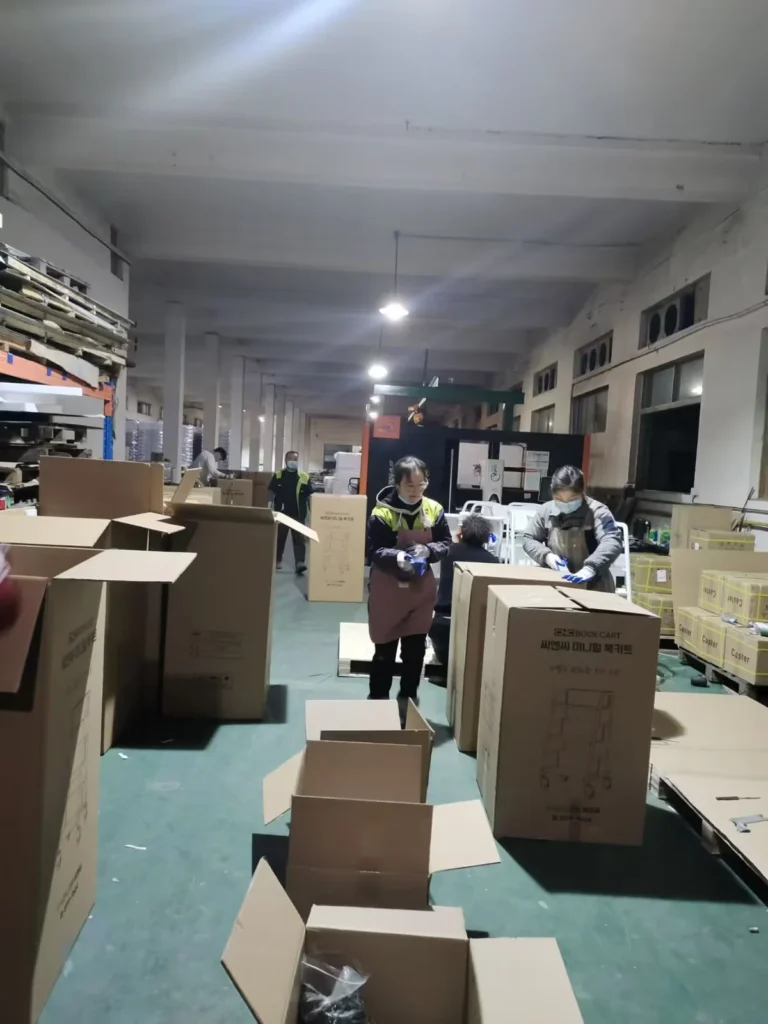
A BRC AA certified fresh produce wholesaler in the UK came to us with a four-page RFQ, nine annotated concept sketches, and no engineering drawings. What followed is a useful example of how a custom trolley programme actually runs: concept in, drawing out, first article, confirmation loop, sample approval, and a 500-unit production order. This article walks through each stage, including the three engineering decisions that shaped the design and the questions we put back to the customer before quoting volume.
Quick answer: what this programme involved
| Stage | What happened | What the customer supplied |
|---|---|---|
| Brief | Four-page RFQ plus nine annotated concept images. No part drawings, no BOM, no 2D dimensions — the RFQ stated the supplier was to engineer and validate the final construction. | Concept, target load, target footprint, fleet size |
| Engineering | We produced the 2D drawing set and an engineering proposal covering structure, caster layout, load rating basis and stacking behaviour. | Review comments and four open technical questions |
| First article | One sample set built to the drawing revision that would govern production, and sent for evaluation. | Sample fee, evaluation feedback |
| Confirmation loop | Caster grade, deck material, handle ratio, colour and payment terms settled in writing before the production order. | Decisions on each open item |
| Production | Sample approved, then a 500-base order committed — the programme moved from quoted tiers to a single volume order. | Purchase order, delivery schedule |
The brief: a concept, not a drawing
The customer runs a two-site wholesale operation with a delivery fleet — roughly a dozen routes, each with its own trolley positions, adding up to a fleet in the several hundreds. That fleet size matters: this was never a pilot order for one or two units. It was a warehouse-wide rollout, which changes what “good” looks like. A trolley that works brilliantly once but is miserable to store, wash or replace across 500 units is a failed purchase.
The original concept asked for a coupling system so trolleys could be pulled in trains. In the second exchange the customer simplified the brief: what was wanted was a strong trolley that could carry up to 300 kg, at a footprint around 600 mm wide and up to 1600 mm long, that would nest or stack to save space. The customer explicitly opened the floor to suggestions on nesting, folding or any other space-saving option.
That sentence is the most important line in the whole RFQ. It tells you the customer cares about the outcome — storage density, durability, cost per year of service — not about a specific mechanism. It also means the engineering risk sits with the supplier, which is exactly where it should sit for a fabricated product.
Step 1 — what we added to the concept
A concept sketch shows intent. A drawing has to survive contact with a workshop, a loading dock and a delivery driver. Here is what the engineering stage added, and why each item exists:
| Item | What the concept showed | What we specified | Why it matters |
|---|---|---|---|
| Deck | A flat top surface | Deck plate with two reinforcement members running the load path to the frame | A 300 kg load on a 1.6 m deck bends the plate between supports if nothing carries the span |
| Frame | Rectangular tube frame | Section and wall chosen against span, load and impact, with corner joints detailed for welding access | Tube section is the cheapest place to add stiffness and the most expensive place to get wrong |
| Casters | “Wheels” | Layout drawing, not a count: two fixed, two swivel with brakes, each rated above its share of the load | All-swivel sets wander and track badly; the customer’s own RFQ warned against assuming free-swivel casters track correctly |
| Handles | One handle | Detachable handles at a quoted ratio (roughly one handle per ten bases) | Handles are the highest-theft, highest-wear part; one per base doubles cost for no operational gain |
| Stacking | “Nestles or stacks” | Nested stacking geometry with the stacking height increment calculated and drawn | Storage density is the whole point; the increment is the number that decides it |
Step 2 — the three decisions that decided the design
Decision 1: nesting beat folding
Folding trolleys save more space per unit than nested ones. We still recommended nesting, and the reason is wear. A fleet that folds and unfolds several times a night, every night, puts every cycle through the hinges and pins. Hinges and pins become the highest-wear parts on the vehicle, and they fail in the aisle, during a delivery run, under load. Nesting has no mechanism to wear out — the space saving comes from geometry, not from hardware.
For a fleet in the several hundreds, mechanism-free beats mechanism-efficient. For a fleet of twenty that gets folded twice a week, folding would have been the right answer. The decision follows the duty cycle, not the brochure.
Decision 2: caster layout is an engineering deliverable, not a line item
The customer’s RFQ contained a line that experienced buyers write and inexperienced ones do not: do not assume that eight or twelve free-swivel casters will track correctly. They were right. A four-caster set with all four swiveling will wander, shimmy at speed and track unpredictably, and a long trolley amplifies all three.
We quoted two fixed and two swivel-with-brake. The fixed pair sets the tracking line; the braked swivels let one person park the trolley safely on a dock or a market slope. Critically, we supplied this as a layout drawing with positions and ratings — not as “four casters, customer to specify”. Casters are also the single largest cost line on this class of trolley, which brings us to the confirmation loop.
Decision 3: the load rating is a tested number, not a marketing number
The brief asked for 300 kg. We engineered to a declared safe working load above that, with the rating established by test rather than assertion: static load at 1.5× and dynamic load at 2.0× the declared rating, per the EN 12195-1 load-restraint framework, with test records and photographs attached to the quotation.
This matters commercially as well as technically. A buyer who has been sold a “300 kg” trolley that fails at 310 kg learns to distrust every number in the next quotation. A rating that comes with a test method attached is a number they can put in a tender document.
Step 3 — the confirmation loop before mass production
Between the approved sample and the production order sits a short list of decisions that change the price. We put these to the customer in writing rather than guessing:
| Open item | Options we quoted | Why it changes the price |
|---|---|---|
| Caster grade | Two tiers: PU and rubber, in two diameters | Casters are roughly half the unit cost on this class of trolley; the grade is the biggest single price lever |
| Deck material | Tread plate, stainless mesh, or polymer | Different weight, different washdown behaviour, different price |
| Handle ratio | Confirmed at roughly one handle per ten bases | Getting this wrong either strands bases without handles or buys handles that sit in a store |
| Colour | RAL 7035 grey recommended | Standard stock colour avoids a custom powder batch and its minimum quantity |
| Payment and packing | Deposit on order, balance against shipping documents; bases nested for container loading | Nested bases ship close to flat-pack density, which is the difference between one container and two |
None of these questions are stalling. Each one has a quoted answer ready, and each one is cheaper to settle before the welding starts than after.
Step 4 — sample approval and the production order
The sample was built to the same drawing revision that would govern production, which is the only way a sample proves anything: if the sample and the production units come off different drawings, the sample has validated a trolley that will never be built.
Approval came with the open items settled, and the programme then committed to a 500-base order. The original quote had carried tiered quantities, which is the normal way to price a fleet programme — the tiers let a customer start smaller and step up as the trolley proves itself on real routes. In this case the customer went straight past the pilot stage and committed the volume in a single order, which moved the programme to the top volume step and removed the tier question entirely.
| Order | Bases | Handles | Spares |
|---|---|---|---|
| Committed production order | 500 | At the confirmed ratio | One set |
Handles were ordered at the confirmed ratio rather than one per base, because the ratio reflects how the fleet is actually used — bases stay in position, handles travel with the crew. Ordering one handle per base would have doubled a cost line for parts that spend most of their life hanging on a hook.
What transfers to your project
Four things from this programme apply to any custom trolley brief, whatever the industry:
- Fleet size changes the engineering. The right answer for 20 units is often wrong for 500. Duty cycle, storage density and spare-parts logistics dominate once volume arrives.
- Ask for the mechanism-free option first. Hinges, pins and latches are where custom trolleys fail. Geometry that needs no mechanism usually wins over a longer service life.
- Insist on a caster layout drawing. Caster count is not a specification. Position, rating and brake placement are.
- Make the load rating testable. A rating with a stated test method survives a tender. A rating without one is an opinion.
Frequently asked questions
How long does a programme like this take from concept to delivery?
For a trolley of this class, the drawing and engineering proposal take a few days once the brief is stable. The first article takes longer than the drawing because it includes material sourcing, welding, finishing and our own inspection before it ships. Volume lead time starts from sample approval, not from order placement, and the sample stage is where the schedule is actually decided.
Why not just quote the lowest caster grade to win on price?
Because the customer would pay for it twice. The cheapest caster on a fleet that runs six days a week becomes a replacement programme, and casters are the part that fails in service. Quoting two grades with the trade-off stated lets the buyer make an informed decision instead of a cheap one.
Can a concept sketch really be enough to start?
Yes, provided the buyer states the outcome they need — load, footprint, fleet size, storage constraint — and accepts that the supplier engineers the construction. That is the normal division of work for fabricated products, and this RFQ said so explicitly.
What is the single most common mistake in trolley briefs?
Specifying a mechanism before specifying the duty cycle. Nesting, folding, coupling and lifting features all solve real problems, but each adds a wear point. Start from how the trolley is used per day, then choose the mechanism — or decide you do not need one.
Do you supply first articles for evaluation before committing to volume?
Yes. The sample is built to the same drawing revision that will govern production, and the volume price is confirmed after the sample is approved. It is the only sequence that protects both sides from paying twice for a change.
Have a fleet to re-spec? Send the numbers.
If you are running a trolley fleet that has grown organically — mixed models, mismatched parts, no storage plan — the fastest way to scope a replacement is to send three numbers: units in service, load per unit, and the storage footprint you have available. We will come back with a drawing approach and a tiered price, the same way this programme ran.
Have a Similar Trolley Project? Send It for Review
Send the concept, the sketch, or the existing trolley you want improved. We will tell you what we would change before you commit to tooling or a sample.
Read Next on the Same Decisions
- Cage Trolleys to Your DrawingRoll cages and cage trolleys welded to your drawing, with mesh gauge, door position and brake layout confirmed before quotation.
- Nestable Roll Cage TrolleysHow nesting geometry is set and what the stacking increment buys you in storage density.
- Platform TrolleysFlat-deck platform trolleys specified by deck size, load and caster layout.
- Trolley Parts and AccessoriesCasters, brakes, handles, shelves, mesh, drawers and locks with the usual specification ranges.
- Trolley Load Ratings ExplainedRated load versus shelf load versus caster rating, and how each is tested.
- Caster Selection for Industrial TrolleysPU, rubber, nylon and pneumatic casters: where each one belongs and how to rate them.
- Export Packing and Container LoadingHow nesting and flat-pack designs change how many units fit in a container.
- MOQ, Lead Time and Repeat OrdersWhat minimum quantities and lead times look like on custom trolley programmes.
Have a Similar Trolley Project? Send It for Review
Send your trolley type, load capacity, size, wheel requirement, quantity, and drawings or reference photos. Our team will review the structure and reply within 24 hours on business days.
Urgent project? Email gao@doingmetal.com or WhatsApp +86 18158549983.