
September 14, 2026
How to Specify a Hygienic Trolley That Survives a Food Plant
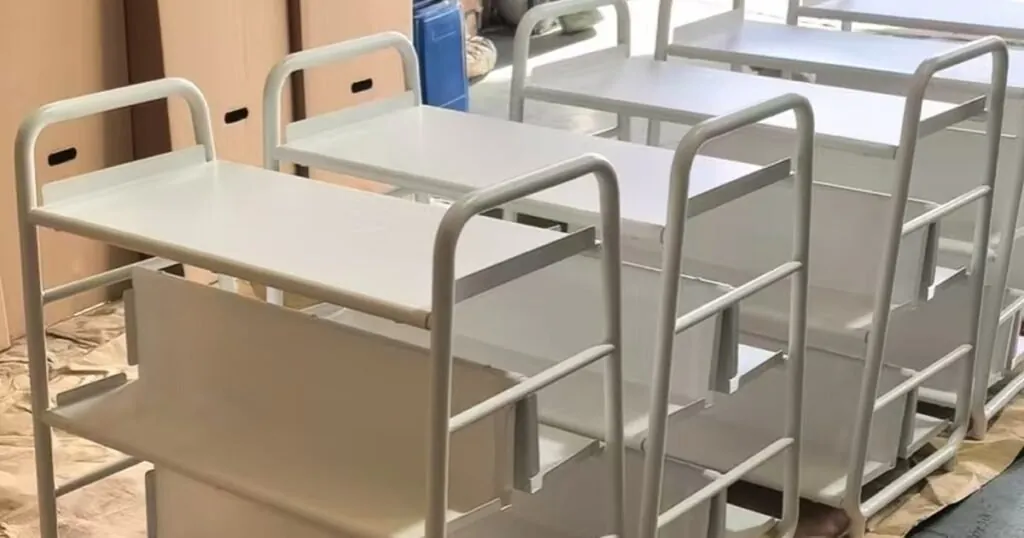
A plant manager walked me past a line of trolleys last spring and pointed at a brown streak running down from a welded corner. The trolleys were three months old.
They had arrived gleaming, passed the goods-in check, and went straight into a chilled packing hall. By week twelve, rust was weeping out of a joint that looked perfectly sealed on the day of delivery.
He had one question. Was this a bad batch of steel, or a bad decision?
It was a bad decision, and it was made long before anyone ordered steel. The trolley had been specified as a general industrial cart with a stainless label, which is a very different animal from a hygienic trolley built for a wet room. Two of the four units failed the same way, and the supplier's inspection sheet had ticked every box.
What follows is the five-axis specification I gave him that afternoon. Material grade, weld geometry, surface finish, caster sealing and washdown rating. Hand this to any supplier and you get a cart that survives the room it lives in. You also get a document you can defend when your customer's auditor arrives with a torch and a swab.
Why a General Industrial Trolley Fails in a Wet Zone
Most wet-zone failures follow one of three routes, and they bite at different speeds. Corrosion is the slowest and the most visible.
Condensation inside a closed section is faster and nearly invisible. Bearing failure is the quickest, and it usually gets blamed on the wheels.
What makes this hard to see is that all three produce the same complaint from the floor. The trolley has gone bad. Nobody writes down that water sat in a crevice, or that a handle flooded from inside.
The purchase team hears cheap steel and buys the same cart again from a different supplier. That is why the problem returns on the next order instead of disappearing.
So the first move is to separate the symptom from the cause. A rust streak is not a material verdict. It is a message about where water was allowed to stop moving.
If your trolleys run in a room that gets hosed down, walk the route once and look for the places where a puddle could sit for an hour. That single habit will tell you more about your specification than any datasheet.
Where Bare Steel Starts to Rust
Follow one trolley through a chilled hall and watch the water. The frame arrives cold, the room is humid, and moisture beads on every cold surface within minutes.
Gravity takes it down the tube, past the flat panels, and into the lowest welded corner where it has nowhere left to go. That corner is always the first to bloom, and it is not a coincidence.
A weld toe is a small valley. It catches a film of water, holds it against the parent metal, and keeps it there long after the deck has dried. Rust begins where water can rest, not where water lands.
The practical test costs nothing. After a washdown, run your hand along the underside of every welded joint and feel for moisture. Any spot still wet ten minutes later is a future rust streak.
Fix that by design rather than by touch-up paint. Paint over a wet crevice hides the problem for one season and returns it as a bigger repair on the next maintenance window.
Rust also does not spread at one speed. A horizontal joint that holds a film of water pits within weeks, while a vertical seam that sheds water may look clean for a year and then fail from the inside.
That is why a visual inspection of a used hygienic trolley tells you so little. The corners that worry you are often fine, and the ones that look dry are the ones worth opening.
A hygienic trolley that spends its life in a chilled room ages faster than the same frame in a dry store, purely because condensation never stops. Anyone who specifies one trolley design for both rooms is choosing to replace the chilled units twice as often.
The Hollow Tube That Becomes a Microbial Harbor
Here is the detail that almost never appears in a specification sheet. A handle made from sealed hollow tube looks tidy, feels rigid and cleans beautifully on the outside.
On the inside it is a closed cavity that breathes. In a chilled room, that cavity cycles between warm and cold with every door opening.
Moisture condenses inside the tube, and a pinhole in a tack weld gives it a way out. The result is a slow weep of rusty water from a joint that looked sound, plus a warm, dark, damp interior that no brush will ever reach.
You can screen for this on a sample in under a minute. Shake the handle and listen for anything moving inside. Put your nose to each tube end and smell for damp metal.
Then ask one direct question. Are the tube ends continuously welded and capped, or tacked and left open?
A hygienic trolley closes every section. A general cart leaves them open because the buyer never asked, and the supplier saves ten minutes per frame.
That ten minutes is the difference between a fleet that lasts a decade and one that gets replaced before the finance team has finished depreciating it.
The same logic applies to every closed section on the frame, not only the handle. Cross members, uprights and folded deck edges all trap air and moisture when nobody purges them.
A hygienic trolley treats each one as a cavity that has to be sealed at both ends. That decision belongs on the drawing, not on the shop floor.
Choosing Between 304 and 316 Stainless for Trolleys
Most buyers approach this as a ladder, with 316 sitting above 304 and therefore being the safer purchase. That framing wastes money in dry rooms and still fails in the wet ones, because it ignores what actually attacks the steel.
Chloride is the attacker. Where chloride is absent or occasional, 304 stainless performs for years and costs meaningfully less. Where chloride is routine, 316 stainless with its molybdenum content holds up while 304 pits.
No amount of polishing will save a 304 frame in a brining room, and no auditor will accept a certificate that names the wrong grade for the duty.
The skill is not picking the higher grade. It is reading your room honestly and naming the chloride sources out loud. Once you list them, the grade picks itself, and you can defend the choice to a finance team that would rather not pay for 316 across the whole fleet.
A food grade trolley specification usually stops at this question, which is why so many of them end up over-specified in one hall and under-specified in the next.
There is a second trap worth naming. A fleet can be mixed without anyone noticing, because 304 and 316 look identical when new and behave identically in a dry aisle. The difference only appears where the chloride is, and by then the two grades have been moved between rooms so many times that nobody remembers which frame went where.
Marking the grade on the frame itself, not only on the paperwork, costs almost nothing and saves an argument two years later.
How Chloride Sources Decide the Grade
Start with the floor. If brine, salt water or salty product drips onto it during a normal shift, you are in 316 territory. That includes fish and seafood halls, pickling areas, and any room where a brine tank gets topped up.
Then look at your cleaning chemicals. Many clean-in-place agents carry sodium chloride or sodium hypochlorite, and a trolley that meets them daily behaves like a trolley in a coastal plant. Ask your sanitation lead for the chemical names and read them rather than trusting the routine.
Finally, check the chilled rooms. Packaging film and condensation can carry chloride onto surfaces that never see a brine tank. A wrap that is perfectly clean to the eye can still leave enough chloride behind, shift after shift, to pit a 304 frame.
The rule of thumb is short. Dry rooms and occasionally wet rooms take 304. Any room where brine touches the floor, or where the sanitation crew runs a chlorinated cleaner daily, takes 316. Coatings do not move a room from one column to the other.
What Crevice-Free Welding Looks Like on a Trolley Frame
Hygiene is a geometry problem before it is a materials problem. A 316 frame with a gap in the wrong place will fail faster than a 304 frame with none, because the bacteria do not care what the steel is called. They care whether they can get in and stay.
This is why the weld matters more than the polish. Two frames can leave the same workshop with the same finish and the same grade certificate while carrying completely different risk, and the difference is invisible once the surface is dressed.
So before you compare prices, decide what kind of weld you are buying. It is the cheapest decision to make and the most expensive one to skip.
On a hygienic trolley, every joint that carries load should run continuously and then be dressed flush. Where a panel simply closes a side, a shorter weld is acceptable as long as the joint is still sealed against water. The distinction is not cosmetic. It is about which joints a puddle can enter.
Buyers who ask this question once tend to keep asking it, and suppliers who know the answer tend to keep quoting the same way. The specification becomes a habit on both sides of the order.
Why Surface Roughness Matters at the Food Contact Face
Where food or a food-contact container rests on the deck, the surface has a second job beyond looking clean. The deck must be smooth enough that a biofilm cannot anchor to it and survive a wash.
You do not need a laboratory to judge this. If you can see or feel fine scratches on the deck, a biofilm can grip them, and a rinse will pass over the top rather than lifting the film away. A finish that a fingernail catches on is a finish that will need scrubbing.
This is where electropolishing earns its place. It does not simply polish the surface, it changes the chemistry at the surface and leaves it less willing to hold on to residue. On a dry general cart that detail is a luxury. On a hygienic trolley it is a working feature.
Matching Caster Seals to Your Washdown Method
The casters are where most hygienic trolleys quietly fail, and the reason is almost always a mismatch rather than a defect. Nobody specifies the seal against the cleaning method, so a caster built for a wiped floor ends up under a pressure lance.
Work backwards from the cleaning crew. Find out whether they use a hose, a bucket and cloth, or a high-pressure hot jet, and how often. That answer determines the seal, and the seal determines whether your casters last five years or five months.
The commercial argument is simple. You specify a sealed-for-life stainless bearing once and then forget it. An open bearing in the same room becomes a monthly consumable, and every replacement stops the line while somebody finds a spanner.
A cleanroom caster and a warehouse caster can look identical in a photograph and behave completely differently after a year of daily washing. The difference sits inside, in a lip seal and a cage material that nobody photographs.
This is also where a food grade trolley earns or loses its reputation. The frame carries the load, but the casters decide whether the unit is still in service after two washdown seasons.
If you take one number away from this section, take the frequency. Daily high-pressure cleaning is the single fastest way to destroy a caster that was never built for it.
Ice, Steam and Pressure in Plain Terms
Think about what each cleaning method physically does to a bearing, and the specifications stop feeling abstract. A splash wets the outside and leaves droplets behind. Immersion floods the whole assembly and lets water sit in every gap. A hot jet drives water past a lip seal with force that gravity never applies.
That is why a caster can look perfect after installation and be grinding within a season. The damage happens during cleaning, not during transport, and it accumulates out of sight.
A simple screening rule covers most plants. If your cleaning routine involves a shoulder-height spray, choose a caster sealed for that method rather than one described only as easy to clean. If the crew uses a lance with heat behind it, treat the caster as a wear part and budget for it honestly.
Replacements then become a line item rather than an emergency, which is the whole point of specifying the seal before the trolley arrives.
One more detail is worth writing into the order. Ask whether the caster can be replaced with the deck in place, or whether the trolley has to be turned over and partly dismantled. A hygienic trolley that needs an hour of labour to change one wheel will stay in service long after the wheel should have gone.
Wheel Tread Choices for Wet and Chilled Floors
Wheel selection gets decided last and matters as much as the frame. A frame that will outlive a decade is let down by a tread that hardens, cracks or marks the floor within a year, and the buyer concludes that stainless trolleys are overrated.
Wet floors change the ranking that works in a dry warehouse. Grip, chemical tolerance and how the tread behaves as it ages all move ahead of quiet running and a soft ride.
Judge each candidate by the room rather than by the price list, and ask the supplier which tread they put on chilled washdown duty in their own reference jobs. A supplier who answers with a room type is a supplier who has done this before.
Chilled duty punishes a tread in a way that a wet room alone does not. Rubber that feels soft on a warm floor stiffens as the temperature drops, and a tread you approved on a summer visit can feel like a solid block by January.
That change raises the effort needed to start the trolley moving, and it shortens the life of everything downstream of the wheel.
When Nylon Beats Polyurethane
There is one common case where the usual advice flips. In a dry cleanroom, where particle shedding matters more than comfort, a harder nylon tread often wins.
Nylon is tough, resists chemicals, and releases far less material as it wears than a softer tread will. It also transmits every bump in the floor straight to the load, and it loses grip quickly once the surface turns wet. In a dry controlled room, that trade is worth taking.
The rule of thumb is easy to carry. A wet floor picks the tread. A dry controlled room picks the hardness. Choose the room first and the wheel second, and you will rarely get this wrong twice.
How to Write a Hygienic Trolley Specification Sheet
Everything above collapses into one page, and that page is the most valuable document in the project. It is not a list of dimensions.
It is a set of questions that force a supplier to commit in writing before you place a batch order.
Write each axis as a question rather than a specification. Ask which grade is being used and for what chloride reason. Ask how the tube ends are closed and whether the weld runs continuously along every load path.
Ask what surface finish reaches the food contact face. Ask which seal matches your cleaning method, and ask for the washdown rating that seal is built to.
Then add the two attachments that reveal more than any brochure. Request the mill certificate for the grade, and request close-up photographs of an actual welded joint from a comparable order, taken before paint or polish.
Expect a few suppliers to answer with adjectives and a price. That reply is useful, because it tells you what the next three months will look like after the order is placed. A supplier who answers in writing is one you can build a programme with.
Keep the sheet to one page and keep the wording plain. A hygienic trolley is not a complicated product, and a specification that needs a glossary invites a supplier to interpret rather than to answer.
Short questions get short answers, and short answers are easy to compare across three quotations. That comparison is where a food grade trolley programme either becomes repeatable or turns back into a series of one-off purchases.
Checking a Hygienic Trolley Before Batch Production
Approval of the first unit is not the same as approval of the run. What you inspect at sample stage is a design, and what you receive later is a production decision made under cost pressure.
So build one habit into the programme. Before the batch ships, run the same short sequence on a finished unit and write down what you find.
Run a fingernail along every weld and feel for a step or a gap. Pour water onto the deck and watch where it chooses to sit rather than where it drains. Spin each caster by hand and listen for a dry or gritty note. Check that every tube end is closed. Read the grade from the certificate and ignore the label.
None of this needs a laboratory, and all of it catches the failures that would otherwise appear in your plant three months later, in front of the person who has to explain them.
Photograph each check as you do it. A hygienic trolley photographed with a caliper on the tube end and a gauge on the deck sends a clear message to the supplier about what the next order will be judged against.
Conclusion
That brown streak on the packing hall corner was never a steel problem. It was water resting in a valley that nobody specified, in a cavity that nobody capped, behind a bearing that nobody matched to a hose.
A hygienic trolley is not a cart with a better alloy. It is geometry, grade and sealing working together, chosen against the way your room actually gets wet and cleaned.
A one-page checklist beats a glossy catalogue every time, and it is the reason one plant buys the same design for a decade while another replaces its fleet every two years.
Start with the floor of your wettest room. Name the chloride sources, find where water rests, and ask your cleaning lead what tool they hold. The specification writes itself from there.
Have a Similar Trolley Project? Send It for Review
Send your trolley type, load capacity, size, wheel requirement, quantity, and drawings or reference photos. Our team will review the structure and reply within 24 hours on business days.
Urgent project? Email gao@doingmetal.com or WhatsApp +86 18158549983.