
October 9, 2026
Quiet Trolleys and Acoustic Panels: Specifying Sound Insulation in Sheet Metal
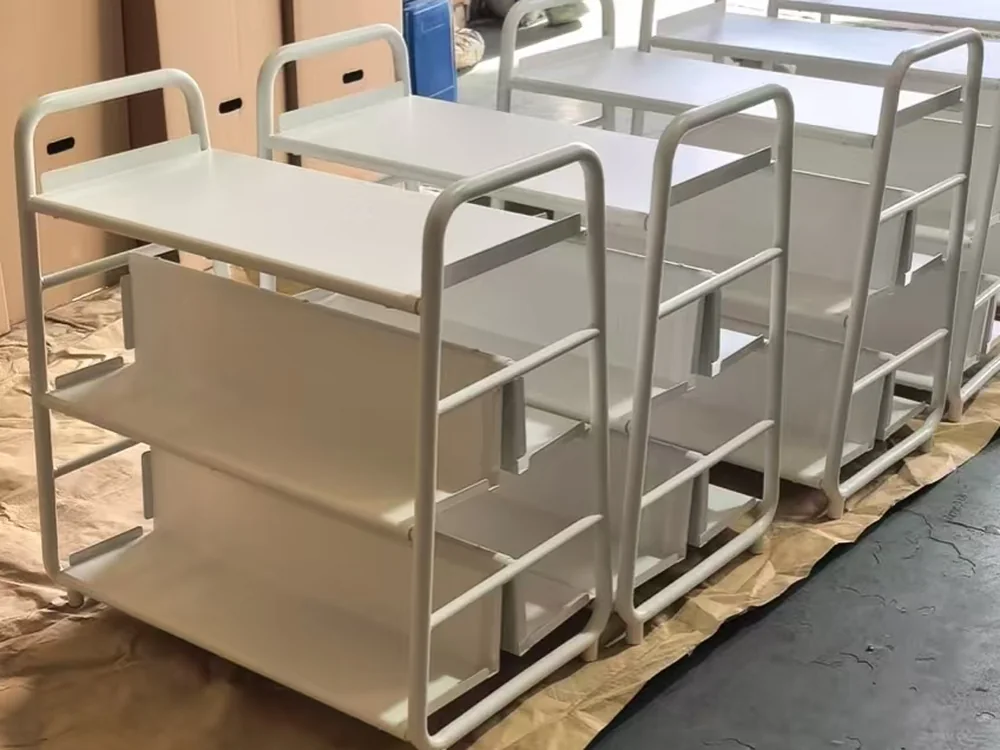
Noise on a trolley comes from three places, and only one of them is the castors
Most buyers who ask for a “quiet” trolley are actually reporting three different problems, and they need different fixes. Treating them as one problem is why quiet trolleys often disappoint.
- Rolling noise — the rumble transmitted through the floor from the castors and wheels. Fixed by castor selection and, where the trolley runs on hard floors at speed, by elastomer wheels.
- Rattle noise — loose shelf plates, unsecured bins, rattling fasteners, a deck that is not captive. Fixed at design level by captive fixings and by closing the structure.
- Structure-borne and panel noise — a hollow panel that rings when knocked, a sheet that resonates when a part is dropped onto it, an enclosure that amplifies sound inside it. This is the one that gets called “we need acoustic treatment” and it is the one people most often try to fix with foam and end up disappointed by.
Acoustic foam and other absorptive material addresses only the third one, partially, and only if it is the right material in the right place. It does nothing for the first two, and it is often unnecessary if the geometry is wrong in the first place.
Rolling noise: choose the wheel before the trolley
Quiet means different things on different floors. A library wants soft, near-silent rolling on a smooth floor for staff all day. A workshop wants a wheel that survives a chipped concrete floor with swarf and oil. A film or studio environment is dominated by camera and equipment noise, so the floor is usually the least important term.
When specifying, give us three things and we will tell you what we have seen work.
- Floor: smooth vinyl and sealed screed, painted concrete, bare concrete, resin, carpet, outdoor asphalt.
- Load: total loaded mass of the trolley, because castor rating and wheel diameter follow from it.
- Frequency and speed: pushed once a day across a room, or run continuously along a production aisle.
Two principles carry most of the benefit. Larger diameter wheels roll over floor joints and debris rather than into them, which is where rolling noise usually originates. Elastomer tyres are markedly quieter on hard floors than hard polymer wheels, and they cost very little more. Brakes matter too — a trolley that rolls away because a brake was left out of the specification is a trolley a user will slam into a wall.
Rattle noise: build it captive
A shelf that is not captive will rattle. This is a design decision, not a quality decision, and it is made on the drawing.
- Use welded tabs or pressed-in nuts so a shelf cannot lift, rather than a screw into a plain edge.
- Specify elastomer feet or a bonded sealing strip between shelf and frame where two metal surfaces meet.
- Clip bins and drawers, or specify them as captive — a bin sitting loose on a deck is the most common rattle source in a real facility.
- Torque fasteners to a stated figure and record it. A trolley assembled by hand without torque targets becomes a rattle source within a month.
- Close the underside of a shelf. A hollow tray resonates; a closed or ribbed panel is quiet.
Panel noise and hollow enclosures
A sheet metal box is a drum. A large flat panel has a natural frequency, and if something in the workflow lands near that frequency — a part dropped in, a tool set down, a case slid across — the panel amplifies it. Geometry fixes this more reliably than material does.
Bend stiffening ribs into the panel
A formed rib or bead changes a flat plate into a stiffened panel. It adds almost no material, it survives powder coating, and it is the single most effective change you can make to stop a large flat panel ringing. If the panel is already drawn flat and you need it quiet, ask us what rib spacing would work — this is a conversation we can have from a drawing.
Break up the span
If a panel must stay flat, shorten the unsupported span by adding a flange return or a hat section. Cost is close to zero and the acoustic change is large.
Choose the thickness for stiffness, not for looks
Thinner sheet at a larger section often beats thicker flat sheet. A 1.5 mm formed return gives a stiffer panel than a 2.0 mm flat panel, and costs less.
Then consider damping material
Only after geometry is fixed. Absorptive material such as closed-cell foam or an acoustic liner placed against the large panel reduces the reverberant build-up inside a closed box — relevant for an enclosure that contains something noisy, or for a panel people touch. It does not reduce the transmitted impact noise. Ask for the material’s density and thickness rather than “acoustic foam”, and tell us whether it must survive a wipe-down or a washdown, because that removes many options.
What to write in an RFQ for a quiet trolley
- Floor type and the noise level that is actually unacceptable — a measurable target is far more useful than “quiet”.
- Loaded mass, and the number of castors you are specifying versus the number the design needs.
- What must not be heard: is the trolley being pushed past people, into an office, into a studio, or into a hospital ward?
- Whether the acoustic treatment must survive cleaning, and whether there is a food or hygiene constraint.
- Any panel a user leans on, writes on, or that parts are dropped onto.
- Whether the trolley is a one-off, in which case acoustic geometry is cheap, or part of a fleet, in which case it must be repeatable.
Send the drawing and the floor description and we will tell you which of the three problems you actually have, and what we would change before production. We would rather tell you that the trolley you have specified is already quiet enough than sell you acoustic treatment that will not make a measurable difference.
Frequently asked questions
Do you supply castors?
We fit the castors you specify and will recommend a type against the floor and load. If you would rather we chose, send the floor and load and we will tell you what we have seen working.
Can you build a trolley that is genuinely silent?
Fully silent on hard floors is not achievable with any caster material, and anyone who promises it is not telling you about rolling resistance. What is achievable is that a trolley is not noticeably louder than the room it is in, and that means the wheel choice, the floor and the speed all have to be right.
Does acoustic foam affect the fire rating?
It can, and you must tell us if a fire rating applies. We will supply the material data so your compliance team can approve it, and we will flag it in the quotation rather than leave it as an open item.
Will the acoustics survive repeat orders?
Yes, if the treatment is geometric — ribs, returns, captive fixings — because it is part of the part. Absorptive material is the part most likely to vary between batches, and we will record the specification so a reorder matches.
Working out which of the three noise problems you have? Send the drawing, the floor type and the loaded mass. Our caster selection guide covers wheel and brake choice in more detail, and the library book trolley design guide covers the quiet-duty case in a full public environment.
Related pages: Caster and wheel selection and film and TV equipment trolleys.
Have a Similar Trolley Project? Send It for Review
Send your trolley type, load capacity, size, wheel requirement, quantity, and drawings or reference photos. Our team will review the structure and reply within 24 hours on business days.
Urgent project? Email gao@doingmetal.com or WhatsApp +86 18158549983.