
September 22, 2026
Cart vs Trolley vs Truck: Terminology Guide | Doing Metal
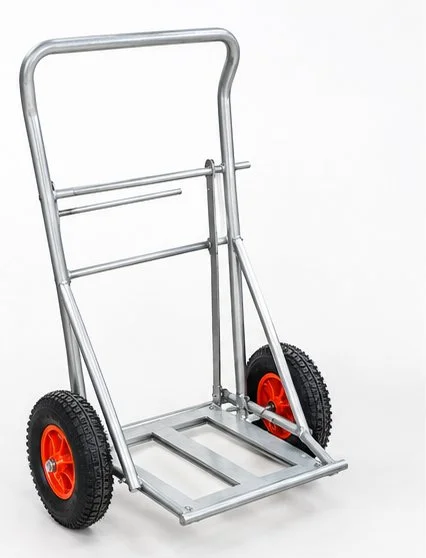
If you have ever searched for a product, found nothing, then found it immediately under a different word, you already understand the problem. Industrial carts have at least three regional vocabularies, and buyers lose hours – and sometimes suppliers – to the mismatch. It also matters when sending an RFQ to a factory that was not raised in your English.
The short version
United States: cart, utility cart, platform truck, flatbed cart, hand truck, stock cart.
United Kingdom and Ireland: trolley, platform trolley, sack truck, cage trolley, roll cage.
Australia and New Zealand: trolley mostly, with American spellings creeping in for warehouse equipment; sack truck for two-wheelers, platform trolley for flatbeds.
A UK buyer asking for a platform trolley and a US buyer asking for a platform truck very often want the same object. A US buyer asking for a hand truck and a UK buyer asking for a sack truck mean exactly the same thing.
Product-by-product translation
- Flat load deck on four wheels: platform truck (US), platform trolley (UK/AU). See our platform trolley page.
- Two-wheel vertical mover: hand truck (US), sack truck (UK/AU). See hand trucks.
- Mesh box on wheels: cage cart or rolling security cage (US), cage trolley, roll cage or roll container (UK/AU). See cage trolleys.
- Library book mover: book cart or book truck (US), book trolley (UK/AU). See book trolleys.
- Tool storage on wheels: tool cart, roller cabinet (US), tool trolley or roller cabinet (UK/AU). See tool trolleys.
- Warehouse pick cart: picking cart, order picking cart (US), picking trolley (UK/AU). See picking trolleys.
Where regional words hide real design differences
Most differences are vocabulary only, but a few carry genuine specification differences worth knowing:
- “Utility cart” in the US usually implies a light-duty two or three shelf cart, often plastic or light gauge steel. In the UK the same phrase is vaguer and may describe anything from a tea trolley to a warehouse cart.
- “Platform truck” in the US often implies higher capacity than the UK “platform trolley”, which covers everything from a light stockroom cart upwards. If you need 1000 kg, write the number – do not rely on the word.
- “Sack truck” describes bags and sacks originally; US “hand truck” may also cover appliance trucks with stair-climbing wheel assemblies.
- Castors vs casters is simply spelling, but it changes nothing about specification – unlike tread material, which matters a great deal.
How to write an RFQ that survives translation
Regional words are useful for finding a supplier and useless for specifying a product. Reduce the risk with four habits:
- Put numbers first. Load, dimensions and wheel diameter are understood in every dialect of industrial English.
- Use one drawing. A sketch removes more ambiguity than any glossary.
- Name the region you will use it in. Regional habits tell the supplier what you probably mean by an unclear term.
- Attach a photo of the cart you are replacing. Even a poor photo resolves most category confusion in seconds.
Our product pages list both vocabularies on purpose, so you can search either way and land on the same specification discussion.
A glossary worth keeping
Ten terms that cover most cross-border confusion:
- Platform truck / platform trolley – flat deck on four wheels
- Hand truck / sack truck – two-wheel vertical mover with a toe plate
- Cage trolley / roll cage / roll container – mesh box on wheels, often foldable or nestable
- Book cart / book truck / book trolley – shelved cart for libraries
- Picking cart / picking trolley – shelved cart designed around an operator pick sequence
- Utility cart – general light duty cart, usually two or three shelves
- Tow line / tugger train – several carts pulled as a set
- Toe plate / nose plate – the flat blade at the bottom of a hand truck
- Total lock brake – brake that locks both wheel rotation and swivel
- Swivel / fixed caster – rotating versus directionally fixed wheel assembly
Why this matters when you write your own catalogue
If you publish into more than one English-speaking market, write specification pages that lead with numbers rather than a single regional word, and use the local term in the page title where it reads naturally. Search behaviour follows local vocabulary, while conversions follow clarity. A page titled “platform trolley” selling into the United States still works when the description, headings and image text also carry “platform truck” – which is exactly how our own product pages are written.
Frequently asked questions
Do you build to American or European standard sizes?
Neither, strictly. We build to your drawing. Standard-size comparisons can be useful references – send a link or photo of a cart you already use and we will work from its dimensions.
Is there a difference between a roll cage and a cage trolley?
In everyday UK usage they overlap heavily. “Roll container” often implies a logistics cage designed to be nested or stacked, while “cage trolley” is broader. We confirm mesh, doors, folding, nesting and brake layout regardless of the word used.
What should I call it in my own catalogue?
Use the word your customers search with. If you sell into the US, lead with cart and truck; into the UK and Australia, lead with trolley. The specification behind the page does not change.
Send your drawing and whichever word you prefer – start from the contact page.
Have a Similar Trolley Project? Send It for Review
Send your trolley type, load capacity, size, wheel requirement, quantity, and drawings or reference photos. Our team will review the structure and reply within 24 hours on business days.
Urgent project? Email gao@doingmetal.com or WhatsApp +86 18158549983.