November 8, 2026
Steel Box Trolley With Forklift Access
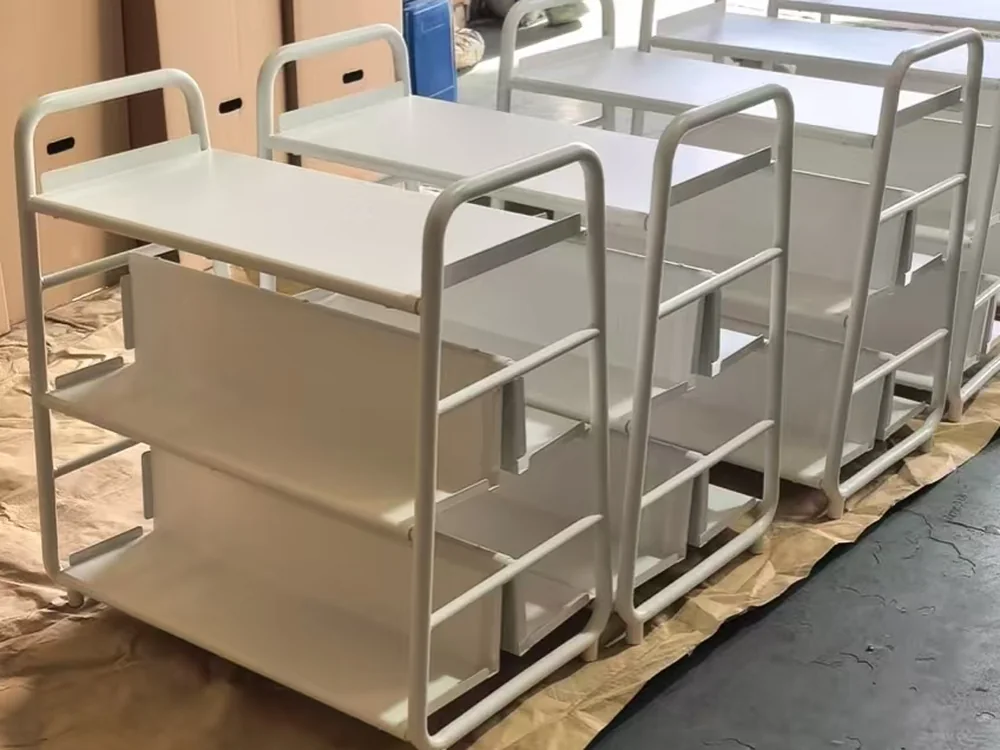
An industrial equipment maker in Central Europe needed a box trolley that did two jobs at once: a worker could push it on casters inside the plant, and a forklift could pick the whole loaded trolley up and move it between buildings. That second requirement changes the design more than people expect, because a trolley engineered only for manual pushing is not automatically safe to lift from below with forks. The brief became a steel shelf trolley with built-in fork access, rated shelves, and a base strong enough to take point loads from the fork tips.
- Load range we build to: 80–1,000 kg per trolley, sized to the real product and cradle geometry.
- Framing: round or square tube from Ø20–50 mm with 1.2–3.0 mm wall; shelf and panel plate 0.8–3.0 mm.
- Casters: 75–200 mm in PU, rubber, nylon or pneumatic, matched to floor type, load and noise limits.
- Finish and terms: powder-coat film 60–80 µm; MOQ 50 units; sample 7–15 days; production 25–35 days; tooling quoted separately.
- We can produce the drawing, but we recommend you supply your own. Our drawing work normally starts from USD 1,000, takes 10 days or more, and complex products can take six months to a year; the fee is quoted case by case.
- Certification scope: we hold a Bureau Veritas factory audit (MIC-ASR263630, 2026-10-09). We do not issue ISO 9001, CE, UKCA, UL, EN 1090, ISO 3834 or EN 10204 3.1 in our name, and we make no food-contact statement.
Two Load Paths, One Frame
A manually pushed trolley carries its load through the deck into the casters and the floor. A fork-lifted trolley carries the same load through the base into two narrow fork contacts that can be metres apart. The frame has to handle both without deflecting, so we build the base from heavier tube or formed channels in the Ø20–50 mm family with a 1.2–3.0 mm wall, and we bridge the fork openings with cross members so a fork tip cannot punch through. The shelf plates, 0.8–3.0 mm thick, are rated for the real part weight and spaced so the tallest bin still clears the one above.
The client in this case originally envisaged sideways fork entry, then switched to lengthwise entry along the trolley’s longest axis after we reviewed the aisle width. That single change moved the highest stress from the side rails to the base channels, and we sized those accordingly. It is exactly the kind of decision that is cheap on a drawing and expensive in steel, which is why we confirm fork direction before cutting tube. Our engineering service supports this review from a client drawing or a measured sample.
Shelves, Bin Walls and Clearance
A box trolley is really a small racking unit on wheels. We set the shelf count and spacing from the parts the client actually moves, and we add low bin walls so components cannot slide off when the trolley is pushed over a lip or braked suddenly. Where parts are mixed, we can divide a shelf with removable separators rather than building a different trolley for each product.
Clearance matters for the forklift. The fork openings need enough height and width for the site’s truck, and we keep the casters clear of the fork path so a wheel is never pinched. If you are deciding between this and a platform trolley with loose bins, the integrated walls are what keep small parts contained during a lift.
Casters That Survive Being Lifted
Casters run 75–200 mm, and for an internal industrial trolley we normally specify non-marking PU on swivel heads with brakes, because the trolley is both pushed and lifted. The casters must also survive the moment the trolley is set down: the impact is higher than a gentle push, so we mount them on reinforced plates and confirm the base does not bounce the load. On rough yards a larger wheel or a pneumatic option smooths the set-down and protects fragile contents.
We finish the frame with a powder coat at 60–80 µm in a colour the client specifies, which also makes the trolley easy to spot on a busy floor. The coating is tough enough for daily steel-on-steel contact, and we mask the fork openings and caster mounts so they stay clear for service.
Identification and Load Plates
On a shared plant floor it helps to mark each trolley with its model and rated load, and we can plate or engrave that information on the frame so it survives repainting. Matching the trolley colour to the client’s internal fleet coding also speeds daily use, because operators recognise the right trolley at a glance rather than reading a label.
Prototype, Approval and Volume
As with every custom trolley we build one first, usually within 7–15 days, so the client can load real bins, push it, and trial a forklift pick before committing tooling. Production runs 25–35 days from approval, with a minimum order of 50 units, and jigs or fixtures are quoted separately so the per-unit price stays honest as volumes change.
If the client asks us to develop the drawing, our work normally starts from USD 1,000 and takes 10 days or more; complex products can take six months to a year, and the fee is quoted case by case before production begins. We recommend supplying your own drawing where possible, and we deliver PDF dimensioned drawings and rendered visuals rather than CAD source files. For the factory-audit and traceability backing behind an order like this, see our certificates and traceability page.
Have a Similar Trolley Project? Send It for Review
Send your trolley type, load capacity, size, wheel requirement, quantity, and drawings or reference photos. Our team will review the structure and reply within 24 hours on business days.
Urgent project? Email gao@doingmetal.com or WhatsApp +86 18158549983.