November 9, 2026
Bolted Modular Machine Enclosure Design
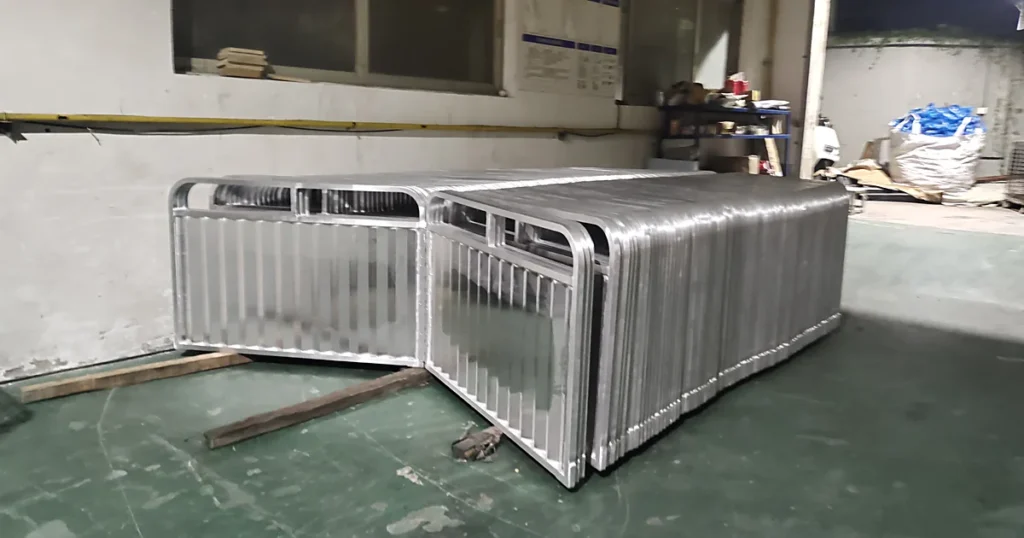
When a piece of industrial equipment has to operate near people, the enclosure around it decides whether the workspace stays tolerable or becomes punishing. One European machinery buyer recently asked us to convert a welded, sound-insulated case into a fully bolted, modular version that a technician could take apart and service on site. That single change is a good window into how a custom sheet-metal enclosure is actually specified: the same functional part can be built several ways, and the early decisions about how panels join, how they are built up, and how the seams seal determine both the acoustic result and the cost of owning the unit for years.
- Materials: stainless steel 304 as standard, 316 optional; carbon steel and aluminum also available for enclosure frameworks and panels.
- We can produce the drawing, but we recommend you supply your own. Our drawing work normally starts from USD 1,000, takes 10 days or more, and complex products can take six months to a year; the fee is quoted case by case before production begins.
- We protect your designs and data by default — we do not publish, reuse, or share customer drawings, and we exchange files as PDF before any editable CAD.
- Certification: we hold only the Bureau Veritas factory audit report MIC-ASR263630 (2026-10-09). We cannot provide ISO 9001, CE, UKCA, UL, EN 1090, ISO 3834, or EN 10204 3.1 under our name, and we issue no food-contact declaration.
- Production: MOQ 50 units, samples 7-15 days, mass production 25-35 days; tooling and fixtures are quoted separately.
- Powder-coat film thickness is held at 60-80 micrometres for durable, easy-clean surfaces.
Why bolted modular beats a welded box
A welded enclosure is cheap to draw and quick to produce in one batch, but it is also a sealed monolith. If a motor, sensor, or cable route needs to change, the only repair is cutting and re-welding, which distorts the panels you were trying to keep flat. A bolted, modular design trades a little more engineering time for a part that ships flat, arrives as a kit, and can be opened, modified, and re-closed with standard fasteners. For buyers who service their own equipment across multiple sites, that serviceability is usually worth more than the small saving of a welded shell. It also helps logistics: a flat-pack panel set fits a smaller carton and a denser container load than a rigid box, which matters once volumes move from samples to recurring orders.
Choosing the base material
Enclosure frames and panels are most often built from carbon steel for cost, stainless 304 where corrosion or hygiene is a concern, and 316 where the environment is genuinely aggressive such as coastal, chemical, or washdown duty. Aluminum is a good choice when weight or a specific anodized look is the priority, though it needs different weld settings and handling. The material decision interacts with the finish: a stainless enclosure may be left brushed or powder-coated, while carbon steel should always be coated to avoid rust in storage and transit. We will flag the trade-off rather than let it become a surprise at the sample stage.
How the panels control noise
The acoustic performance of an enclosure does not come from one magic material; it comes from construction. A common, effective approach is a mass-spring-mass sandwich: two steel or aluminum skins separated by a damping or mineral-wool core that breaks the path the sound would otherwise travel straight through. The core material, its density, and how completely it fills the cavity matter more than the brand of insulation. Who supplies the acoustic lining is a real commercial decision — some buyers send certified insulation to our plant for us to encapsulate, while others ask us to source a standard product. Either way, we treat the lining as a supplied or separately specified component and we do not certify an overall decibel rating ourselves, because that would require lab testing outside our scope.
The gaps, not the panels, are where sound escapes
This is the part first-time specifiers miss. A perfectly damped panel is wasted if a narrow gap runs around the access door, because sound finds the path of least resistance. We design overlapping flanges, continuous gasket channels, and stepped joints so that air — and therefore noise — cannot travel in a straight line from inside to outside. Holding those flanges flat is a fabrication tolerance problem, not a material problem, which is why the next point matters.
Tolerances and flatness that actually matter
For a sealed enclosure, flatness of mating flanges and consistency of hole patterns dominate the result. We hold panel flatness and hole-center tolerances to levels appropriate for gasket seating and bolt alignment, and we use pressed-in threaded inserts where panels need repeated removal. The full list of what we can hold and how we measure it is on our tolerances and dimensions page. Getting these right at the drawing stage is far cheaper than reworking a welded frame that has already distorted.
Surface, acceptance, and what we need from you
For most enclosures we apply a powder-coat finish with a film thickness of 60-80 micrometres, which gives a durable, wipe-clean surface suitable for industrial environments. Acceptance is straightforward: a dimensional check against the approved drawing, a fit-up check of the bolted assembly, and a visual inspection of the coating and edges. Because every enclosure is built to a customer’s drawing, the fastest and lowest-risk path is for you to supply the drawing. If you do not have one yet, our engineering service can help develop it — and you can read how we protect your drawings and data by default before any file is shared.
None of this requires an exotic certificate or a special factory. It requires a clear drawing, an honest conversation about who supplies which component, and a fabricator disciplined enough to hold the flanges flat. Send us the drawing and we will tell you, quickly, whether a bolted modular enclosure is the right call for your equipment.
Have a Similar Trolley Project? Send It for Review
Send your trolley type, load capacity, size, wheel requirement, quantity, and drawings or reference photos. Our team will review the structure and reply within 24 hours on business days.
Urgent project? Email gao@doingmetal.com or WhatsApp +86 18158549983.