
September 22, 2026
Export Packing and Container Loading for Trolley Orders | Doing Metal
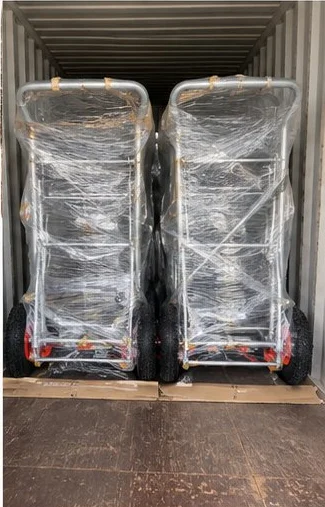
Two suppliers can quote the same cart at similar unit prices and deliver different landed costs, simply because one thought about packing earlier. Carts are mostly air: how that air is arranged decides container count, freight per unit, damage rates and how long your team spends assembling on arrival.
The three packing routes
Assembled and individually packed
The cart ships as it will be used. Highest freight per unit, lowest handling at destination. Best for distributors who ship onward to end customers, where arriving assembled matters more than freight cost.
Semi-assembled
Typical example: platform trucks with their handles or removable sides detached and bagged with fixings. Often the best compromise – it can cut container volume substantially while keeping assembly to a short, tool-light task.
Knock-down or nested
Maximum container utilisation. suits shelf trolleys, folding cages and any design that can be bolted together rather than welded at every joint. Requires real assembly time at destination, which must be costed honestly.
How much freight does the choice move?
Rough intuition, worth confirming per project:
- A fully welded cart occupies its full envelope whether empty or loaded, so container count is set by overall dimensions
- Removing handles on tall carts can change stacking height enough to fit an additional layer
- A genuinely knock-down design can double or triple units per container compared with assembled
- Nesting roll cages behaves similarly when the design allows it
The right answer depends on your destination costs. Where labour is expensive relative to freight, assembled wins. Where freight dominates and your team can assemble efficiently, knock-down wins. We quote both when the design supports it.
Protecting the finish in transit
Finish damage is the most common complaint after a first shipment, and it is almost always a packing specification problem rather than a paint problem:
- Separators between contacting surfaces, not just a single wrap
- Edge and corner protection wherever cartons meet strapping
- Caster protection – wheels take abuse in transit and arrive flat-spotted
- Non-marking wrapping for light-coloured finishes
- Desiccant where containers will sit in humid ports
Stainless carts need particular attention, which is why they are wrapped individually at source. See our stainless trolleys page for how those are handled.
Container loading discipline
Loading is not just filling space – it is preparation for several weeks at sea:
- Weight distributed low and evenly, heaviest units near the front bulkhead
- Blocking and strapping so loads cannot walk during braking and rolling
- No unsupported spans where the lower layer carries the upper layer’s full weight on one point
- Photographic record of the load before doors close – invaluable if a claim is ever needed
- Container and seal numbers recorded against your order documents
What to specify in your RFQ
- Packing method: assembled, semi-assembled or knock-down
- Whether individual cartons are needed for onward distribution
- Labelling: barcodes, part numbers, language markings
- Assembly instructions if the cart ships knocked down
- Whether you want a loading photograph set before shipment
- Destination port, and whether you consolidate with other suppliers
See also our RFQ checklist for the rest of the quotation package.
Calculating landed cost properly
Unit price plus freight is not landed cost. A fair comparison includes:
- Unit price at your actual quantity
- Packing cost where charged separately
- Freight and port charges to your destination
- Duty and taxes for your market
- Inland delivery
- Assembly labour if the cart ships knocked down
- Expected damage rate and the cost of replacing damaged units
- Spare wheels and service parts for the first year
Knock-down packing often looks cheapest on freight and loses its advantage on assembly labour, while premium packing looks expensive until damage rates are compared. Ask for both quotations and compare the whole line rather than the headline number.
Receiving: what to do in the first hour
Most freight claims fail on timing rather than merit. On arrival:
- Photograph the container and seal before opening, especially if either is damaged
- Count units against the packing list before releasing the truck
- Photograph any damaged units in place, before anything is moved
- Note damage on the delivery document, however minor it looks
- Notify the supplier and the forwarder the same day, with photographs
Because shipments are photographed during pre-shipment inspection and during loading, comparing arrival photographs with ours usually settles a claim quickly.
Frequently asked questions
How many units fit in a 40HC container?
It depends entirely on cart dimensions and packing method. Send the drawing and target method and we will calculate it rather than guess.
Can you ship spare wheels in the same container?
Yes, and it is strongly recommended. Spares added to a main shipment cost a small fraction of an emergency air freight order later.
Do you handle consolidation with other suppliers?
We can load alongside goods from other suppliers where you arrange it, and we will coordinate documentation with your forwarder.
Ask for both assembled and knock-down quotations through the contact page and compare landed cost, not unit price.
Have a Similar Trolley Project? Send It for Review
Send your trolley type, load capacity, size, wheel requirement, quantity, and drawings or reference photos. Our team will review the structure and reply within 24 hours on business days.
Urgent project? Email gao@doingmetal.com or WhatsApp +86 18158549983.