
October 10, 2026
Stacking vs Nesting Platform Trolleys: Solving the Empty-Trolley Floor Space Problem
The problem nobody puts in the brief
A platform trolley that works all day can still be the reason a warehouse runs out of room. A 600 × 800 mm base is 0.48 m². A hundred of them parked against a wall is48 m² of nothing. Five hundred is 240 m², and if that block is in the middle of the working floor it will eventually cost you an aisle.
So the question is not really “which trolley do I buy”. It is “where do 500 empty trolleys live”. Three answers exist — nesting, stacking and folding — and they are not equivalent. The arithmetic below decides it before any drawing does.
The arithmetic first
Take a real brief: 600 mm wide crates, 300 kg of produce, 500 trolleys. Compare how much floor each storage method needs for the same fleet.
| Storage method | Floor used by 500 units | As a share | What it costs you instead |
|---|---|---|---|
| Unstacked | 240 m² | 100% | A block the size of a small warehouse, oraisles eaten |
| Nested | about 45 m² | 19% | A 75 metre unbroken run of trolleys. Realistically several runs, which eats the savings |
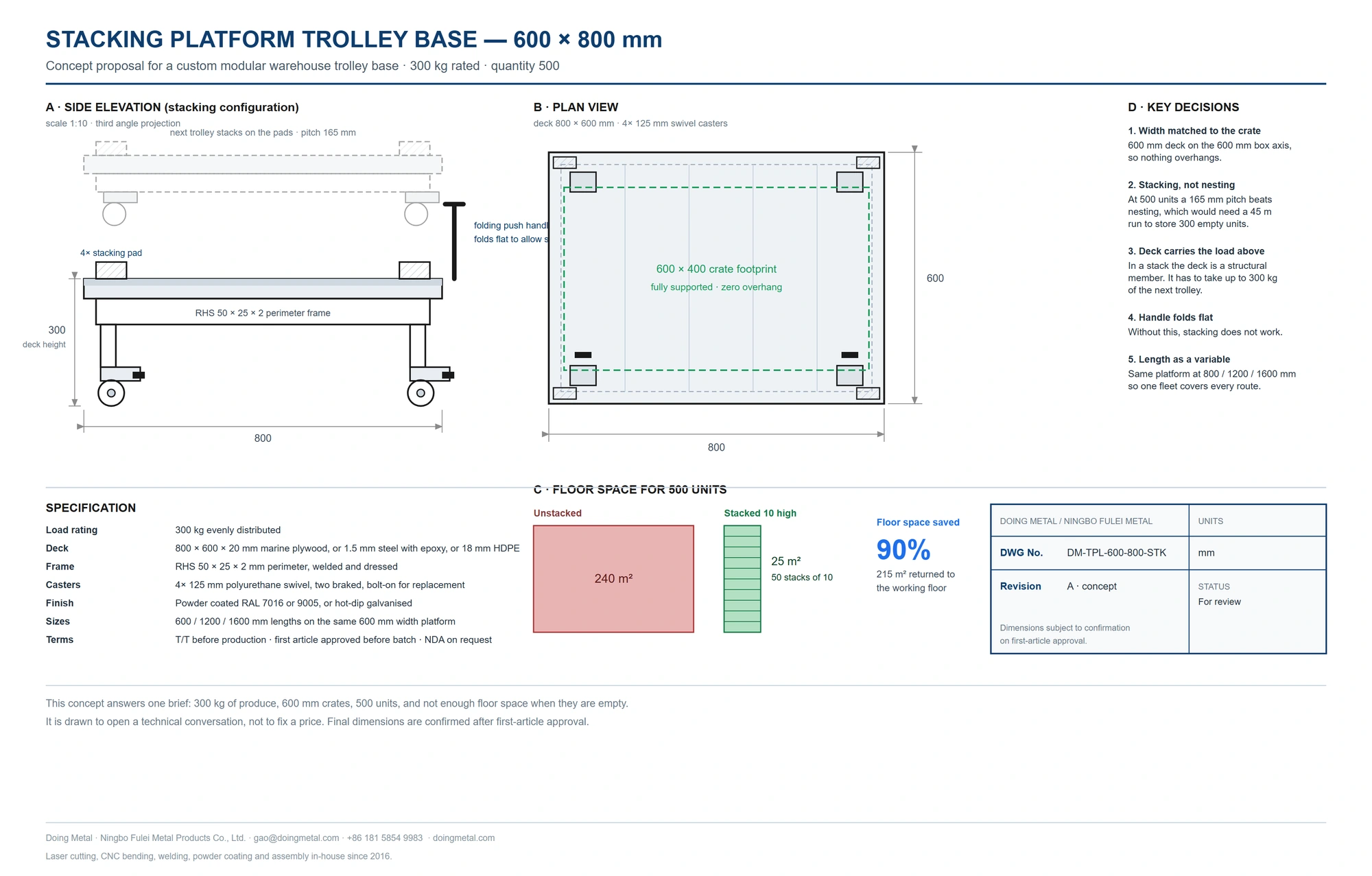
| Stacked 10 high | about 25 m² | 10% | 1.65 m of height, and a site rule that has to be obeyed |
Nesting is the answer people default to, and at small fleet sizes it is the right one. At 300 to 500 units it stops working, because the saving depends on length while the problem you have is floor area. You trade a rectangle of floor for a very long thin strip, and a strip that cannot be broken up without losing most of its benefit.
Stacking trades floor area for height, and in most warehouses height is the abundant dimension. That is why stacking wins at scale.
There is also a lower limit worth stating: below roughly 80 units the engineering cost of stacking — a reinforced deck, a folding handle, positive stacking pads — is not repaid by the space saved. Under that number, buy nesting or buy plain.
Stacking changes the design in five places
A stacking trolley is not a normal trolley with a label added. Five things have to change, and if a supplier quotes you a stacking trolley without mentioning them, they have not thought about it.
1. The deck becomes a structural member
On a normal platform trolley the deck carries produce. On a stacking trolley the deck also carries up to 300 kg of the next trolley sitting on top of it. That changes the material and the thickness: marine plywood, HDPE or steel all work, but the deck is now specified as a structural panel with a deflection limit, not as a surface. Ask what the deflection under the stacked load is, because an unstated answer means nobody checked.
2. The handle has to fold
A fixed handle is the single most common reason a stacking trolley does not actually stack. The handle has to fold flat, and the folding action has to hold in both positions so it cannot swing up as the stack is moved.
3. The casters have to let go
For trolleys to sit on top of each other, the casters have to be released and preferably removable, and the swivel has to be lockable in a fixed direction. Bolt-on casters are worth specifying on a fleet like this, because the first thing that fails on a stacking trolley is a caster, and a bolt-on one is changed with a spanner instead of a new trolley.
4. The stacking point must be positive
“Resting on the frame” is not a stacking feature. The corner pads need to be defined: welded bosses or pads at all four corners, positioned so the load goes into the perimeter frame and not into the deck panel between the corners. If the pads are not dimensioned, trolleys in a stack will drift out of alignment over time.
5. Nothing protrudes
Handles, brackets, hooks, shelf lips and brake pedals must all sit inside the footprint, otherwise the next trolley does not sit flat. This is why the plan view matters more than the side view when you review a stacking design.
Site rules that belong in the conversation
A stacking trolley transfers responsibility to the site. It is worth writing down before 500 arrive rather than after the first incident.
- Maximum stack height, decided by your floor loading and your fire policy, not by how tall the stack can physically get.
- Stack on a level, clear floor — not across a doorway, not in an escape route, not where a forklift tracks.
- One trolley carries the load of the stack above it. The bottom trolley in a ten-high stack is carrying 2.7 tonnes, so it is the one to inspect.
- Damaged trolleys leave the stack immediately. A bent corner pad or a cracked deck in the middle of a stack is a load path nobody designed for.
- Signage and a marked stack footprint, so the block is never extended “just for a few more”.
The concept we would propose
For the brief above, we would draw it as follows. Deck sized to the crate rather than to a standard, so nothing overhangs; a perimeter frame in RHS 50 × 25 × 2 mm with four welded stacking pads; a folding handle at one end; four 125 mm bolt-on swivel casters, two braked; and the same platform offered at 600, 1200 and 1600 mm lengths so one fleet covers more than one route.
The drawing at the top of this article is that concept. It is issued to open a technical conversation rather than to fix a price — the deck material, the caster type and the stack height are all decisions that should be made against your actual floor and your actual crates.
What to send us for a quotation
- The crate, not just the trolley. Crate footprint and the load inside it. Most trolley problems are actually crate problems.
- Fleet size and how many are typically in use at once. This decides stacking versus nesting, and it is the single most useful number in the enquiry.
- Fleet storage: the floor you have and the height you may use.
- The route. Aisle width, thresholds, floor type, and how far the trolley is pushed in a shift.
- Any existing trolley to match or beat — a sample, a drawing, or a competitor’s catalogue line, with what specifically needs improving.
- Whether the deck must be washable, food-contact adjacent, or simply durable.
Send those six and we will come back with a drawing, a first-article plan and a quotation. If the brief turns out to be better served by nesting than stacking, we will tell you that instead of selling you the more complicated answer.
Frequently asked questions
How many trolleys should be in one stack?
Between 6 and 10 is the usual working range. Above ten, the bottom trolley carries more than most people are comfortable loading by hand, and the stack becomes unstable in a way that ends somebody’s day. It is also a site policy question rather than a design question.
Can a stacking trolley still be nested?
Not usefully in the same product. A stacking trolley with a flat, positive stacking surface is the wrong shape for nesting, because the frame does not taper. If you need both, you need two products.
Does a stacking trolley need a different load rating from a normal one?
It should be quoted separately. Ask for the rating in two states: the normal in-service rating, and the rating while carrying a stacked load above it. Those are different questions and only one of them appears on most drawings.
What about nesting bins and foldable carts?
They solve a different problem. Nesting cuts the number of carts in use; nesting bins cut the number of containers. Neither stores an empty fleet as efficiently as stacking.
Working through your own numbers? Send the crate size, the fleet quantity and how many are in use at once, and we will tell you whether stacking or nesting is the honest answer for your floor. If you are also deciding whether to build this as a modular platform, our guide to modular trolley systems covers when a shared platform pays off.
Related pages: Custom platform trolley manufacturer and knock-down carts packed flat for export.
Have a Similar Trolley Project? Send It for Review
Send your trolley type, load capacity, size, wheel requirement, quantity, and drawings or reference photos. Our team will review the structure and reply within 24 hours on business days.
Urgent project? Email gao@doingmetal.com or WhatsApp +86 18158549983.