
September 22, 2026
Caster Brake Types: Which One You Need | Doing Metal
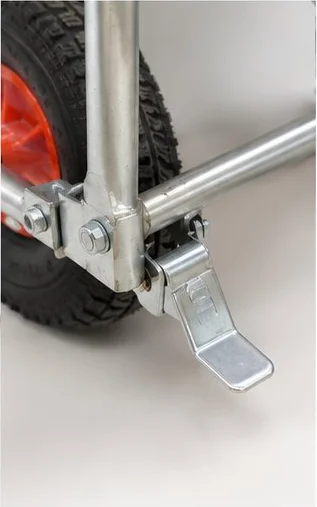
Brakes are specified last and complained about first. A brake that is out of reach when the cart is loaded, or that cannot hold on the one slope in the building, is effectively decoration – and operators will wedge the cart against a wall instead. Choosing the right brake type is a five-minute decision at drawing stage and an expensive one afterwards.
The four brake types you will be offered
Wheel brake
Locks wheel rotation only; the caster can still swivel. Cheapest and adequate for keeping a cart from rolling on level ground. On a slope, or where the cart is pushed sideways, a swivelling wheel will let it drift.
Total lock brake
Locks both rotation and swivel, so the caster cannot turn. This is the right choice wherever someone works at a parked cart – maintenance benches, picking stops, service trolleys. It costs more and it is worth it.
Directional lock
Locks the swivel but allows the wheel to roll, turning a swivel caster into a fixed one. Used to keep a long cart tracking straight down a corridor, or on tow trains where wandering is a problem. See our tow train carts.
Central braking system
One pedal or lever operates brakes on two or more casters. Useful on larger carts and medical or laboratory equipment where the operator needs one action to secure the cart. Adds cost and linkage complexity, and needs protection from damage in service.
Choosing by working condition
- Flat warehouse floor, short stops: two wheel brakes, positioned at the handle end, is usually enough.
- Slopes, docks or ramps: total lock brakes, and specify the slope so holding can be checked rather than assumed.
- Operators work at the parked cart: total lock, because a cart that swivels while someone leans on it is a safety problem.
- Long carts in corridors: directional lock on the trailing end reduces snaking.
- Heavy carts started and stopped often: brake reach matters more than brake type – if it cannot be reached under load, it will not be used.
- Towed trains: braking has to cover the train, not one cart. See the tow train page.
Where brake specification goes wrong
Common failures, in the order they show up:
- Reach. The pedal sits behind a panel, shelf or load once the cart is full.
- Clearance. The pedal fouls the floor on thresholds or ramps.
- Release under load. A brake that holds but cannot be released safely causes more incidents than one that slips.
- Wear adjustment. Brakes that depend on a fixed pad gap need adjustment over time; specify whether that is acceptable to your maintenance team.
- Mixed fleets. Two brake types across one fleet guarantees the wrong one gets used.
How many brakes does a cart need?
Common practice is two braked casters on a four-wheel cart, at the handle end so the operator can reach them. More braking helps on slopes and with heavy loads, but adds cost and pedal clutter. Decide from the worst parking condition on your route, not from the average.
For towed carts and trains, the calculation changes again: braking capacity has to match the train weight and the slope, which is why we ask about route gradients before specifying.
Specifying brakes on your drawing
- Brake type per caster position, not just number of brakes
- Pedal or lever position relative to the handle
- The slope the cart must hold on, and whether holding should be tested
- Whether brakes must be operable by foot, hand, or both
- Whether the cart is parked while worked at, or only stored
- Spares: brake modules should be orderable as separate parts
Brake materials and floor interaction
The brake works against the floor as much as against the wheel:
- Hard treads on smooth epoxy hold predictably and wear slowly
- Soft treads grip better on dusty or slightly rough surfaces but wear faster
- Steel or cast iron wheels on steel plate need a brake designed for low friction, not a standard pad
- Wet or oily floors reduce holding dramatically, which is why the parking condition belongs in the specification
If your route includes wet areas, say so. The brake type and material choice follow from it.
Retrofitting and fleet standardisation
Where a fleet already exists, standardisation usually beats specification:
- Settle on one brake type and one caster model across the fleet so training and spares are simple
- Retrofit is possible where the mounting pattern matches, but check plate thickness and bolt access first
- Replace brakes in sets on a cart so behaviour stays consistent
- Record the brake model on the asset tag so reordering is a part number rather than a description
Frequently asked questions
Is a total lock brake worth the extra cost?
Almost always, if anyone works at the parked cart or parks on any slope. If the cart is only ever parked on a flat floor and moved in a straight line, a wheel brake is sufficient.
Can brakes be added later?
Sometimes, if the caster model and mounting allow it. It is cheaper and more reliable to specify brake positions on the original drawing so the frame and caster plates suit them.
How do we check brake performance on a sample?
Park it loaded on the worst slope you have, try to move it, then release it under load. Do this during first article approval rather than after the batch arrives.
Do brake pads need maintenance?
Yes, particularly on designs where holding depends on pad wear. Ask how the brake wears and whether replacement modules are available as spares.
Tell us the parking condition and route slope through the contact page and we will specify the brake type with the reasoning attached.
Have a Similar Trolley Project? Send It for Review
Send your trolley type, load capacity, size, wheel requirement, quantity, and drawings or reference photos. Our team will review the structure and reply within 24 hours on business days.
Urgent project? Email gao@doingmetal.com or WhatsApp +86 18158549983.