
October 28, 2026
Guard Rail Platform Trolleys for Tall Loads
On a platform trolley, a loop handle with horizontal crossbars is not decoration. It is the thing you strap a tall or unstable load against, and the reason an operator can push a full trolley across a long route without stooping. If the load is taller than it is wide, or it shifts in transit, this is the configuration to specify.
- What the guard rail is for: a strap point for tall or unstable loads, and a push point that keeps the operator upright on a long route.
- What it costs: it will not slide under a low bench, it does not pack as flat as a fold-down handle, and the handle height is fixed at build.
- Build range: load 80-1,000 kg, sheet 0.8-3.0 mm, tube OD 20-50 mm, casters 75-200 mm.
- Commercial: MOQ 50 units, samples 7-15 days, production 25-35 days.
- Certification boundary: Bureau Veritas audit report MIC-ASR263630 (2026-10-09). We cannot provide ISO 9001, CE, UKCA, UL, EN 1090, ISO 3834 or EN 10204 3.1 certificates, and no food-contact declaration.
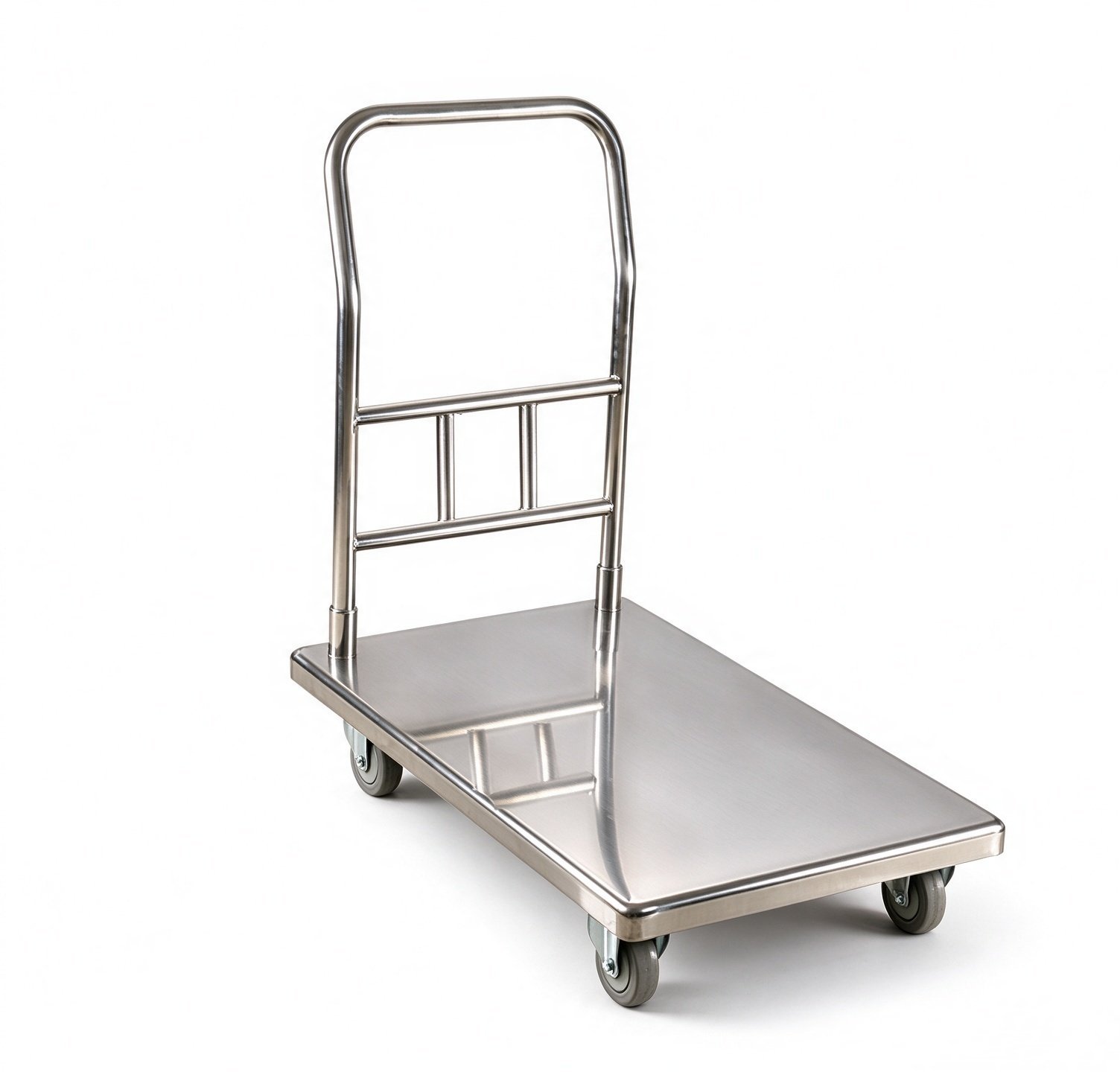
SS304 platform trolley with a tall loop handle and horizontal crossbars. The crossbars are strap points, not styling.
What the guard rail does
- Gives you somewhere to strap. A stack of boxes, a drum, a piece of equipment — all of them need a vertical surface to be pulled against. The crossbars provide it at two heights.
- Stops the load walking off. Under braking, at a threshold, or on a ramp, the guard rail is the backstop. Without it, the operator becomes the backstop.
- Sets a proper push height. On a long route the handle height matters more than buyers expect. It is specified from the operator, and we build to it.
- Adds rigidity. The uprights and crossbars tie the deck together, which is why this configuration is the stiffer one at the top of the load range.
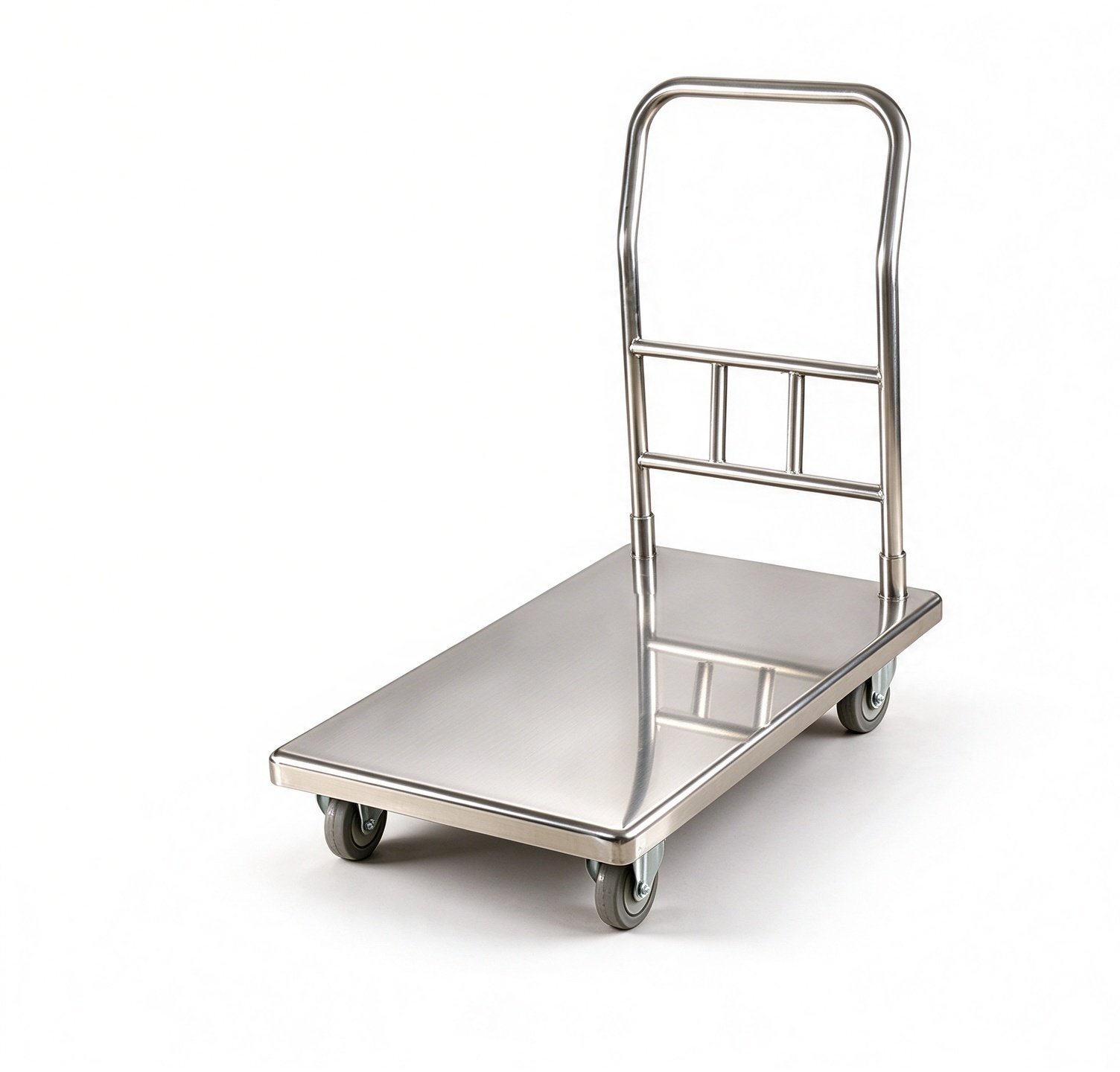
Polished deck version with a two-bar guard rail. On a customer-facing or wash-down route, the finish is chosen from the cleaning method.
The honest cost
The trade-offs are about space, not strength:
- It will not go under a low bench. If empty trolleys need to park beneath something, the fixed handle is the wrong choice and our folding handle platform trolley is the one to look at.
- It takes more space in a container. Fixed handles do not stack flat. On a large export order that is a real freight cost, and it is the main reason buyers who ship long distances choose the folding option instead.
- Handle height is fixed at build. If operators of very different heights will use it, tell us and we set the height for the middle of the range — but a single fixed handle cannot suit everyone.
Specifying one
These are the ranges we hold in production. The right column is the input we need from you to pick a point inside them.
| Item | Range we build to | What decides where you land |
|---|---|---|
| Deck length × width | To your drawing | Cargo footprint, plus the aisle turning space you actually have |
| Deck height | To your drawing | Load and unload height, and operator reach |
| Handle height | To your drawing | The operators who will push it, and how far they push it |
| Guard rail bars | To your drawing | Load height and where the strap needs to sit |
| Load rating | 80–1,000 kg | Cargo weight, shock loading, and any side load into the rail |
| Frame tube | Ø20–50 mm | Deck span, load, and the push force into the uprights |
| Tube wall | 1.2–3.0 mm | Load and the abuse expected on the route |
| Deck plate | 0.8–3.0 mm | Point loads — machine feet, pallet feet, or a spread load |
| Casters | 75–200 mm | Floor condition, thresholds, and push effort over the route length |
| Material | SS304 standard, SS316 where required | Cleaning method and environment |
For the wider platform configuration see our platform trolley page, and for material choice, tolerances and the full sizing argument see our SS304 platform trolley guide.
Casters: size them for the route length
This configuration is chosen for longer routes, which makes the wheel the most important line on the specification. A bigger wheel rolls over expansion joints, cable runs and thresholds with far less effort, and on a route measured in hundreds of metres that is the difference between a trolley that gets used and one that gets complained about.
Wheel size runs 75–200 mm. Brake position should be specified from where the operator stands — a brake on the far corner is a brake that does not get used. Non-marking grey rubber or polyurethane is the default for finished floors.
Material: why SS304
Guard rail trolleys are frequently specified for food production, pharmaceuticals, laboratories and wash-down areas, which is exactly where powder-coated carbon steel fails first — at the weld, at a plated fastener, or under a ledge holding water. SS304 removes those failure points.
Where we will talk you out of it: a dry, indoor route with a cost target. Powder coating at 60–80 µm is a hard, good finish and usually the better buy there.
Lead time, quantity and certificates
- Samples: 7–15 days from approved drawing.
- Production: 25–35 days after sample approval.
- Minimum quantity: 50 units for a standard custom programme. Large or heavy-duty builds can be discussed case by case.
On drawings: we recommend you supply your own. We can produce the drawing, but it normally starts from USD 1,000 and takes 10 days or more; complex builds can take six months to a year, because the communication and engineering time are substantial. The fee and timeline are quoted case by case before any work begins. We do not release CAD source files; you receive a dimensioned PDF and a rendered image for approval.
On certificates, plainly: we hold a Bureau Veritas audit report, MIC-ASR263630, dated 2026-10-09. We do not hold ISO 9001 certification and cannot supply CE marking, UKCA, UL, EN 1090 or ISO 3834 certification, cannot issue EN 10204 3.1 in our own name, and cannot issue a food-contact declaration. Full detail on our certificates and traceability page.
Frequently asked questions
Can I get a brake on the handle instead of on the casters?
A foot-operated caster brake is the normal solution and it is more reliable than a hand brake linkage. Tell us where the operator stands and we position the brakes there.
Can the guard rail be made removable?
Yes. A removable or folding rail is possible when the trolley sometimes needs to carry something too wide for the rail. It is a more expensive build and it reintroduces a joint to inspect, so it is worth specifying only if you genuinely need both modes.
Do you sell a stock size?
No. Deck size, load rating, handle height and rail layout are all built to your requirement.
Is 316 available instead of 304?
Yes, where the environment calls for it — chloride exposure, salt, or aggressive cleaning. Grade selection is covered on our stainless steel trolley page.
Have a Similar Trolley Project? Send It for Review
Send your trolley type, load capacity, size, wheel requirement, quantity, and drawings or reference photos. Our team will review the structure and reply within 24 hours on business days.
Urgent project? Email gao@doingmetal.com or WhatsApp +86 18158549983.