
October 28, 2026
Fold-Down Handle Platform Trolley Guide
If your problem is not moving the load but finding somewhere to put the trolley afterwards, a folding handle is usually the answer. The handle folds flat onto the deck, so the trolley slides under a bench, stacks with others, or ships more units per container. Nothing about the load path changes — the deck, frame and casters are specified the same way. What changes is what happens when the trolley is empty.
- What folding buys: flat storage under a bench, stacking with other units, and more units per export container.
- What it costs: the hinge is a moving joint and adds an inspection step. On an SS304 body the hinge pin must be stainless – a galvanized pin is the most common failure we see.
- Build range: load 80-1,000 kg, sheet 0.8-3.0 mm, tube OD 20-50 mm, casters 75-200 mm.
- Commercial: MOQ 50 units, samples 7-15 days, production 25-35 days.
- Certification boundary: Bureau Veritas audit report MIC-ASR263630 (2026-10-09). We cannot provide ISO 9001, CE, UKCA, UL, EN 1090, ISO 3834 or EN 10204 3.1 certificates, and no food-contact declaration.
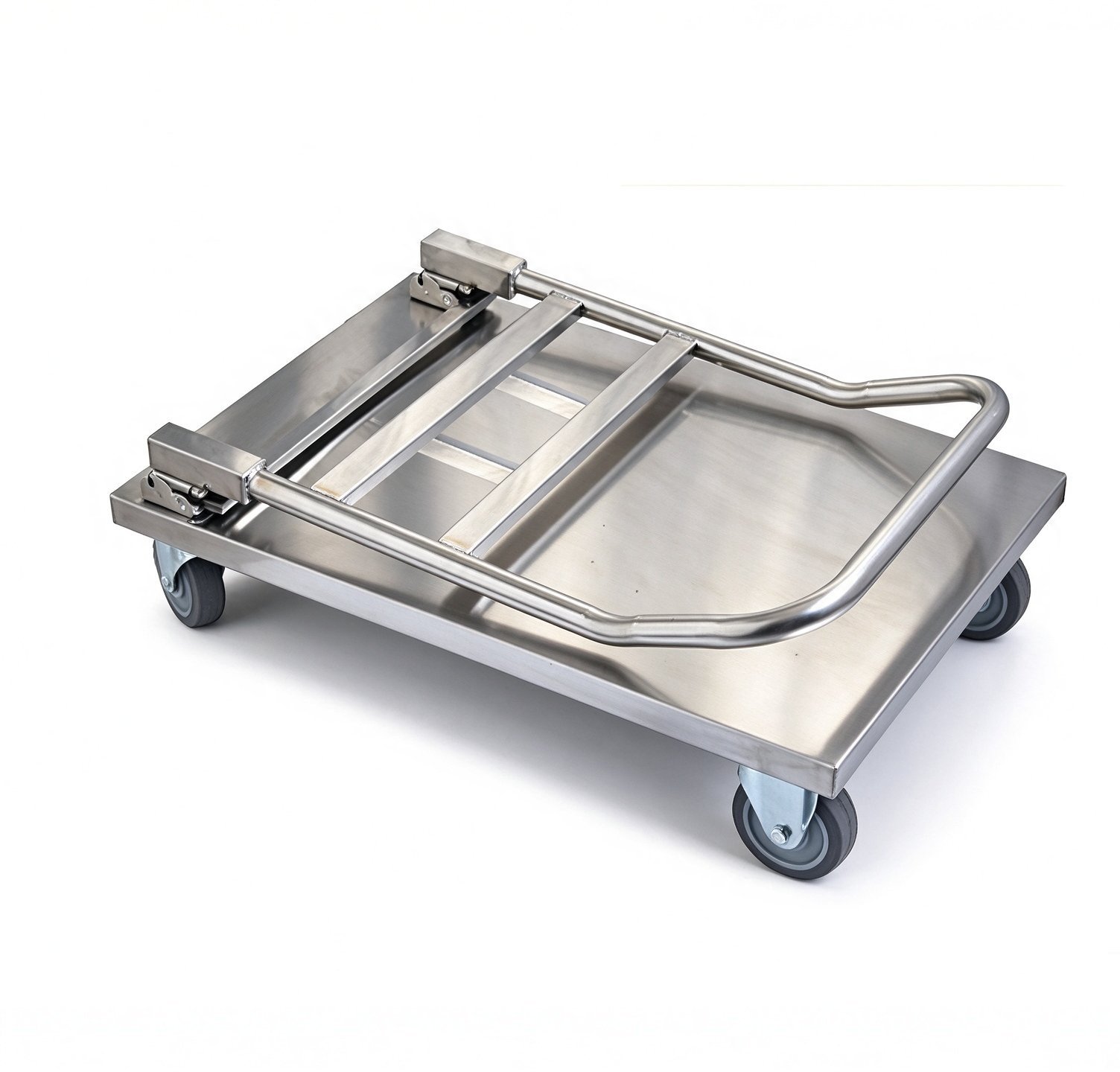
SS304 platform trolley with the tubular handle folded flat onto the deck. Folded, it is a low tray; upright, it is a normal platform trolley.
What the folding handle actually buys you
- Freight. A folded trolley is a flat rectangle. On an export order that difference is measured in units per container, and on a 50-unit programme it is usually the single largest logistics saving available.
- Storage on site. Empty trolleys are the space problem nobody plans for. Folded, these go under benches, under machines, or stand against a wall without protruding into an aisle.
- Vehicle height. If the trolley rides in a van or a service vehicle, the folded height is often the difference between fitting and not fitting.
- Stacking and nesting. Folded units can be stacked for storage or transport, provided the deck and caster layout are designed for it. Tell us if stacking matters and we design the deck edge and caster positions for it.
What it does not buy you is better pushing. A folding handle is a storage and logistics feature. If your operators push the trolley long distances every day, or the load is tall and needs restraining, the fixed handle in our guard rail platform trolley guide is the better configuration.
The honest cost of a hinge
We would rather state this up front, because it is the reason some buyers should not choose this option.
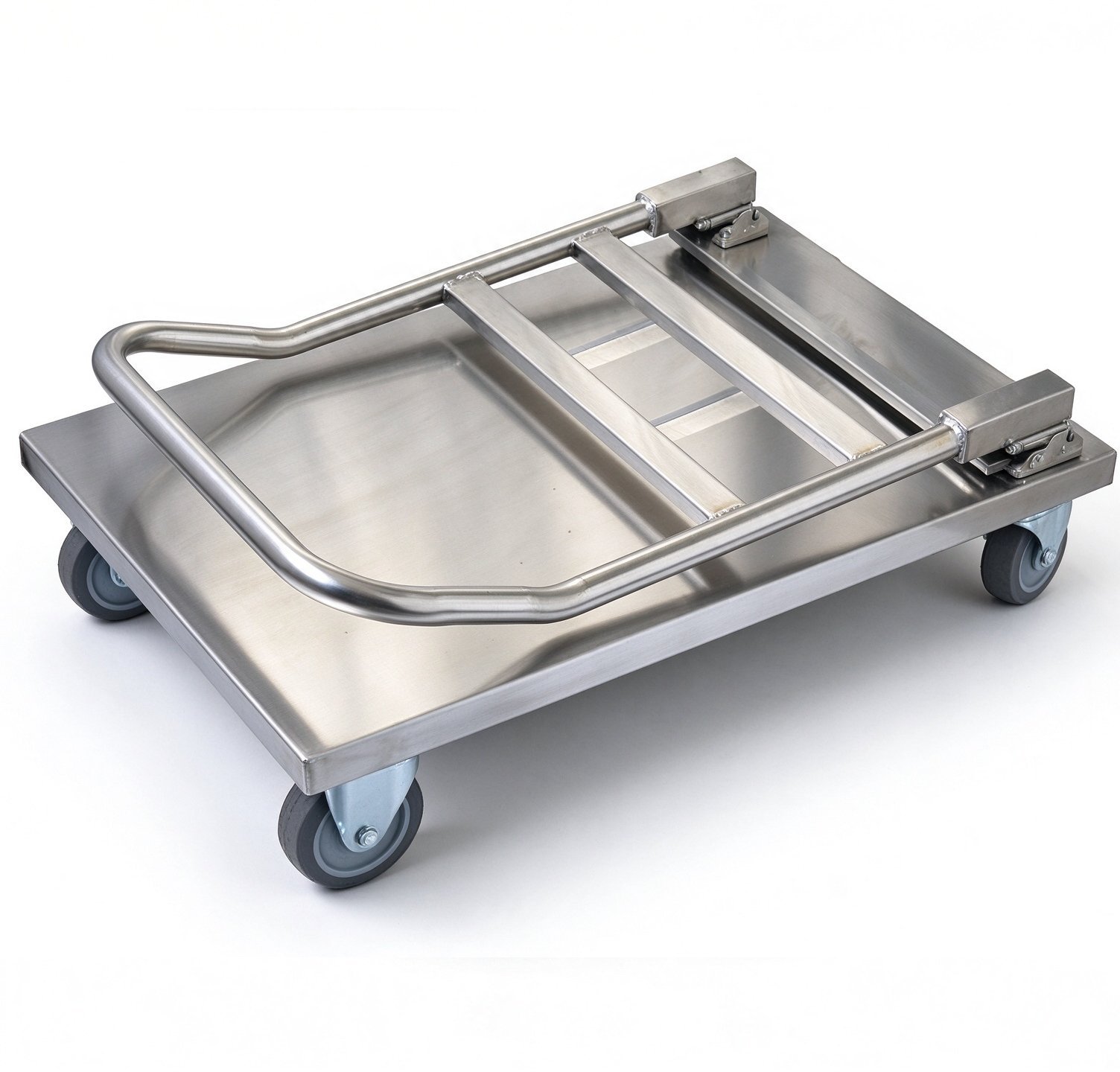
Hinge detail. The folding mount is a moving part, and on a wash-down route the hinge hardware matters as much as the frame material.
- There is more to inspect. A hinge, its pins and its latch are wearing parts. They are checked at assembly and they should be on your goods-in checklist. A welded post has nothing to check.
- It is slightly less stiff. A folding handle transfers push force through the hinge. For a light to medium load on a smooth floor this is a non-issue; at the top of the load range, on rough ground, a fixed post is the stiffer structure.
- The hardware has to match the material. This is the failure we see most: an SS304 frame with a zinc-plated hinge pin. The frame survives and the pin rusts. On a stainless build the hinge, the pins and the fasteners are stainless too — this is the same point covered in more detail on our stainless steel trolley page.
Specifying one
These are the ranges we hold in production. Nothing here is a stock option; the right column is the input we need from you.
| Item | Range we build to | What decides where you land |
|---|---|---|
| Deck length × width | To your drawing | Cargo footprint plus the storage space the folded unit must fit into |
| Deck height | To your drawing | Load and unload height, and the clearance under whatever it parks beneath |
| Folded height | To your drawing | Bench underside, shelf gap, or vehicle aperture — measure the tightest one |
| Load rating | 80–1,000 kg | Cargo weight plus shock loading, and whether the hinge sees side load |
| Frame tube | Ø20–50 mm | Deck span and the push force the handle has to take |
| Tube wall | 1.2–3.0 mm | Load, abuse expected, and weight target |
| Deck plate | 0.8–3.0 mm | Point loads — pallet feet, machine feet, or a spread load |
| Casters | 75–200 mm | Floor condition and threshold height, within the folded-height budget |
| Material | SS304 standard, SS316 where required | Cleaning method and environment |
For the full platform configuration — deck reinforcement, tow bars, and the wider sizing discussion — see our platform trolley page, and our SS304 platform trolley guide for the material and tolerance detail.
Casters, and the folded-height budget
Caster size and folded height pull against each other. A larger wheel rolls over expansion joints and thresholds with less effort, but every millimetre you add to the wheel is a millimetre added to the deck height and, if the handle folds over the deck, to the folded package.
Specify the two constraints and we work between them: the lowest obstacle the trolley must cross, and the tightest gap it must park in. Wheel size runs 75–200 mm, and non-marking grey rubber or polyurethane is the default for finished floors because black rubber leaves a line someone will ask about.
Material: why SS304 on this build
Folding trolleys are often specified for food production, laboratories and clean rooms, which is exactly where a coated frame fails first — at the weld, at a plated fastener, or under a ledge that holds water. SS304 removes those failure points and wipes clean in one pass.
Where it is not worth it: a dry, indoor route with a cost target. Powder coating at 60–80 µm is a hard, good finish and it is the better buy on a dry route, and we will say so rather than sell you a more expensive material.
Lead time, quantity and certificates
- Samples: 7–15 days from approved drawing.
- Production: 25–35 days after sample approval.
- Minimum quantity: 50 units for a standard custom programme. Large or heavy-duty builds can be discussed case by case.
On drawings: we recommend you supply your own. We can produce the drawing, but it normally starts from USD 1,000 — the communication and engineering time are substantial — and takes 10 days or more; complex builds can take six months to a year. The fee is quoted case by case before any work begins. We do not release CAD source files; you receive a dimensioned PDF and a rendered image. Tolerances we hold are ±0.1 mm on laser cutting, ISO 2768 on bending (commonly ±0.5 mm and ±1°), and 0.5–1.5 mm per metre on welded assemblies.
On certificates, plainly: we hold a Bureau Veritas audit report, MIC-ASR263630, dated 2026-10-09. We do not hold ISO 9001 certification and cannot supply CE marking, UKCA, UL, EN 1090 or ISO 3834 certification, cannot issue EN 10204 3.1 in our own name, and cannot issue a food-contact declaration. The full statement is on our certificates and traceability page.
Frequently asked questions
Can the handle be removed entirely instead of folding?
Yes, for a pure dolly. It is the stiffest and cheapest option, but you lose the push height, so it suits short moves on smooth floors rather than long routes.
Will the folded trolley stack?
It can be designed to, but stacking has to be specified up front — the deck edge profile and the caster positions both change. Tell us the stack height you need.
Do you sell a stock folded size?
No. Deck size, load rating and folded height are all built to your requirement.
Is the hinge stainless as well?
Yes on an SS304 build — hinge, pins and fasteners. A plated hinge on a stainless frame is the failure mode this is designed to avoid.
Have a Similar Trolley Project? Send It for Review
Send your trolley type, load capacity, size, wheel requirement, quantity, and drawings or reference photos. Our team will review the structure and reply within 24 hours on business days.
Urgent project? Email gao@doingmetal.com or WhatsApp +86 18158549983.