
September 2, 2026
How to Design a Foldable Cage Trolley for Warehouse and Retail Use
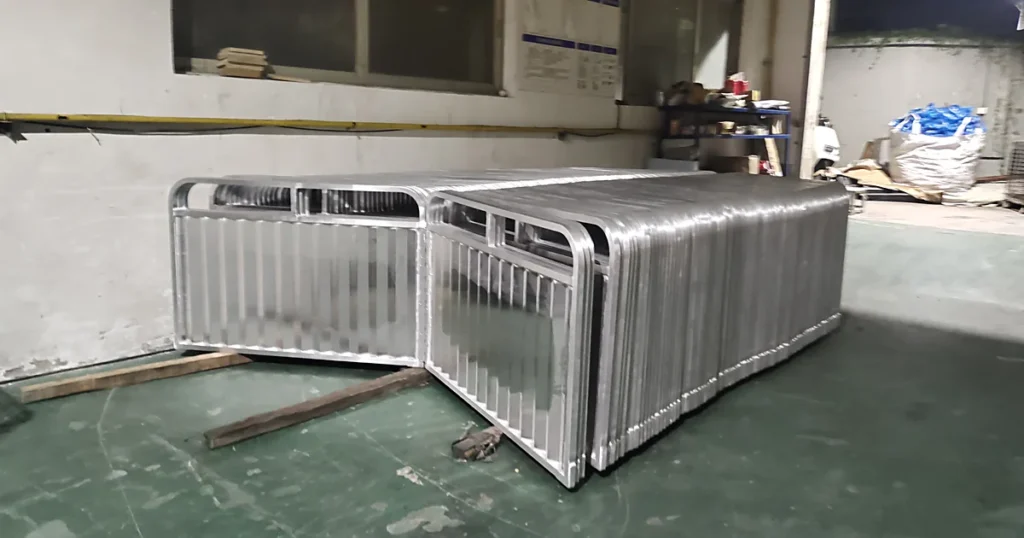
A foldable cage trolley has to do two jobs that pull against each other: contain the load securely, and collapse to almost nothing when it is empty. That tension is what makes this trolley harder to specify than it looks. A cage that is over-built will not fold neatly or nest properly; one that is under-built will rack out of square within a season of daily use. This guide covers the decisions that decide which side of that line your trolley lands on.
What a cage trolley is actually for
Cage trolleys — roll containers, in much of Europe and Australia — are used where goods need containment, visibility and fast loading at the same time. The open mesh means operators can see what is inside, stock can be counted without unloading, and air circulates. Typical duties include retail replenishment, distribution centre order picking, parcel and mail handling, laundry and linen movement, and back-of-house transfer.
The foldable version earns its cost when empty return transport or storage space is expensive. If the trolley makes a return journey empty — back from store to depot, for example — folding saves real money on every trip. If it never travels empty, a fixed cage is simpler, stronger and cheaper, and is usually the better answer.
Mesh and panel design
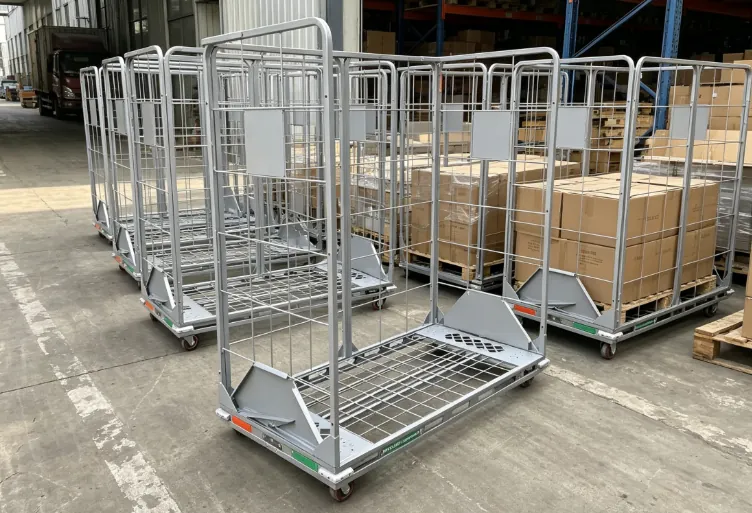
The mesh is where cost, weight, strength and containment are balanced.
- Mesh aperture. Smaller apertures contain smaller items and stop fingers reaching through, but add weight and cost. A common approach is a finer mesh on the lower panels, where small items sit, and a more open mesh higher up.
- Wire diameter. Thicker wire resists impact and distortion from loaded cartons being pushed against the panel, at the cost of weight.
- Panel frame. The mesh is only as good as the tube or angle it is welded into. A well-framed lighter mesh outlasts a heavy mesh welded into a flimsy frame section.
- Door configuration. Half-drop, full-height hinged, or split doors. The door is the most-used moving part on the trolley, so latch design and hinge wear deserve specific attention.
- Security. If the cage carries saleable goods through public areas or between sites, a lockable door or a seal point should be part of the specification.
The folding mechanism: where designs succeed or fail
Nearly every complaint about a foldable cage trolley traces back to the folding mechanism, not the frame. The points to settle:
- Which way does it fold? Base folds up, sides fold down, or a combination. The direction has to suit how the operator handles it — a mechanism that needs two hands and clear floor space will not be used.
- How is it latched when open? A cage that can collapse while loaded is a safety problem. Positive latches that cannot release under vibration or impact are essential.
- Can it be folded with gloves on? Warehouse and retail staff wear gloves. Handles, release levers and latches must work with gloves and in cold conditions.
- How many moving joints? Every joint is a wear point and a potential rattle. Fewer, larger, better-supported joints generally last longer than many small ones.
- Clearance for coating. Hinges and sliding parts accumulate powder coat or zinc. If clearances are not designed for coating thickness, the mechanism binds after finishing.
Ask for the folding cycle to be tested on a prototype before a full run. This is the single most valuable check on a new cage design.
Base, casters and stability
Cage trolleys are tall and narrow relative to their load, which makes stability the main design constraint.
- Base footprint. Wider bases resist tipping but reduce how many units fit side by side in a truck or a store room.
- Load height. Where the weight sits determines the tipping risk. Heavy items belong low; a cage loaded top-heavy on a sloping route is dangerous regardless of the frame.
- Caster layout. Two fixed and two swivel is standard for longer routes. Four swivel suits tight store aisles. Braked casters matter wherever the cage is loaded on a slope or parked on a delivery ramp.
- Wheel size. Retail back-of-house floors are usually smooth, so moderate diameters work well; dock areas, car parks and yards need larger, softer wheels.
- Nesting and stacking. Decide whether empty units nest, stack, or both, and confirm the pitch. This decides how many fit in a container — a real cost item on large orders.
Finish for cage trolleys
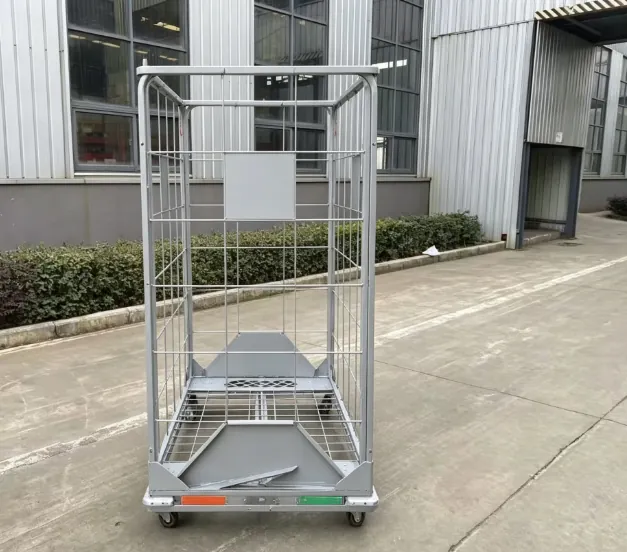
Cage trolleys take a lot of impact, and mesh has a lot of surface area relative to its mass, so preparation and coverage matter. Bright zinc plating is common for indoor retail cages because it is clean-looking and resists the scuffs of daily handling. Powder coating is used where brand colour matters or where a smoother finish is wanted. Hot-dip galvanizing suits outdoor yards and washdown areas.
Whichever is chosen, check the welds where the mesh meets the frame — that is where coating coverage fails first and where rust appears first.
Retail use: the details that differ from warehouse duty
Cages used in customer-facing or public areas have extra requirements that are easy to forget on a drawing:
- Noise. Rattling mesh and hard wheels in a shop area is a complaint waiting to happen. Panel fixing and wheel choice both matter.
- Snag points. Protruding wire ends, sharp corners and open hooks catch clothing, packaging and skin. Edge finishing is not optional.
- Appearance. A cage standing in a store aisle represents the brand. Finish quality, colour consistency and a clean weld appearance all count.
- Security. Lockable doors and seal points for stock that has value to thieves.
- Floor protection. Softer treads to protect tiles and polished concrete.
Frequently asked questions
Foldable or fixed cage?
Foldable if empty return transport or storage is a cost you pay regularly. Fixed if the trolley always travels loaded, or if maximum rigidity and lowest unit cost matter most.
How many units fit in a container?
It depends entirely on whether the design nests, stacks, or knocks down, and at what pitch. Confirm the folded height and the nesting pitch before you plan the shipment — this often changes the landed cost more than the unit price does.
Can shelves or dividers be added inside?
Yes, and they are common — a mid-height shelf turns one cage into two levels for mixed loads. Shelves should be removable or folding so they do not block the cage from collapsing.
What load rating should we ask for?
State the payload and the distribution rather than a headline number. Cages are often loaded unevenly, and a tall cage with weight high up behaves very differently from one loaded low.
RFQ checklist
- Intended use: warehouse, retail replenishment, parcel, laundry, or mixed.
- Overall size, base footprint and maximum load height.
- Payload and how the load is distributed.
- Mesh aperture, wire diameter and door configuration.
- Fixed or foldable; if foldable, the folding direction and latch type.
- Shelf or divider requirement, and whether they fold with the cage.
- Caster layout, wheel material, diameter and brake requirement.
- Finish: zinc, powder coat, galvanized, or duplex.
- Nesting or stacking requirement, folded height, and quantity per shipment.
We build cage trolleys to your drawing, so the folding mechanism, mesh specification and wheel layout are all confirmed before production. Send the use case and the payload, or start from the cage trolley page if you are comparing configurations.
Related pages: cage trolley and retail trolley applications.
Have a Similar Trolley Project? Send It for Review
Send your trolley type, load capacity, size, wheel requirement, quantity, and drawings or reference photos. Our team will review the structure and reply within 24 hours on business days.
Urgent project? Email gao@doingmetal.com or WhatsApp +86 18158549983.