
September 2, 2026
Laser Cutting Design Checklist for Custom Trolley Parts
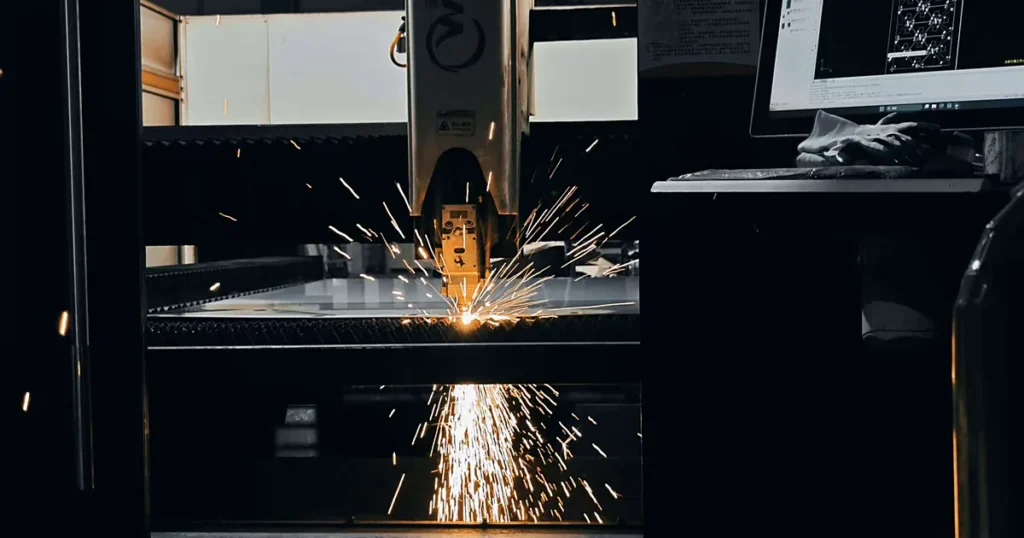
Every welded trolley starts as a set of flat parts. Platform decks, caster plates, shelf blanks, drawer panels, lock plates, side guards, brackets, cable hooks and reinforcement plates all begin as a laser-cut blank. If that blank is wrong — a hole slightly out of position, a slot too narrow to deburr, a tab that does not match the bend allowance — the error does not show up at the laser. It shows up at the brake press, at the welding fixture, and finally at assembly, when it is expensive.
Why laser cutting matters more than it looks
Laser cutting is chosen for trolley parts because it is accurate, it handles mixed part shapes in one nested sheet, and it produces a clean edge that usually needs little secondary work. On a trolley, that matters because so many parts are interrelated: the caster plate has to match the frame, the shelf blank has to match the bend tooling, the holes have to line up across an assembly that will be welded in a fixture.
The parts where laser accuracy pays off most:
- Caster plates — bolt hole pattern and plate flatness decide whether the trolley tracks straight.
- Shelf and tray blanks — hole position relative to the bend line decides whether the formed part fits the frame.
- Drawer fronts and panels — visible parts, where edge quality affects the finished appearance.
- Brackets and gussets — fit-up parts, where a consistent outline makes fixture welding repeatable.
- Handle and bracket blanks — parts touched daily, where sharp edges are not acceptable.
Kerf, holes and slots: the rules that prevent rework
Kerf is the material the beam removes. It is small, but it is not zero, and it behaves differently depending on material and thickness.
- Hole diameter versus thickness. Very small holes in thick plate are slow, inconsistent and hard to deburr. As a working rule, keep hole diameter at or above material thickness where the design allows.
- Narrow slots. Long, very narrow slots can close up with heat and are awkward to clean. If a slot is needed, give it a width that can be finished.
- Critical holes. Caster mounting holes, hinge holes and any hole that sets assembly alignment should be dimensioned explicitly on the drawing, with a tolerance. Marking them “critical” tells the fabricator which ones to check.
- Hole spacing near edges. Holes too close to a part edge distort or break out. Keep sensible edge distance, particularly on load-bearing plates.
- Tabs and fit-up features. If parts are designed to interlock before welding, tab width has to suit the kerf, or the joint will not close consistently.
Material and thickness: what trolley parts actually use
Most trolley components fall in a well-defined band. Knowing where a part sits helps set realistic tolerances:
- 0.8–1.5 mm — drawer bodies, light panels, covers, bin fronts.
- 1.5–3.0 mm — shelf decks, caster plates, brackets, side guards, drawer fronts, reinforcement plates.
- 3.0 mm and above — heavy caster plates, tow bar mounts, forklift pockets, structural gussets where loads concentrate.
Material choice interacts with the process. Mild steel is the default and cuts cleanly. Stainless steel needs different parameters and produces a harder edge burr. Aluminium is cuttable but reflects heat differently and needs its own settings. State the grade on the drawing, not just “steel”.
Heat-affected zone, burr and edge quality
Laser cutting puts heat into the cut edge. For most trolley parts this is not a metallurgical problem — it is a handling, coating and fit problem.
- Burr. Dross or burr on the underside of a cut is normal but must be removed on parts that are handled, that slide, or that sit against another part.
- Sharp edges. Handles, trays, shelves and guards are grabbed daily. Specify an edge break or a deburr requirement on the drawing rather than leaving it to chance.
- Coating adhesion. A cut edge with heavy oxide or dross will not hold powder coat well. Edge condition affects finish life, especially on outdoor trolleys.
- Flatness. Thin, heavily pierced parts can distort from heat. Where flatness matters — caster plates especially — it should be stated.
Designing for the next operation
A laser-cut blank is rarely the finished part. Tell the fabricator what happens next, because it changes how the blank should be cut:
- Will it be bent? Hole position relative to the bend line, and bend allowance, must be right before cutting.
- Will it be welded in a fixture? Consistency matters more than absolute accuracy in that case.
- Will it be plated or galvanized? Coating thickness changes hole sizes and thread fit; some holes need to be oversize or masked.
- Will it be powder coated? Sharp edges need breaking so the coating does not pull back.
- Will threads be tapped? Allow material for the tap and consider whether the hole should be pierced or drilled.
Nesting, quantity and repeat orders
Laser cutting rewards volume planning. Parts from one trolley — or from several trolley sizes — can often be nested on the same sheet, which reduces waste and unit cost. Two practical points:
- Order in sensible batches. Setup and programming are a fixed cost. Very small quantities cost more per part.
- Freeze the drawing for repeat orders. If a trolley will be reordered, keep the DXF or STEP file named and versioned. Re-deriving a file from a sample part later introduces differences you did not intend.
Frequently asked questions
What file format should I send?
DXF or DWG for flat parts, STEP for assemblies, PDF for a readable reference. The flat DXF is the most useful document for quoting the laser work.
How small can a hole be?
It depends on thickness and material. As a rule, keep hole diameter at or above material thickness. Below that, expect inconsistency and extra deburring cost.
Do cut parts need deburring?
Parts that are handled, that slide against other parts, or that will be coated need an edge break. State it on the drawing so it is quoted rather than assumed.
Can you work from a sample part?
Yes — a sample can be measured and redrawn. For repeat orders, the redrawn file should then be approved and kept as the reference.
RFQ checklist
- DXF, DWG, STEP or PDF drawing, with revision identified.
- Material grade and thickness for each part.
- Critical holes, slots and assembly dimensions, marked as critical.
- Deburr, edge radius and cosmetic edge requirements.
- What happens next: bending, welding, plating, galvanizing or powder coating.
- Quantity, and whether repeat orders are expected.
- Flatness or tolerance requirements on load-bearing plates.
Flat-part accuracy is what makes assembly predictable. Send the drawing and the material specification, or see the laser cutting process page for capability detail.
Related pages: laser cutting process and platform trolley.
Have a Similar Trolley Project? Send It for Review
Send your trolley type, load capacity, size, wheel requirement, quantity, and drawings or reference photos. Our team will review the structure and reply within 24 hours on business days.
Urgent project? Email gao@doingmetal.com or WhatsApp +86 18158549983.