
September 2, 2026
How to Choose a Custom Platform Trolley for Warehouse Loads
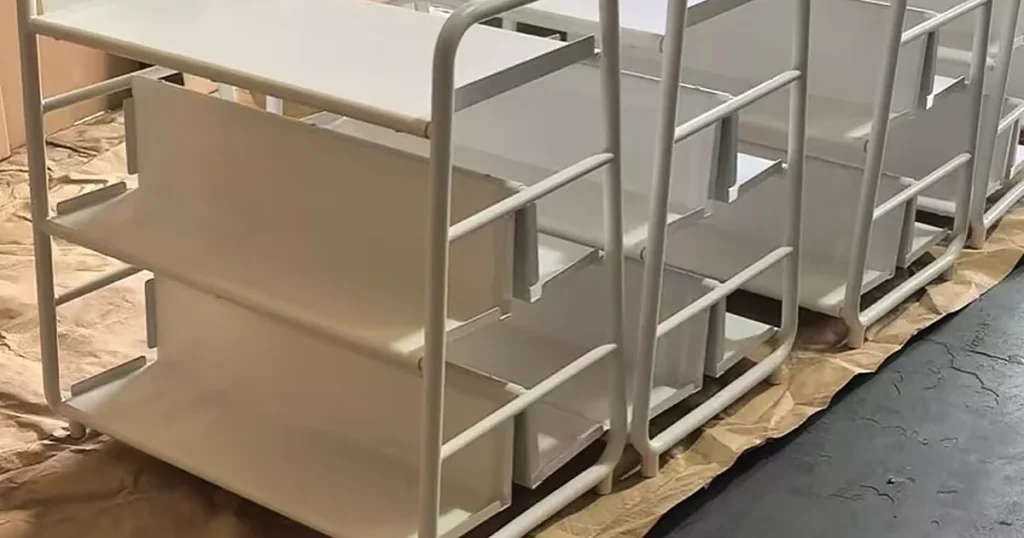
A platform trolley quote should start from the load and the route, never from a catalogue photograph. Two trolleys that look identical in a picture can differ completely in service life, pushing effort and safety, because the differences are inside the specification: tube wall thickness, how the deck is stiffened, how the caster plates are welded back into the frame, and whether the wheel diameter suits the floor. This guide sets out the inputs that actually decide the design, and the order in which to settle them.
Start with the load, then describe how it sits
Total payload is the number everyone quotes, and it is the least useful one on its own. What matters just as much is how that weight is distributed and how it arrives.
- Point load or distributed load? A 400 kg load spread across a deck is easy. The same 400 kg landing on a 300 mm square footprint will dent a thin deck and overload two caster plates.
- Where does the load sit? Load placed on one half of the deck, or stacked high on one side, changes the frame design and the tipping margin.
- How does it arrive? Hand-stacked cartons are gentle. A part dropped from a bench, or a pallet set down by a forklift, is a shock load — and shock loads are what crack welds and bend caster plates.
State the payload, the footprint, the worst-case distribution and how the load is placed. That single paragraph lets a fabricator size the deck plate and the frame honestly instead of guessing.
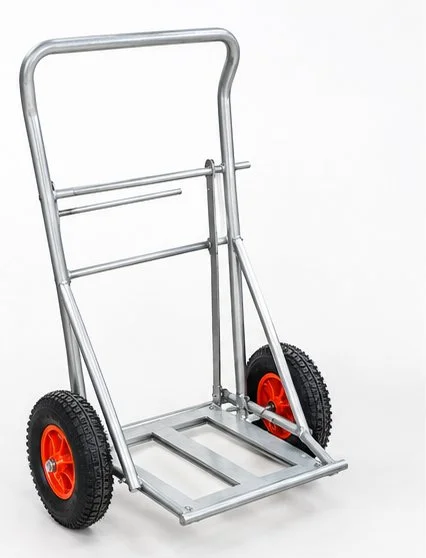
Then describe the route, because the route sets the wheels
The route is the most commonly missing piece of information in a platform trolley enquiry, and it drives more of the design than the load does.
- Floor condition — smooth sealed concrete, epoxy, tiles, expansion joints, steel plate, gravel, or a mix.
- Distance and frequency — a 20 m occasional move and a 300 m continuous shift route are different machines.
- Transitions — door thresholds, lift lips, drain covers, dock plates, ramps and slope percentage.
- Who pushes — one operator or two, and whether the trolley is towed, pushed by hand, or moved by a pallet truck.
Long routes and rough floors push the specification towards larger wheels and better bearings. Short, smooth, indoor routes allow a lower deck height, which in turn makes hand loading easier. There is no universal answer, which is exactly why a platform trolley should be specified rather than bought off a shelf.
How load class changes the build
Within the range most buyers ask for — roughly 150 kg to 1000 kg payload — the design changes in four places as the load rises.
Frame tube and wall
Light-duty trolleys commonly use steel tube in the 20–30 mm outside diameter range with wall thickness around 1.2–1.5 mm. As loads, spans and duty cycles increase, the section moves towards 30–50 mm tube with 1.5–3.0 mm wall. Wall thickness matters more than diameter for resisting the bending that builds up under a loaded deck over a long shift.
Deck plate and stiffening
Deck plate in the 0.8–3.0 mm band covers everything from light shelf decks to heavy platform beds. Above roughly 1.5 mm, the usual problem is no longer strength but flatness and weight — which is why heavier decks are stiffened with folded edges, longitudinal ribs or a formed tray section rather than simply made thicker. A folded edge also removes the sharp perimeter that damages cartons and hands.
Caster mounting
At higher loads the caster plate, its bolt pattern and the weld back into the frame become the critical detail. A thick plate welded into a thin frame just moves the failure point. On heavy trolleys we design the mounting area as part of the frame, not as an afterthought bolted to it.
Wheel diameter and rating
Higher loads usually mean larger wheels, both for rating and for rolling resistance. This raises deck height, so the loading method has to be considered at the same time: a deck that is comfortable to load by hand at 125 mm wheels may be too high at 200 mm.
Deck height, handle and ergonomics
Ergonomics decide whether a trolley is used correctly. The points that come back to us most often:
- Deck height — set by wheel diameter plus frame depth. Match it to the bench, shelf or machine the trolley serves.
- Handle height and side — confirm which side the operator stands on, and whether the trolley is pushed, pulled, or both.
- Handle type — a simple tube loop, a full-width bar, a removable handle for knock-down packing, or a tow bar.
- Brake access — a brake the operator cannot reach while standing is a brake that will not be used.
Where a trolley runs the same route every day, operator fatigue is a real design constraint, not a soft one. Reducing starting force often does more for throughput than increasing capacity.
Containment: what stops the load leaving the deck
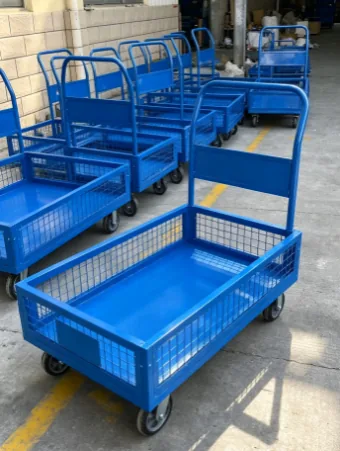
A flat platform is rarely enough. Depending on the cargo, the containment is designed in from the start:
- Fixed side rails or low guards for cartons and crates.
- Removable or folding rails where the trolley also has to carry oversize items.
- Mesh panels or cage sides where small items or loose parts must not fall.
- Anti-slip deck surface — perforated plate, checker plate, or a rubber mat — for smooth or sloping routes.
- End stops, dividers or locating pockets where the same part is carried repeatedly.
Finish, packing and repeatability
Finish is not cosmetic on a platform trolley. Powder coating over correctly prepared carbon steel is the standard for indoor warehouse duty; where the trolley works outdoors, in humid areas or near corrosive material, galvanizing or stainless construction is considered instead. Areas that get hit — deck edges, rail tops, handle grips — are the places where coating failure starts.
Two practical points that are easy to overlook:
- Packing. Trolleys are bulky and cheap to damage in transit. Decide whether units ship assembled, knocked down, or stacked, and how the coating is protected.
- Repeatability. If this is the first of several orders, fix the colour code, wheel model, caster layout and packing method now and record them on the drawing. Matching a fleet two years later is far easier when the specification was written down the first time.
Frequently asked questions
What payload should I specify if I am unsure?
Specify the heaviest load you expect plus a margin, and tell the supplier it is an estimate. It is much easier to build in margin at the drawing stage — a slightly thicker deck plate and a larger caster plate — than to strengthen a fleet already in service.
Can one trolley design cover several different loads?
Often yes, if the loads are similar in shape and weight. Where the range is wide, it is usually better to standardise the frame and vary the deck fitting or the top fixture, so the fleet stays maintainable.
Should the deck be solid plate or perforated?
Solid plate holds small items and spreads point loads. Perforated or checker plate resists slipping and sheds dirt, and is lighter. If the trolley carries small parts, solid is usually right; if it carries cartons on a wet or oily floor, a textured surface helps.
Do you keep stock sizes?
We build to drawing. That means the deck size, height, wheel specification and containment are set around your load and route rather than around a stock list. If you have a reference unit or a photograph, that is a useful starting point for the drawing.
RFQ checklist
- Target load capacity, load footprint and worst-case distribution.
- Overall trolley size and usable platform size.
- Deck height limitation, or the bench or shelf height it must match.
- Floor condition, route distance, thresholds and maximum slope.
- Wheel material, diameter, brake requirement and bearing preference.
- Containment: rails, mesh, end stops, dividers, anti-slip surface.
- Manual push, pull handle, tow bar, forklift pocket or AGV interface.
- Surface finish, colour, logo, packing method, quantity and destination country.
Every unit is made to your drawing, so the more of this you can confirm up front, the closer the first quote will be to the final price. Send a sketch or a reference photo with the payload and route, or start from the build-to-print page if you already have drawings.
Related pages: platform trolley, warehouse logistics trolleys, and manufacturing processes.
Have a Similar Trolley Project? Send It for Review
Send your trolley type, load capacity, size, wheel requirement, quantity, and drawings or reference photos. Our team will review the structure and reply within 24 hours on business days.
Urgent project? Email gao@doingmetal.com or WhatsApp +86 18158549983.