
October 28, 2026
Custom 304 Stainless Platform Trolley Guide
If you are pricing an SS304 platform trolley, you are not shopping for a catalogue size. You have a load, a route, a floor and a cleaning method, and the trolley has to fit all four. We build these to drawing, which means the deck size, deck height, frame tube, caster size and handle style are all set from your requirement rather than pulled off a shelf.
- Material: stainless steel 304 as standard, 316 on request. Sheet 0.8-3.0 mm, frame tube OD 20-50 mm, wall 1.2-3.0 mm.
- Load range: 80-1,000 kg, set by deck size, frame tube and caster rating rather than by a catalogue class.
- Casters: 75-200 mm, PU, rubber, nylon or pneumatic, chosen from the floor and the wash-down method.
- Handle: fold-down tubular handle, or a fixed loop handle with crossbars. Both are built to the same deck.
- Drawing service: we recommend you supply your own. Where we produce it, the work normally starts from USD 1,000 and takes 10 days or more; complex builds can take six months to a year. Quoted case by case before production starts. PDF dimension drawings and rendered images are supplied; CAD source files are not released.
- Certification boundary: Bureau Veritas audit report MIC-ASR263630 (2026-10-09). We cannot provide ISO 9001, CE, UKCA, UL, EN 1090, ISO 3834 or EN 10204 3.1 certificates, and no food-contact declaration.
The two configurations shown below are both SS304 platform trolleys we build. They differ in exactly the way most enquiries end up splitting: one folds flat for storage and transport, the other stands up with a guard rail to restrain a load.
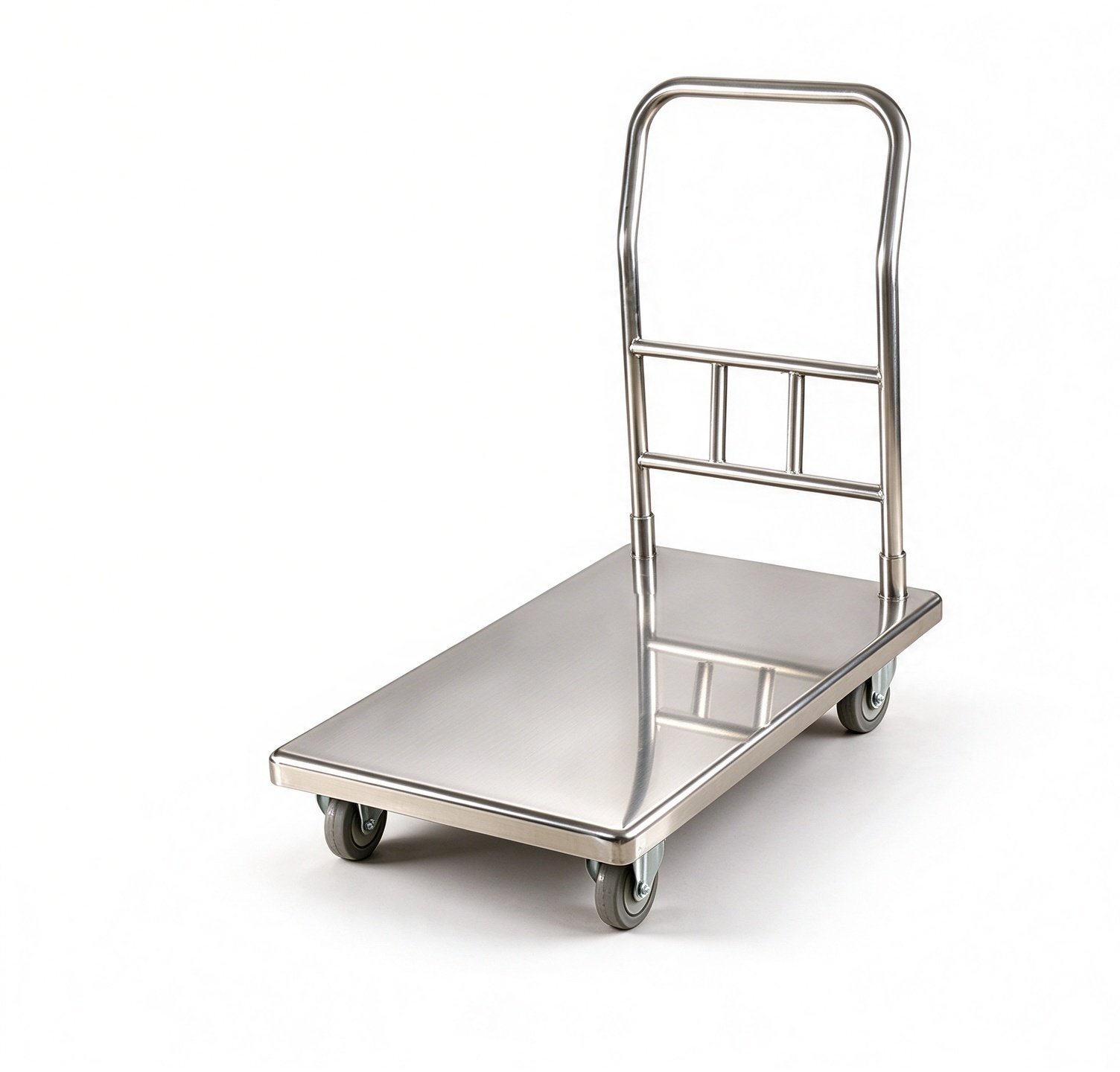
SS304 platform trolley with a polished deck, an upright loop handle and a two-bar guard rail. Deck size, tube size and caster size are all set per order.
What we build to, and what decides it
These are not stock options. The middle column is the range we can hold in production; the right column is the input we need from you to pick a point inside it.
| Item | Range we build to | What decides where you land |
|---|---|---|
| Deck length × width | To your drawing | Longest cargo plus the turning space your aisle actually has |
| Deck height | To your drawing | Load and unload height, and how far the operator can comfortably reach |
| Load rating | 80–1,000 kg | Cargo weight, plus shock loading and the safety factor your site requires |
| Frame tube | Ø20–50 mm | Deck span, load, and whether the welder can reach the joint |
| Tube wall | 1.2–3.0 mm | Load, abuse expected, and the weight target for pushing |
| Deck plate | 0.8–3.0 mm | Point loads — pallet feet, machine feet, or a uniformly spread load |
| Casters | 75–200 mm | Floor condition, threshold height, and the push effort you can accept |
| Material | SS304 standard, SS316 where the environment calls for it | Cleaning method, chlorides, salt, and outdoor exposure |
| Finish | Brushed or polished | How it is cleaned, and whether it is customer-facing |
| Handle | Fold-down or fixed loop | Storage and transport height versus load restraint |
If you want the wider material discussion — 304 versus 316, how the joint design and hardware change with stainless, and what actually causes a stainless trolley to rust — it is covered on our stainless steel trolley page. For the platform configuration in general, including deck reinforcement and tow-bar options, see our platform trolley page.
Why SS304 instead of powder-coated steel
Powder coating at 60–80 µm is a good, hard finish and it is the right call for a lot of routes. It fails in predictable places: at a weld that was not dressed before coating, at a zinc-plated fastener, or under a ledge that holds water.
SS304 earns its premium when one of these is true:
- The trolley is washed down, hosed, or steam cleaned.
- It lives in a humid room, a cold store, or outdoors.
- The load is food, pharmaceutical, or laboratory material.
- Appearance matters because customers or auditors walk past it.
Where we will talk you out of it: a dry, indoor route with a cost target. If the environment will not attack a coated frame, carbon steel with a powder coat is usually the better buy, and we would rather tell you that than sell you a more expensive material you do not need.
The deck
The decks below are solid plate, not mesh or perforated sheet. That choice is deliberate and it is worth being clear about the trade-off:
- Solid plate holds small parts, wipes clean in one pass, and spreads a point load. It is heavier and it will hold spilled liquid.
- Perforated or mesh drains, sheds debris and saves weight, but small parts drop through and it needs more support under the load.
Deck plate runs 0.8–3.0 mm, and thickness is chosen from what touches the deck. A uniformly spread load can sit on thinner plate; four machine feet concentrating the same weight cannot. Under the deck we add cross members where the span and the load need them, and the corners are rounded with a turned-down edge so the deck is both safer to walk past and easier to wipe without catching a cloth.
The handle: fold it down, or stand it up
This is the decision that most buyers have not made up their mind about when they write to us, and it is worth deciding early because it changes the frame and the packing.
Fold-down handle
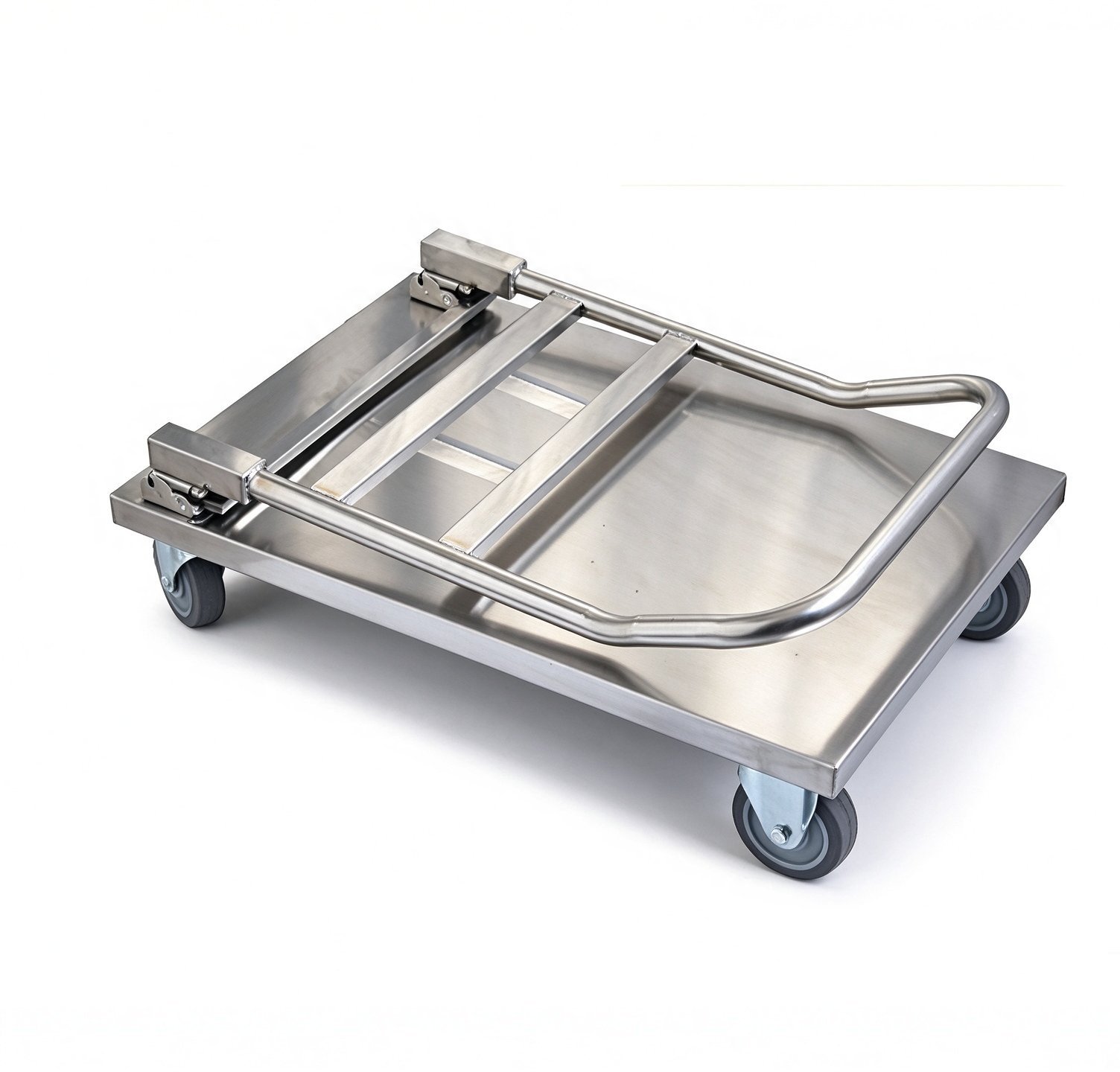
The tubular handle folds flat onto the deck, hinged at both mounts, so the trolley can be stored under a bench or stacked for transport.
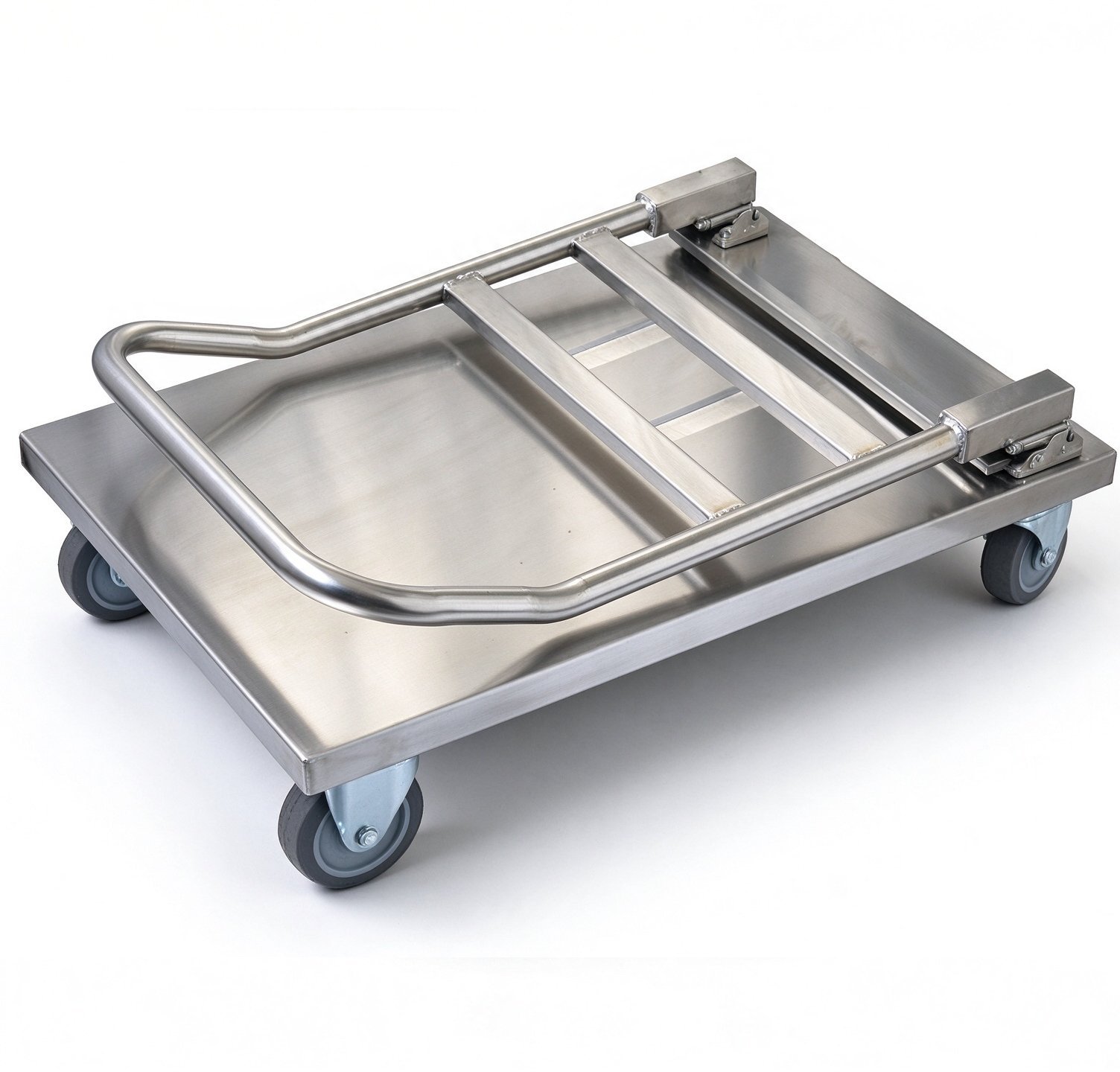
Hinge detail. The folding mount is a moving part, so it is one more item to check at assembly and at goods-in.
Choose a folding handle when the trolley spends meaningful time empty: stored under benches, stacked in a vehicle, or shipped flat to save freight. The honest cost is that a hinge is a moving part — it is one more thing to inspect, and it is slightly less stiff than a welded post.
Fixed loop handle with guard rails
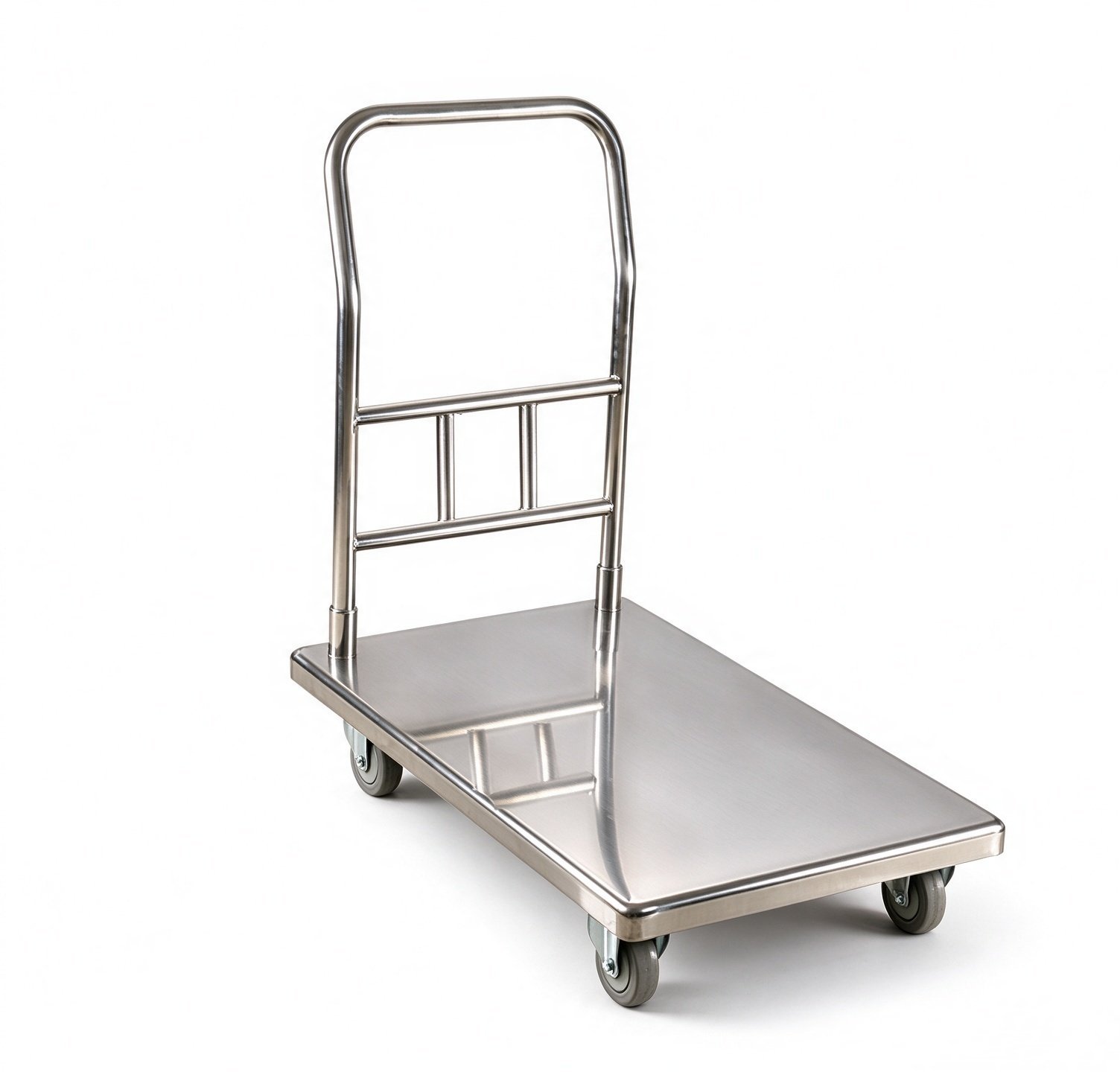
A tall loop handle with horizontal crossbars gives a comfortable push height and something to strap a tall or unstable load against.
Choose a fixed loop when the load is tall, unstable, or when the trolley is pushed long distances and the operator needs a proper push height. The crossbars are not decoration: they are the place you strap a load to. The cost is that the trolley will not go under a low bench and it takes more space in a container.
Casters: the part that decides whether it rolls
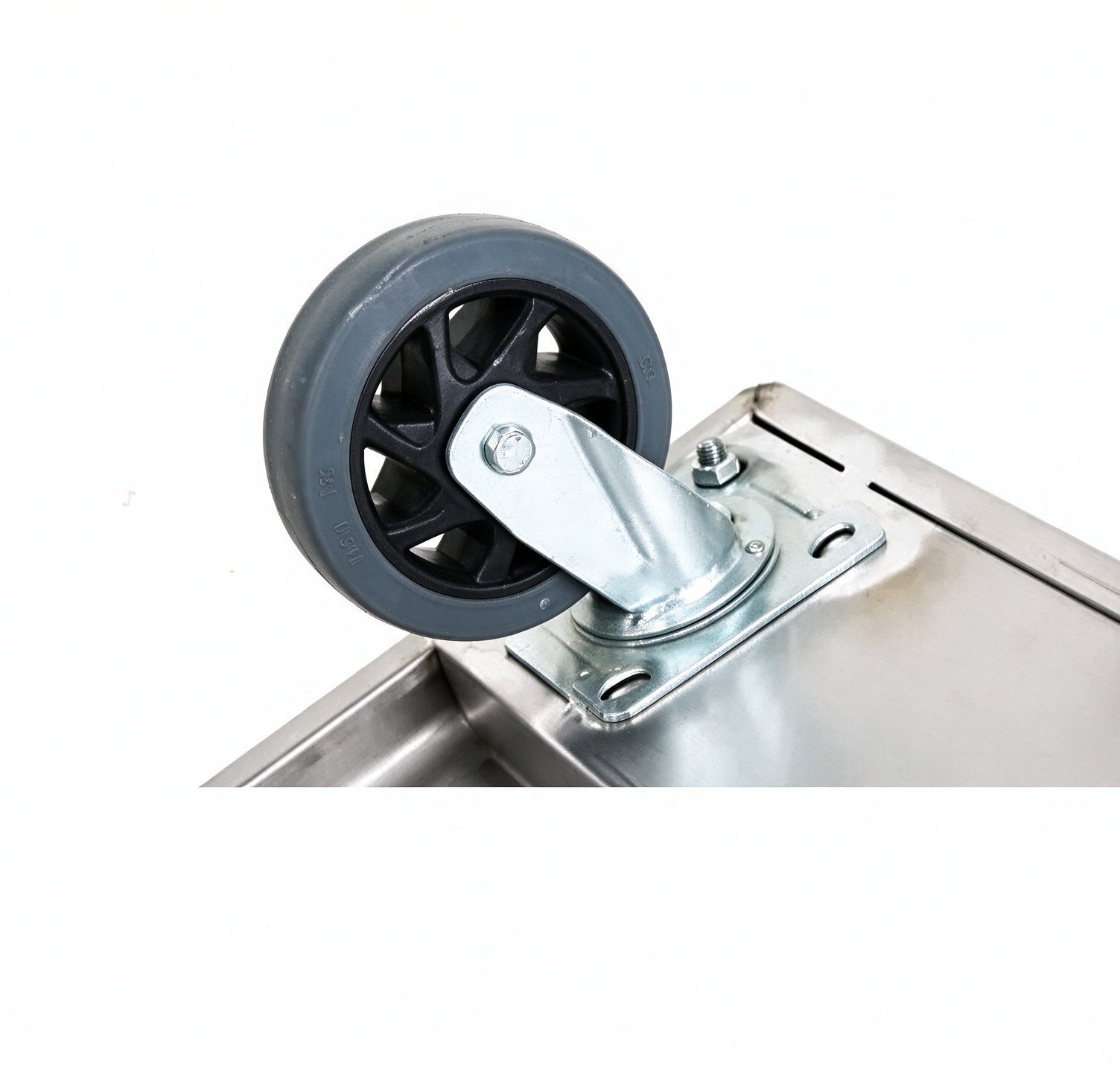
Grey non-marking wheel on a swivel fork with a four-hole top plate. Wheel size runs 75–200 mm and is picked from your floor, not from habit.
Casters are where platform trolleys fail in service, and the two failures are consistent: the wheel is too small for the floor, or the mounting plate tears out of the frame.
- Size, 75–200 mm. A bigger wheel rolls over expansion joints, cable runs and thresholds with less effort, but it raises the deck height. If your deck height is fixed by the bench or machine it feeds, that fixes your wheel size first.
- Tread. Non-marking grey rubber or polyurethane on finished floors — retail, laboratories, food plants — because black rubber leaves a line you will be asked about.
- Mounting. A four-hole top plate through reinforced plate, not into thin sheet. Tell us the load and we size the mount for it.
- Brakes. Specify where the operator stands. A brake on the wrong corner is a brake that does not get used.
Lead time, samples and quantity
- Samples: 7–15 days from approved drawing.
- Production: 25–35 days after sample approval.
- Minimum quantity: 50 units for a standard custom programme. Large or heavy-duty builds can be discussed case by case.
Those are planning numbers, not promises. The two inputs that move them most are whether a drawing exists yet and whether the caster specification is settled.
Drawings: what we need, and what you get
The fastest enquiries arrive with a drawing. Many do not — roughly a third of the enquiries we receive have no drawing at all, and that is normal for purchasing teams that are not staffed with someone who can produce a sheet-metal development.
- Our capability: we do have in-house drawing capability, but it is a paid service. We do not release CAD source files. You receive a dimensioned PDF drawing and a rendered image so you can approve what will be built.
- Cost and timing: normally from USD 1,000 and 10 days or more; a complex product can take six months to a year. Quoted case by case before any drawing work starts.
- What does the drawing cost, and how long does it take? It normally starts from USD 1,000 and takes 10 days or more; a complex product can take six months to a year. The exact fee and timeline depend on the difficulty of the product and are quoted case by case before we start. We recommend you supply your own drawing instead.
Tolerances we hold in production: laser cutting at ±0.1 mm, bending to ISO 2768 (commonly ±0.5 mm and ±1°), and welded assemblies at 0.5–1.5 mm per metre. Full detail is on our tolerances and dimensions page, and the drawing service is described on our drawing and engineering service page.
Certificates: what we can and cannot provide
We would rather you find this out now than at your goods-in audit.
What we have. A Bureau Veritas audit report, number MIC-ASR263630, dated 2026-10-09. It is a company-level factory audit covering our workforce, export history and equipment.
What we cannot provide. We do not hold ISO 9001 certification, and we cannot supply CE marking, UKCA marking, UL listing, EN 1090 or ISO 3834 certification. We cannot issue an EN 10204 3.1 certificate in our own name; where the steel mill issues one, we pass the original document through to you unchanged. We cannot issue a food-contact declaration.
The full statement, with the reasoning behind it, is on our certificates and traceability page.
Three things that delay an order
- No drawing, only a photo. We can work from photographs and samples, and we often do. A dimensioned sketch is still faster.
- Caster and brake specification left open. Casters drive deck height and the frame mounting, so leaving them late reopens the deck design.
- Cleaning method not stated. On an SS304 build the finish follows the cleaning method. Tell us how it gets cleaned and the finish question answers itself.
What to send with your enquiry
- Cargo: weight, overall dimensions, and what actually touches the deck — feet, a pallet, or the full base.
- Deck size you have in mind, plus your narrowest aisle and turning space.
- Floor: smooth, concrete, expansion joints, thresholds, ramps.
- Cleaning method and environment.
- Quantity and target delivery date.
- Photographs of the route if you have them. They answer more questions than a paragraph usually does.
Send it to us and we will come back with a drawing or a question, usually inside 24 hours.
Frequently asked questions
Do you sell a standard size?
No. Every deck size, deck height and load rating on this page is built to an order.
Can you build exactly to my drawing?
Yes — that is the point of the product. Where a drawing cannot be built as drawn, we tell you which feature is the problem and what we would change, before quoting.
Will you send me the CAD files?
No. You receive a dimensioned PDF and a rendered image; CAD source files are not released. Our drawing work is a paid service from USD 1,000, so supplying your own drawing saves both the fee and the waiting.
Is 316 available instead of 304?
Yes, where the environment calls for it — chloride exposure, salt, or aggressive cleaning. Grade selection is covered on our stainless steel trolley page.
Do you have ISO 9001?
No. We hold a Bureau Veritas audit report (MIC-ASR263630, 2026-10-09) and no ISO 9001 certificate, CE marking, or EN 10204 3.1 in our own name.
Can the trolley be powder coated instead?
If the route is dry and indoor, yes, and it is usually the cheaper build — powder coating at 60–80 µm. If the trolley is washed down or works wet, bare stainless will outlast a coating.
Have a Similar Trolley Project? Send It for Review
Send your trolley type, load capacity, size, wheel requirement, quantity, and drawings or reference photos. Our team will review the structure and reply within 24 hours on business days.
Urgent project? Email gao@doingmetal.com or WhatsApp +86 18158549983.