
October 23, 2026
Medical Equipment Trolleys: 1,000 Units
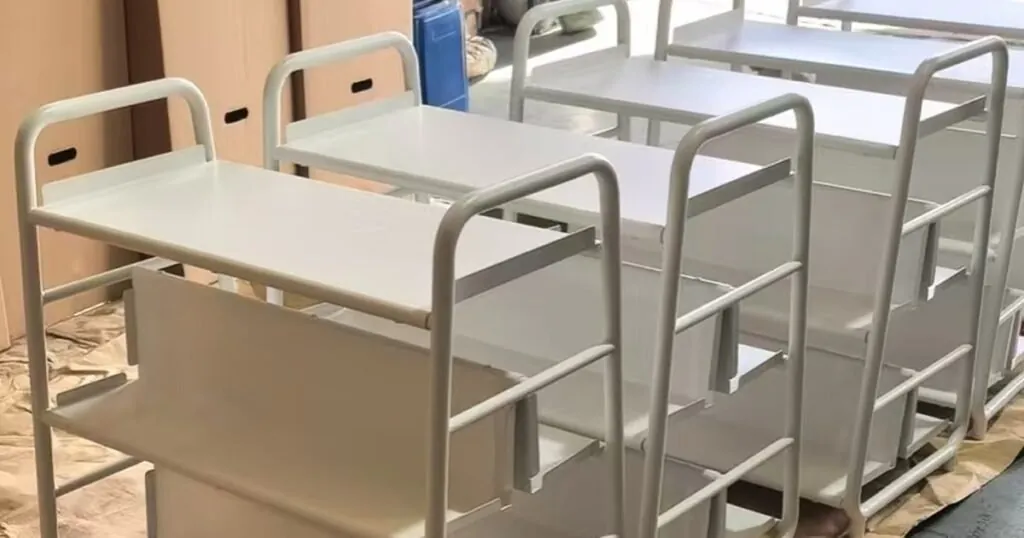
A medical equipment manufacturer came to us with a concept and a requirement, and no production drawings. What followed is the sequence every custom programme should run: concept in, our drawing out, a sample built, confirmation with the customer while the work was still open, sample approval, and then 1,000 units delivered. This article walks through that sequence stage by stage, because the value of a case study is not the finished trolley — it is the order the stages happen in.
Quick answer: how the programme ran
| Stage | What happened | What the customer supplied |
|---|---|---|
| Concept | The customer described what the trolley had to do and where it would be used. No production drawings existed. | Concept, requirement, intended use |
| Drawing | We turned the concept into a drawing set and sent it for review before anything was cut. | Review comments |
| Sample | One unit built to the same drawing revision that would govern production. | Sample evaluation |
| Confirmation | Open points settled with the customer while the sample was still being built — not after. | Decisions on each open point |
| Approval | Sample confirmed against the requirement, drawing revision frozen. | Sample approval |
| Production | 1,000 units built to the approved sample and drawing. | Purchase order, delivery schedule |
The brief: a concept, not a drawing
The customer is a medical equipment manufacturer. They knew what the trolley had to do — what it would carry, where it would live, who would push it, how often it would be cleaned — and they had a concept for how it might look. What they did not have was a drawing a workshop could build from.
That is the normal starting point for a custom programme, and it is a healthier starting point than a fully specified drawing from a buyer who has never had a trolley fabricated before. A concept plus a clear requirement leaves the engineering open, which is where it belongs. What the customer was buying was not a part number — it was the engineering.
Medical programmes also arrive with expectations that ordinary material-handling work does not carry: consistency across every unit, documentation that survives an audit, and the assumption that nothing changes without being written down. None of that makes the fabrication harder. All of it makes the process discipline non-negotiable.
Stage 1 — from concept to drawing
The first deliverable is never a quotation. It is a drawing, because a price without a drawing is a guess with a currency symbol on it. Turning this concept into a drawing meant settling, in order:
| What the drawing had to settle | Why it comes first |
|---|---|
| What the trolley carries, and how that load reaches the floor | Every later decision — frame, deck, casters — follows from the load path |
| Who moves it, and on what floor | Caster type, wheel hardness and brake behaviour depend on the floor and the user, not on the catalogue |
| How it is cleaned, and how often | Open construction, drainable surfaces and finish choice all follow from the cleaning regime |
| How it is stored and transported when not in use | Nesting, folding or stacking geometry is a storage decision before it is a design feature |
| How many units, and over what period | Volume sets the production method and separates one-time costs from unit price |
The drawing went to the customer for review before any material was ordered. This is the cheapest review in the whole programme: a comment on a drawing costs an email, and the same comment after the sample is built costs a sample.
Stage 2 — the sample
One unit, built to the same drawing revision that would govern production. That detail matters more than it sounds. A sample built from a preliminary drawing proves the preliminary drawing, and the customer is then approving a trolley that will never be built again.
The sample stage is also where the fabrication questions surface — the ones no drawing fully answers:
- Weld sequence on a multi-tier frame. Corner joints pull as they cool. The sequence and the fixture decide whether the frame sits square, and that is discovered by building one, not by calculating one.
- Caster tracking on a smooth floor. A trolley that tracks perfectly on a workshop floor can wander on a polished clinical floor. The sample gets pushed over the floor it will actually live on.
- Finish coverage and adhesion. Edges, weld seams and inside faces are where coatings fail first. The sample is inspected at those locations, not at the pretty ones.
- Assembly and disassembly. If the trolley ships partly assembled or gets taken apart for cleaning, the sample proves that it can be — repeatedly.
Stage 3 — confirming with the customer while the work was open
This is the stage most programmes skip, and skipping it is what turns a sample into an argument. While the sample was being built, we worked through the open points with the customer rather than guessing and presenting a finished article:
| Open point | What gets confirmed | What happens if it is left open |
|---|---|---|
| Dimensions that meet the customer’s equipment | The trolley has to fit the space, the doorway and whatever it docks against | A trolley that is perfect except for the one dimension that matters |
| Tier spacing and shelf arrangement | What goes on each tier, and in what order it is reached | Shelves that are theoretically adequate and practically wrong |
| Casters and brakes | Wheel material, diameter, which positions brake | A trolley that moves beautifully and cannot be parked safely |
| Finish | Colour, film type, and which surfaces must stay uncoated | A finish that fails inspection after the whole batch is coated |
| Fasteners and fixings | What is welded, what is bolted, what is removable | Parts that cannot be serviced, or fasteners nobody stocks |
| Marking and labelling | What is marked, where, and how permanently | Units that cannot be identified once they enter service |
| Packaging | How units arrive, how much assembly the customer does | Damage in transit, or a surprise assembly bill at the far end |
Every confirmation became a drawing revision. Nothing lived in an email thread, because an email thread is not a specification — it is a memory of one. When the sample was approved, the drawing revision it was built from was frozen, and that revision governed production.
Stage 4 — sample approval
Approval meant three things existed and matched: the physical sample, the drawing revision it was built from, and the written record of what had been confirmed along the way. When all three agree, production has a definition of “correct” that does not depend on anyone’s memory.
Approval is also the point where the volume price is finalised. Sample-stage pricing is provisional by definition, because the sample can still change. Once it is approved, the unit price, the quantity and the delivery schedule are all fixed together.
Stage 5 — 1,000 units into production
Production ran against the approved sample, not against the drawing alone. A drawing describes a part; a sample is the part. For a 1,000-unit order, the difference between the two is the difference between a batch that matches and a batch that matches the paperwork.
| Production control | What it does |
|---|---|
| First unit off the line checked against the approved sample | Catches setup drift before it becomes 1,000 units of drift |
| In-process checks at the operations that can drift | Welding, forming and coating are checked during the run, not only at the end |
| Final inspection against the approved sample | Every unit is compared to the physical reference, not to an opinion |
| Documentation pack with the shipment | The customer’s audit trail travels with the goods |
One-time costs — the drawing work, fixtures, the sample itself, testing — were quoted separately from the unit price. That separation is what makes a 1,000-unit order comparable to any other quotation the customer received, and it is what makes the repeat order cheap: nothing one-time is paid twice.
What this programme teaches
- Concept in, drawing out, then everything else. No quotation before a drawing, and no cutting before the customer has reviewed the drawing.
- The sample must be built to the production drawing revision. Otherwise it proves something that will not be built.
- Confirm while the work is open. Decisions made during the sample stage cost emails; the same decisions after production starts cost batches.
- The approved sample is the specification. Freeze the revision, build to the sample, inspect against the sample.
- Separate one-time costs from unit price. It is the only structure a buyer can compare, and the only structure that makes repeat orders cheap.
Frequently asked questions
Can a programme start from a concept with no drawings at all?
Yes, and it is the common case for custom work. What the customer needs to supply is the requirement — what the product does, where it is used, how many are needed — and the acceptance that the supplier engineers the construction. What the supplier supplies is the drawing, the sample and the production discipline.
Why build a sample before quoting the full order?
Because the sample is where the drawing meets reality. Welding distortion, caster behaviour on the actual floor, finish coverage at the locations that matter — none of these are fully predictable from a drawing. The sample either confirms the design or improves it, and both outcomes are cheaper before 1,000 units than after.
What does “sample confirmed” actually mean?
Three things that agree: the physical sample, the drawing revision it was built from, and the written record of the decisions made along the way. When all three match, production has an objective definition of correct.
How is a 1,000-unit order priced?
One-time costs — engineering, fixtures, sample, testing — are quoted separately and once. The unit price covers material, labour and finishing at the agreed quantity, and it holds for repeat orders because nothing one-time is repeated.
What documentation comes with a medical programme delivery?
The documentation pack agreed at the sample stage, travelling with the goods. Medical buyers need an audit trail that does not depend on anyone’s memory, and the pack is part of the delivery rather than an extra.
Have a medical equipment project to scope? Send the concept.
You do not need finished drawings to start. Send what the product has to do, where it will be used and how many you need, and we will come back with a drawing approach, a sample plan and a tiered price — in that order.
Have a Similar Trolley Project? Send It for Review
Send the concept, the sketch, or the existing trolley you want improved. We will tell you what we would change before you commit to tooling or a sample.
Read Next on the Same Decisions
- Cage Trolleys to Your DrawingRoll cages and cage trolleys welded to your drawing, with mesh gauge, door position and brake layout confirmed before quotation.
- Multi-Tier Shelf TrolleysMulti-tier trolleys specified by tier count, spacing and load per shelf.
- Stainless Steel TrolleysTrolleys for washdown, food and clean-duty environments.
- Trolley Parts and AccessoriesCasters, brakes, handles, shelves, mesh, drawers and locks with the usual specification ranges.
- Trolley Load Ratings ExplainedRated load versus shelf load versus caster rating, and how each is tested.
- MOQ, Lead Time and Repeat OrdersWhat minimum quantities, lead times and repeat-order pricing look like on custom programmes.
- How Trolleys Are Built: Cut, Bend, Weld, CoatThe full fabrication sequence from raw sheet to finished, coated product.
- Trolley Production: 7 Steps to ContainerHow a production order moves through cutting, forming, welding, finishing and packing.
Have a Similar Trolley Project? Send It for Review
Send your trolley type, load capacity, size, wheel requirement, quantity, and drawings or reference photos. Our team will review the structure and reply within 24 hours on business days.
Urgent project? Email gao@doingmetal.com or WhatsApp +86 18158549983.