September 22, 2026
Private Label OEM Trolley Programs | Doing Metal
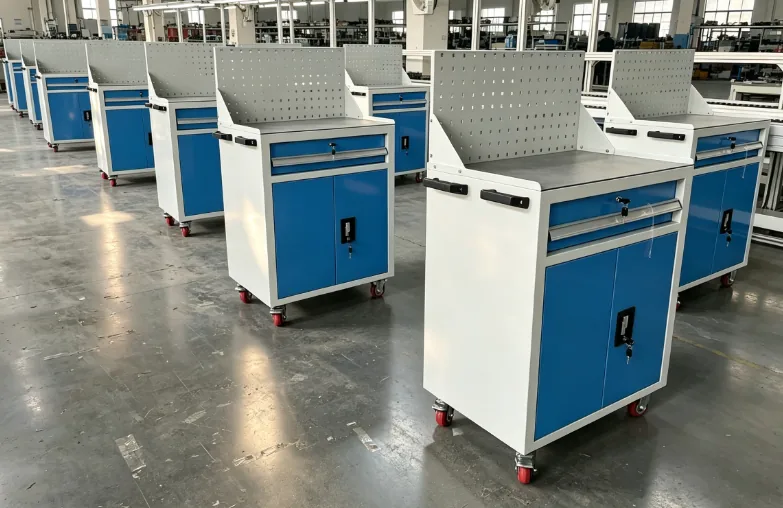
Equipment distributors reach a point where reselling someone else’s catalogue stops working. The price is visible, the same cart appears under a competitor’s listing, and the only lever left is discount. A private label programme – your own brand on a cart built to a drawing you control – solves all three, and it is more achievable than most distributors assume.
What private label actually means here
Private label on industrial carts is not buying a random product and sticking a label on it. It is agreeing a specification, held as a drawing and a set of components, that only your business sells. In practice it covers:
- The geometry you own. Dimensions, load rating, shelf layout, handle type – fixed on a drawing kept on file.
- The finish you own. A colour matched to your brand rather than whatever the factory had in stock.
- The branding. Logo plates, etched badges, decals or printed panels.
- The packing you own. Cartons, barcodes, manuals and labelling designed for your warehouse.
Everything else – the factory, the welding, the inspection – stays invisible to your customers, which is the point.
Choosing the first three products
Most programmes start too wide. Three products chosen well outsell ten chosen badly, because you have to hold stock, publish spec sheets and service spares for every line you open. A sensible opening range:
- One general-purpose cart with broad appeal in your market – usually a platform trolley or a shelf trolley.
- One speciality cart tied to your own customers’ complaints – a picking cart, a lockable service cart or a rolling bench.
- One consumable-adjacent item you can reorder easily, such as replacement wheels, brake kits or handles.
Starting with a strong general-purpose line also reduces risk: if the speciality product moves slowly, the core line still turns your capital.
Getting the specification right before quoting
The specification you publish becomes a warranty claim waiting to happen, so it is worth reviewing properly:
- Load rating based on tested performance, not on the number that sells best this month
- Wheel specification that matches the floors your customers actually have
- Finish that survives their environment, not just the photograph for your catalogue
- Spare parts available as individual line items, ideally in the same shipment
A good manufacturing partner will push back on parts of your draft. That pushback is the most valuable part of the review.
Branding options that survive industrial use
Carts get pressure washed, stacked, dragged and repainted by accident. Branding should be chosen with that in mind:
- Powder coat colour matched to a RAL reference you keep on file
- Etched or printed stainless plates for premium lines
- Screen printed or digital decals protected with a clear coat
- Embossed or laser-marked surfaces where regulations or anti-counterfeit concerns apply
- Own-brand cartons and manuals for customers receiving direct shipment
Keeping repeat orders identical
Consistency is what makes a private label programme defensible. It depends on a few habits agreed at the start:
- Drawings and jigs held by the manufacturer, referenced by your part number
- Colour and finish standards recorded, so batch two matches batch one
- A first article rule for any change, however small
- Fixed component specifications – especially casters, which suppliers quietly change more often than anything else
- Spare parts ordered with the main shipment rather than after it
Structuring a specification sheet your sales team can defend
Your published specification becomes a promise, so write it so it cannot be read two ways:
- State the load condition. Evenly distributed load, or concentrated load, and over what area
- State the floor assumption. Wheel performance figures depend on the surface
- State what is included. Wheels, brakes, shelves, assembly hardware, instructions
- State what is not. Assembly service, indoor use only, no wash-down rating
- State the spare parts. Part numbers for wheels, brakes and handles, available to order
Distributors with defensible specifications get fewer warranty arguments and fewer price objections, because buyers can see exactly what they are comparing.
Three mistakes distributors make
- Opening too many lines at once. Working capital spreads thin before any line proves itself
- Choosing on sample price rather than repeat reliability. The third order is where the programme makes money, and it depends on drawings, jigs and finish control being held for years
- Ignoring spares. A customer whose cart sits out of service waiting for a wheel remembers that longer than the price they paid
Frequently asked questions
What quantities does a private label programme need?
Typical custom programmes start around 50 units per model; larger or more complex carts can sometimes be discussed from 10 units. Consumables like wheels are quoted separately. See our MOQ and lead time guide.
Can we protect the design from our own competitors?
An NDA before drawing exchange is normal and we are used to it. Legal protection beyond that is a matter for your own counsel in your market.
Can you drop-ship to our customers?
Packing and labelling can be set up for onward distribution, including own-brand cartons and documentation. Discuss it during RFQ so it is priced from the start.
Tell us which three products would open your range – start at the contact page.
Have a Similar Trolley Project? Send It for Review
Send your trolley type, load capacity, size, wheel requirement, quantity, and drawings or reference photos. Our team will review the structure and reply within 24 hours on business days.
Urgent project? Email gao@doingmetal.com or WhatsApp +86 18158549983.