
September 22, 2026
Why Trolley Shelves Bow and How to Prevent It | Doing Metal
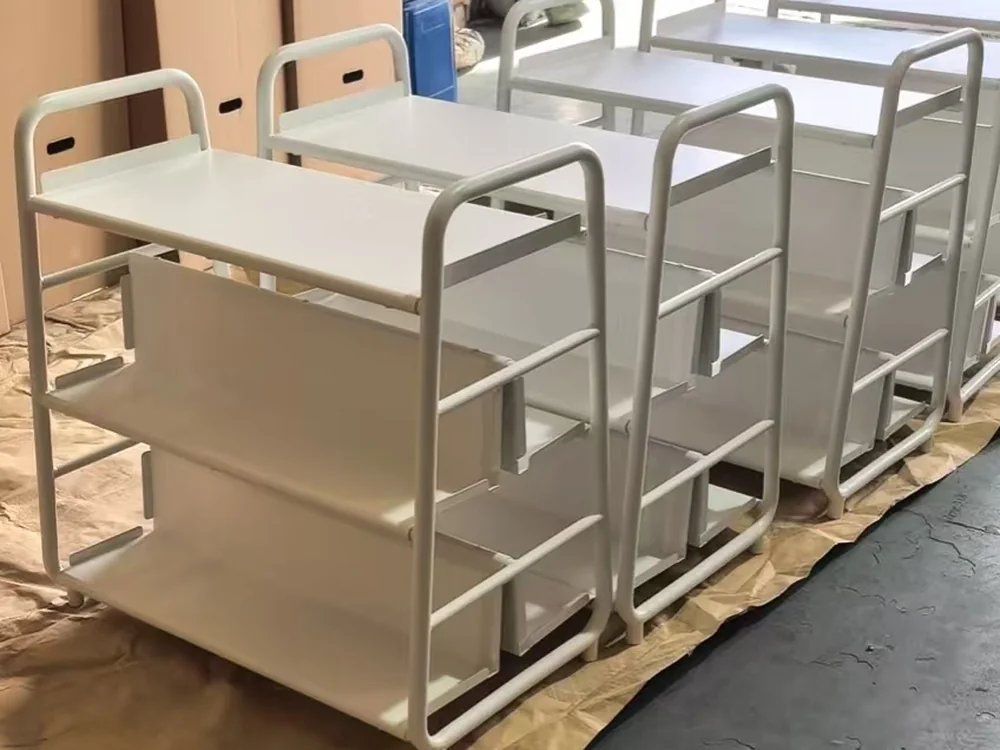
Nobody notices a shelf deflecting on day one. It appears after a season: the middle of the shelf sits lower than the ends, totes slide toward the centre, and the cart slowly becomes annoying to use. By then the batch is built. The cause is almost always one of four drawing decisions.
1. Span is the dominant factor, not thickness
Deflection rises very quickly as span increases – far faster than it falls when you add thickness. A long unsupported shelf made from thicker plate will still bow, while the same shelf with one support underneath stays flat. This is why the fix is usually a support or a change in section shape rather than thicker steel.
Practical implications: keep shelf spans short, add a support member under long shelves, and treat a wide cart as two narrower bays rather than one wide shelf.
2. Load placed where the shelf is weakest
Most shelf deflection problems are really load placement problems. A shelf rated for a distributed load will bow if the same weight lands in the middle, and repeated point loading permanently deforms plate that would have survived a spread load.
Tell the manufacturer where the weight actually sits. On our own builds, shelf structure follows the load case you describe, which is why we ask for load per shelf rather than only a cart total – see the multi-tier shelf trolley page.
3. Flat plate used where a formed section is needed
A flat sheet has little stiffness. The same material folded into a tray, lipped on the edges, or formed into a hat section is dramatically stiffer for almost no extra weight. Common solutions:
- Folded edges or lips along the long sides
- A formed channel underneath running the span
- A tube or angle welded under the front and rear edges
- Perforated or wire decks where the load allows it, which also cuts weight
4. Temperature, impact and time
Steel does not creep much at room temperature, but repeated impact loads and overloading leave permanent set. Shelves in cold stores, or shelves that are loaded by dropping rather than placing, deserve a heavier specification than a static calculation suggests. Tell us how the cart is loaded, not only how much it carries.
How much deflection is acceptable?
There is no universal number, but a useful working rule for industrial shelving is deflection small enough that it is not visible to an operator when the shelf is loaded, and small enough that items do not roll or slide into the centre. What matters more than the figure is agreeing it before production, so a sample can be judged against something.
How to test a shelf honestly
On a sample, before approving the batch:
- Load the shelf with the real product, not test weights placed conveniently
- Leave it loaded overnight, then measure and photograph
- Unload it and check whether it returned to flat or took a permanent set
- Repeat on the worst shelf – usually the longest span or the lowest shelf under the heaviest load
- Push the loaded cart down the actual route and watch whether items migrate
This is the kind of check worth doing during first article approval, when a change costs a drawing revision rather than a rework programme.
Material choice: steel, stainless or aluminium
Shelf material affects stiffness as well as corrosion behaviour:
- Carbon steel: the default. Stiff, economical, and easy to form into stiff sections
- Stainless: slightly different stiffness behaviour and a higher price, chosen for wash-down and corrosion rather than strength. See stainless trolleys
- Aluminium: roughly a third the weight of steel but also less stiff, so spans need more support or a deeper section
Choosing aluminium to save weight usually means redesigning the shelf section rather than simply swapping material.
When the answer is not a shelf at all
If the load is heavy, concentrated and repeated, a flat shelf may be the wrong concept. Alternatives that solve the same problem:
- A rack or cradle that holds the part at two points instead of supporting it across a span
- Dividers or guides that spread load into the frame rather than the shelf
- A shorter cart with two bays instead of one long shelf
- A purpose-built fixture, which is often what a parts cart really needs
Frequently asked questions
Can an existing bowed shelf be fixed?
Sometimes with an added support underneath, but it is a retrofit. The better route is to specify the support in the drawing so the shelf never bows.
Does thicker steel always help?
It helps less than people expect relative to its cost and weight. Shortening the span or forming the shelf usually gives more improvement for less money and less weight to push.
What should we tell the manufacturer?
Load per shelf, where the load sits, span between supports, how it is loaded, and how much deflection you would consider acceptable. That is enough to design the shelf properly.
Do wire or perforated shelves deflect less?
They deflect differently – often they are stiffer for their weight but concentrate load on fewer points. Choose based on the product sitting on them rather than on weight alone.
Send shelf span and load per level through the contact page and we will review the shelf structure before quoting.
Have a Similar Trolley Project? Send It for Review
Send your trolley type, load capacity, size, wheel requirement, quantity, and drawings or reference photos. Our team will review the structure and reply within 24 hours on business days.
Urgent project? Email gao@doingmetal.com or WhatsApp +86 18158549983.