
September 2, 2026
Caster Selection for Industrial Trolleys: PU, Rubber, Nylon and Pneumatic Wheels
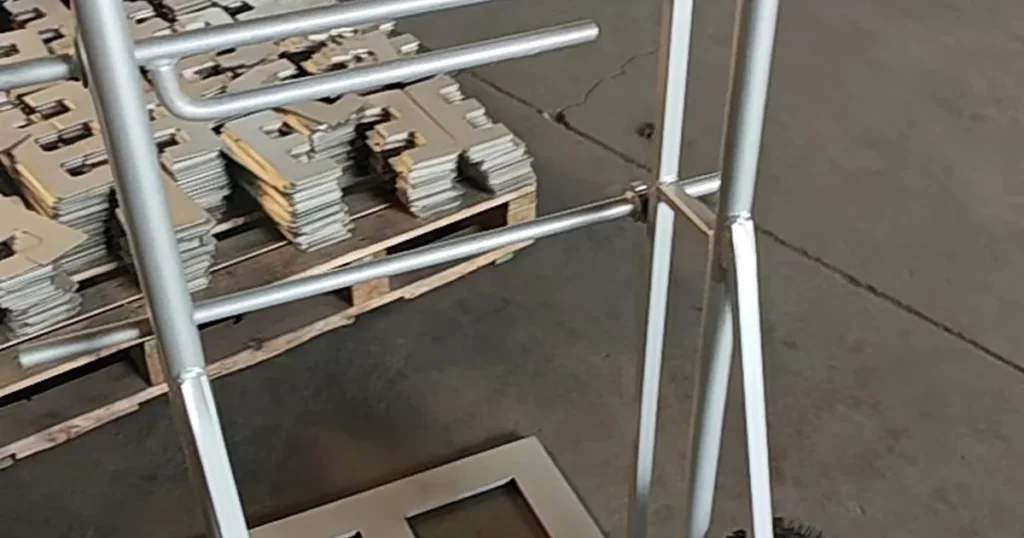
Casters are the single most underestimated line item on a custom trolley. The frame decides how much the trolley can carry; the casters decide whether anyone actually wants to push it. A well-built 500 kg platform trolley fitted with the wrong wheels will be abandoned in a corner within a week, while a lighter cart with correctly specified wheels gets used every shift for years. Wheel diameter, tread material, bearing quality, brake design and layout all change pushing effort, noise, floor wear and safety — and they are all decided before the first tube is cut.
What a caster specification actually controls
Four things change together when you change a caster: rolling resistance, load capacity, floor contact and noise. They pull against each other, so the right choice is always a compromise that matches your route rather than a single “best” wheel.
- Rolling resistance — larger diameters roll over joints, thresholds, expansion gaps and debris far more easily. Moving from 100 mm to 160 mm wheels on the same load typically makes the difference between a cart that one person pushes and a cart that two people push.
- Load capacity — the rating printed on a caster assumes an even, static, four-wheel load. Real trolleys are never perfectly even, and on an uneven floor only three wheels may be carrying at any moment.
- Floor contact — soft treads protect floors and damp vibration but wear faster and roll harder. Hard treads roll easily, carry more, and can mark or damage finished floors.
- Noise — in libraries, hospitals, studios and customer-facing retail, noise is often the deciding requirement, not load.
Tread materials and where each one belongs
Most industrial trolleys in this capacity range use one of four tread materials. The honest answer is that none is universal; each has a floor type and a duty cycle it suits.
Polyurethane (PU)
PU is the default for smooth indoor floors and quiet warehouse work. It carries more than rubber at the same size, rolls with moderate effort, resists most oils and greases, and does not mark floors as readily as black rubber. It is the common choice for platform trolleys, picking carts and library trucks running on sealed concrete, epoxy or vinyl. On rough ground PU transmits more vibration than rubber, and very soft PU compounds can develop flat spots if a loaded trolley is parked for weeks.
Rubber
Rubber absorbs vibration and is the quietest option on hard floors, which is why it shows up on library book trucks and studio equipment carts. It protects thresholds and tiles well. Trade-offs: higher rolling resistance, faster wear under heavy loads, and poor resistance to some oils and solvents. Elastic solid rubber is a middle ground — quieter than PU, rolls better than soft rubber.
Nylon and polyamide
Nylon is very hard, very low rolling resistance and handles high loads in a compact diameter. It suits hard, smooth, debris-free floors and heavy static loads. It is noisy, it transmits every floor joint into the frame, and it can mark or crack brittle floor finishes. Nylon is often chosen when a caster must fit inside a tight overall height but still carry a rated load.
Pneumatic
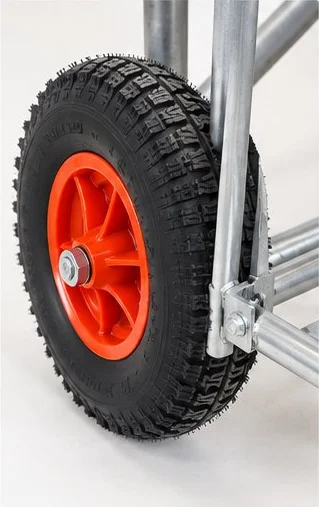
Air-filled wheels are the answer when the route is genuinely rough: yards, construction sites, thresholds, gravel, kerbs. They cushion impact better than anything else. The cost is maintenance — punctures, pressure checks, and a load rating that drops if the pressure is wrong. For mixed indoor/outdoor routes, a large PU wheel is usually the better compromise unless the ground is truly bad.
Wheel diameter: the cheapest upgrade you can buy
Wheel diameter is the fastest lever on pushing effort, and it costs very little compared with the frame. Typical diameters for hand-pushed trolleys run from 75 mm up to 200 mm:
- 75–100 mm — light carts, tool trolleys, cabinet-style units, laboratory and studio carts, or any design where overall height is constrained.
- 125 mm — the general workhorse for warehouse and workshop trolleys carrying a few hundred kilos on sound floors.
- 160 mm — a common choice where routes are long, floors have joints or thresholds, or loads approach the upper end of a manual trolley.
- 200 mm and above — heavy platform trolleys, long-distance routes, outdoor yards and towed trains where rolling resistance dominates.
If a trolley feels heavy to start and heavy to stop, increase diameter before you increase anything else. The penalty is deck height: bigger wheels raise the working surface, which matters for shelving trolleys, book trucks and anything loaded by hand.
How to read a load rating honestly
A 300 kg trolley does not need four 75 kg casters. Ratings assume ideal conditions that rarely exist on a shop floor. A practical approach:
- Take the maximum payload plus the trolley’s own weight.
- Assume uneven load distribution and a floor that is not perfectly flat — size for three wheels carrying, not four.
- Add a margin for shock loading: thresholds, dropped loads, and starting and stopping forces all multiply the static figure.
That is why two trolleys with the same “500 kg” label feel completely different in service. The frame may be identical; the caster plates, bearings and wheel ratings are what carry the margin. When you send an RFQ, state the payload, the worst-case distribution (all weight on one half of the deck, for example) and the route — not just the headline number.
Bearings, brakes and layout
Bearing type
Plain bore and roller bearings cost less and suit occasional, slow movement. Precision ball bearings reduce starting and rolling effort noticeably and are worth specifying on anything pushed repeatedly across a shift. Sealed bearings matter wherever there is dust, washdown or metal swarf. On a trolley that travels hundreds of metres a day, bearing choice is felt more than horsepower is.
Fixed, swivel and brake layout
Two fixed plus two swivel casters give directional control on long routes and keep the trolley tracking straight — the standard layout for warehouse platform trolleys. Four swivel casters turn inside their own footprint and are easier to position in tight aisles, but they wander on long pushes and feel less stable at speed. A directional lock (swivel lock) on one pair gives both behaviours in one trolley.
Brake choice
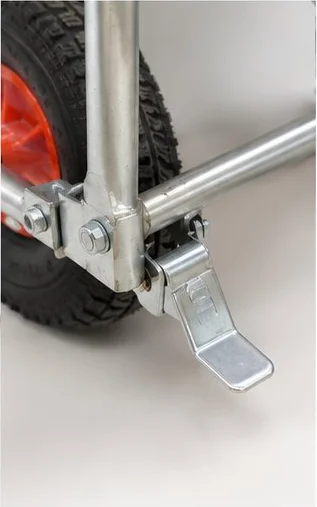
Brakes are not optional wherever a trolley is loaded while parked, used on a slope, or used as a mobile workstation — tool carts and film equipment carts in particular. Options include a wheel tread brake, a total lock that stops both swivel and rotation, a central brake system operated from the handle, and simple swivel locks. Total lock is the safer default for public areas and slopes.
Common specification mistakes
- Specifying casters from a photo. The wheel that looks right is often a size too small for the route. Decide diameter from the floor and the distance first.
- Ignoring the floor transition. Most trolley complaints start at a door threshold, a lift lip or a drain cover. Tell the supplier what the trolley has to cross.
- No brake on a cart that is loaded while standing. This is the most common safety gap we see in drawings.
- Forgetting replacement supply. If you are ordering 50 units a year, confirm that the same wheel model will be available for repeat orders, or specify the mounting pattern so a substitute can be fitted.
- Mounting plate too thin. The caster plate and the weld back into the frame carry the load into the structure. Under-specifying the plate is a frequent cause of early failure on heavy trolleys.
Frequently asked questions
Which wheel is quietest?
Soft rubber or a soft PU compound on a precision bearing. Hard nylon on a hard floor is the loudest combination. For libraries and studios we usually recommend a soft tread plus sealed bearings, and we check the threshold height before fixing the diameter.
Can a trolley be fitted with both fixed and braked casters?
Yes. A common layout is two fixed, two swivel, with brakes on the swivel pair. For heavier platform trolleys we often add a foot-operated brake on two wheels so the operator does not have to reach underneath a loaded deck.
How much does wheel diameter really change pushing effort?
Materially. On a rough or jointed floor, moving from 100 mm to 160 mm generally reduces the effort to start and keep the trolley moving far more than any frame change would. It costs a little deck height and very little money.
What if the trolley is towed instead of pushed?
Towing changes everything: speed, heat build-up in the tread, and lateral forces in corners. Say so in the RFQ. Towed trains need wheels rated for speed, not just for load, and the coupling geometry has to be designed into the frame.
What to confirm before quotation
- Floor type, route distance, thresholds and maximum slope.
- Payload plus trolley weight, and the worst-case load distribution.
- Noise requirement and floor protection requirement.
- Tread material, wheel diameter and bearing type.
- Fixed, swivel, brake, swivel-lock or central brake layout.
- Manual push, pull handle, tow bar or AGV interface.
- Whether the same wheel model must be available for repeat orders.
Every trolley we build is made to your drawing, so the caster specification is confirmed together with the frame, the deck and the finish before production starts. Send the route description and payload and we will come back with a caster layout that matches the floor rather than a catalogue picture. If you are still comparing trolley types, the product overview shows the range we build to order.
Related pages: warehouse trolley, tool trolley, and warehouse applications.
Have a Similar Trolley Project? Send It for Review
Send your trolley type, load capacity, size, wheel requirement, quantity, and drawings or reference photos. Our team will review the structure and reply within 24 hours on business days.
Urgent project? Email gao@doingmetal.com or WhatsApp +86 18158549983.