
September 2, 2026
Film and TV Equipment Trolley Design for Cameras, Lights and Cables
An equipment cart on a production set is judged by one thing: whether the crew can find and reach the gear fast. Load capacity matters, but it is rarely the constraint. A cart holding cameras, lenses, monitors, batteries, cables, lighting controls and sound equipment has to keep each item in a known place, protected from impact, and accessible while a shot is being set up. Millimetres matter — a shelf that is 5 mm too shallow for a case turns a five-second grab into a two-minute shuffle.
Design from the equipment list, in case dimensions
The most useful document a buyer can send is the equipment list with case dimensions. Not the gear itself — the cases, because that is what has to fit.
- List the major cases with external dimensions: camera bodies, lens cases, monitor cases, battery cases, sound bags, lighting control cases.
- Group them by access frequency. Items needed constantly go on the top or at the front; items needed once a day go lower or behind.
- Separate fragile from heavy. Lenses and monitors go where they cannot be knocked; batteries and ballast are heavy and belong low, which also keeps the centre of gravity down.
- Plan for growth. Kit lists change. Adjustable or removable dividers give the cart a longer useful life than fixed compartments sized for one shoot.
Shelf layout, dividers and containment
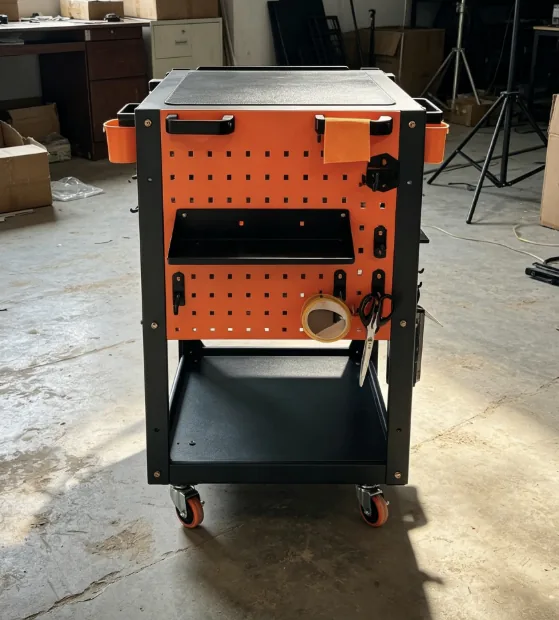
Most production carts are a combination of open shelves, divided compartments and a protected top surface.
- Open shelves for cases that are carried in and out whole.
- Dividers and rails to stop cases sliding when the cart is pushed over a cable run or a threshold.
- Padded or lined compartments for lenses, monitors and anything with a screen or glass.
- Cable management — hooks, spools, or a dedicated bin. Cables are the item that turns a tidy cart into a mess fastest, and they are usually the reason a crew abandons a cart.
- Battery trays with containment, since batteries are heavy, valuable, and increasingly subject to transport rules.
- A clear top surface for the item being set up right now.
Decide whether shelves are fixed or adjustable. Fixed shelves are quieter and more rigid; adjustable shelves let the cart adapt when the kit changes. For most carts a mix works best: fixed main shelves, adjustable dividers within them.
Quiet mobility on set
Studio and location floors create conflicting requirements, and the wheels have to suit both.
- Studio floors are usually smooth, and noise is the priority. Soft treads and quality bearings keep a cart quiet on hardwood, polished concrete and stage floors.
- Location work adds gravel, kerbs, door thresholds, cable ramps and wet ground. Larger, softer or pneumatic wheels handle this, at the cost of overall height.
- Mixed routes are the common case. A larger soft-tread wheel is usually the best compromise unless the location is genuinely rough.
- Non-marking compounds matter on location — floors in hired venues have to be handed back undamaged.
Braking and stability
A production cart is frequently used as a temporary workstation, with crew leaning on it or working from it. That makes braking a primary requirement:
- Total-lock casters that stop both swivel and rotation are the safer default, because a cart that rolls while a monitor is being set on it is a hazard.
- Brake pedals must be reachable without crawling under the cart, and must work with the cart fully loaded.
- Load distribution matters on uneven location ground. Heavy items low, and nothing heavy above the handle line.
- Consider a wider base if the cart carries tall equipment such as lighting stands or a monitor stack.
Power, cable and accessory provision
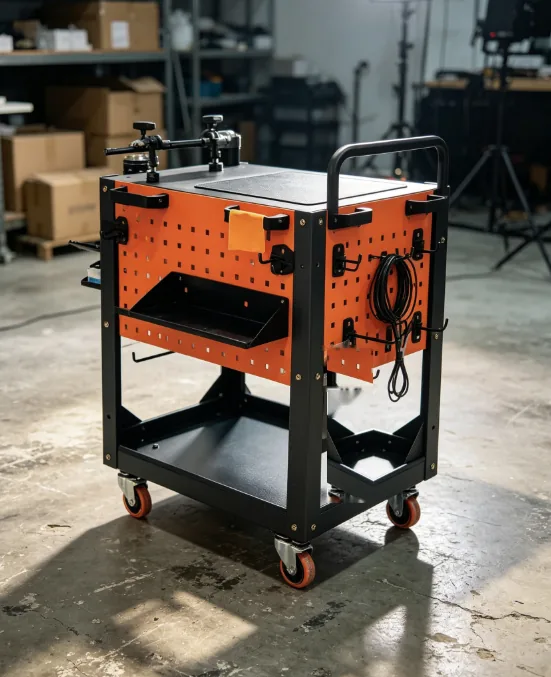
Modern production carts increasingly carry power. This changes the specification from a metalwork job to a metalwork job with an electrical interface, and it needs to be decided early:
- Cable entry and exit points so leads are not trapped by shelves or pinched by doors.
- Strips or outlets mounted where they are reachable and not where a spilled drink lands.
- Ventilation around chargers and power supplies — heat has somewhere to go.
- Battery charging and storage laid out so units can be charged without being unpacked.
State clearly which parts of the cart you supply and which the fabricator supplies. A power provision left ambiguous is the most common source of delay on this type of build.
Finish and appearance
Production carts are seen on camera and handled constantly, so finish is both practical and presentational:
- Dark, low-glare finishes are standard for studio work — a gloss cart reflects into shots.
- Durable coating on edges and rails, which take constant impact from cases.
- Sound damping — lined shelves, padded compartments and tight fixings stop the rattling that is audible on a quiet set.
- Brand colour where the cart belongs to a rental house or a production company.
Knock-down and transport
Unlike warehouse trolleys, production carts often have to travel — in a truck, a van, or as checked equipment. Consider:
- Folding or removable shelves so the cart packs flat.
- Removable handles that do not need tools.
- Overall weight, since crew lift these in and out of vehicles.
- Corner protection and a durable finish, because carts are stacked against each other in transit.
Frequently asked questions
Fixed or adjustable shelves?
Fixed for rigidity and quietness, adjustable for flexibility. A common answer is fixed shelves with adjustable dividers, which keeps the structure tight while allowing the compartment sizes to change with the kit.
Can the cart carry mains power?
Yes, but decide it at the drawing stage. Cable routing, mounting positions and ventilation all have to be designed in, and responsibility for the electrical components has to be agreed in writing.
What wheels for mixed studio and location work?
A larger soft-tread wheel with sealed bearings, non-marking. Step up to pneumatic only if the location ground is genuinely rough.
Do you build to a reference cart?
We build to your drawing or to a reference unit you supply. Send photographs, dimensions and the equipment list, and the layout can be drawn from that.
RFQ checklist
- Equipment list with case dimensions and weights.
- Required shelves, hooks, rails, dividers and padded areas.
- Cable management and battery storage requirements.
- Power provision, if any, and who supplies the electrical parts.
- Indoor studio, outdoor location, or mixed route.
- Wheel noise requirement, brake type and floor protection requirement.
- Folding or knock-down requirement for transport.
- Finish colour, logo, packing method, quantity and destination.
Send the equipment list and the route and the layout follows from it. Send your cart requirements, or review the film and TV trolley page for the configurations we build to order.
Related pages: film and TV trolley and film production applications.
Have a Similar Trolley Project? Send It for Review
Send your trolley type, load capacity, size, wheel requirement, quantity, and drawings or reference photos. Our team will review the structure and reply within 24 hours on business days.
Urgent project? Email gao@doingmetal.com or WhatsApp +86 18158549983.