
September 2, 2026
Custom Tool Trolley Design for Workshops and Maintenance Teams
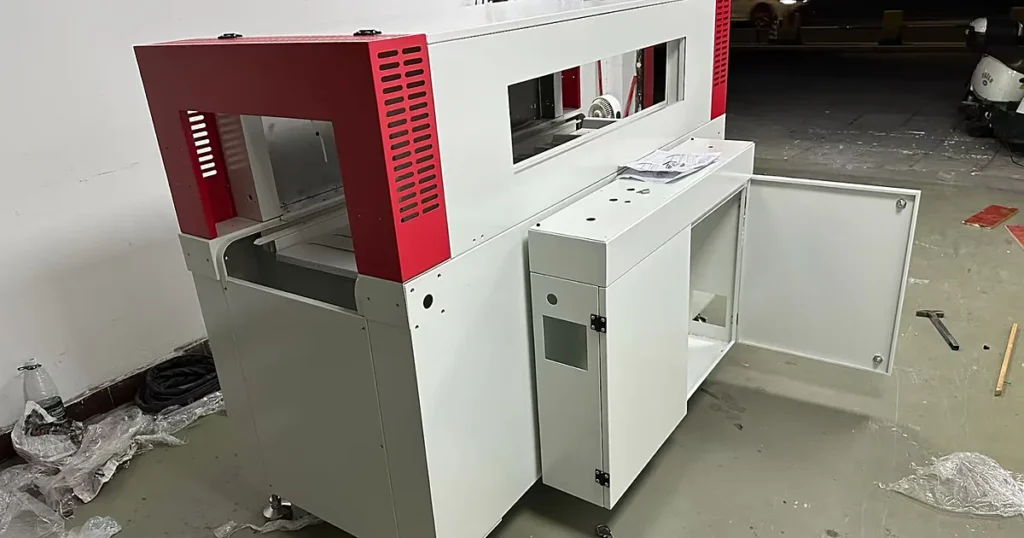
For a maintenance team, a tool trolley is not a cart — it is a mobile workstation. It stores tools, spare parts, measuring instruments, fasteners, power tools and consumables, and it gets pushed to wherever the job is. A good one removes walking time, keeps frequently used tools visible, and survives being parked next to a running machine all day. A bad one becomes a drawer that happens to have wheels.
Design from the tool list, not from the catalogue
The single most useful thing a buyer can send is the tool list. Not “a tool cart” — the actual items, with weights. That list determines drawer count, drawer depth, load rating per drawer, shelf spacing, and whether the cart needs power, lighting, or a work surface.
Work through it in this order:
- Heavy items first. Power tools, spanners, hydraulic gear and fluid containers set the bottom drawers and the load rating. Heavy tools stored low also keep the centre of gravity down, which matters on a cart that is pushed across a sloping or uneven floor.
- Frequent items next. The tools used every job belong at waist height and in the top tray, not buried.
- Small parts last. Fasteners, fuses, seals and consumables need bins or dividers, and they are the reason most tool carts end up with a bin rail.
- What has to be secured. Measuring instruments, calibrated tools and expensive power tools need lockable storage, and sometimes foam inserts so damage is visible immediately.
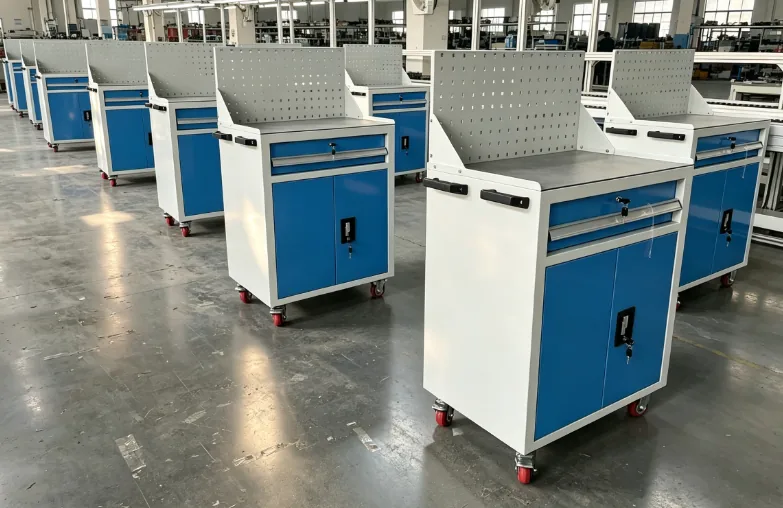
Drawers, shelves and load ratings
Drawer specification is where a tool trolley is made or broken. The rating printed on a slide is a static figure for an evenly loaded drawer; a drawer slammed shut with a heavy impact wrench at one end is a different test.
- Rating per drawer. State the expected weight per drawer, not the total. A cart rated 200 kg overall can still have drawers that fail at 25 kg each.
- Slide type and extension. Full extension shows the back of the drawer; partial extension does not. Ball-bearing slides run smoothly under load and are worth specifying on anything used daily.
- Drawer height mix. A uniform stack of shallow drawers wastes space. A mix of shallow, medium and one or two deep drawers usually fits the tool list better.
- Retention. Drawers should not roll open when the cart is pushed over a threshold. Latches or detents matter.
- Liners, mats and dividers. Anti-slip matting stops tools sliding and reduces noise; dividers stop small parts mixing.
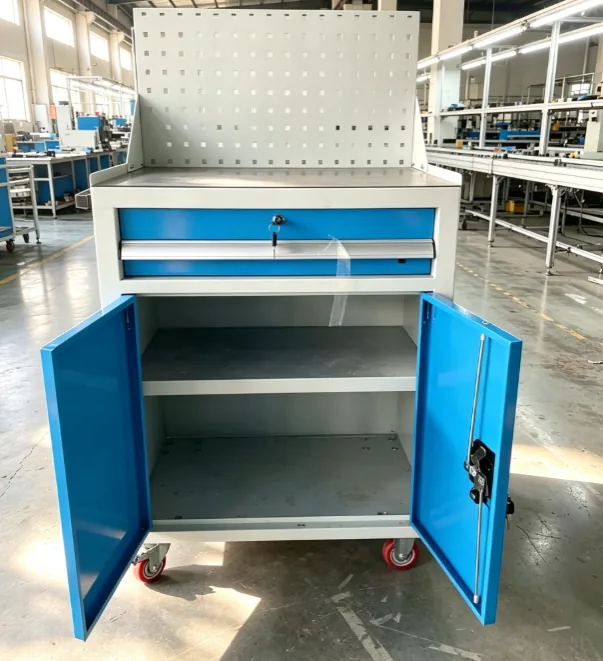
Shelves and trays serve different purposes. Open shelves suit bulky items and cases; trays suit parts in transit; a perforated back panel with hooks suits hand tools that need to be grabbed rather than found.
Work surface, height and access
If the trolley is used as a bench, three dimensions matter more than anything else: the working height, the clear top area, and whether the top can take a vice, a drill press or a test instrument.
- Working height. Match the bench height the team already uses. A cart that is 100 mm too low causes back strain over a shift.
- Top material. Steel plate, stainless for clean areas, or a replaceable hardboard or rubber surface where the top is a sacrifice layer.
- Access from which side? Confirm which side the operator stands on, and whether drawers should open towards them or away.
- Handle side and type. A full-width bar is easier to control than a narrow loop; the handle should not block drawer travel.
Wheels and brakes: the mobile-workstation problem
A tool cart spends most of its life parked beside a machine, a vehicle or a bench, and only a small fraction being pushed. That reverses the usual priorities: braking and stability matter more than rolling resistance.
- Brakes are not optional. A cart that rolls while a drawer is pulled open or a vice is used is dangerous. Total-lock casters that stop both rotation and swivel are the safer default.
- Two braked casters minimum, positioned so the brake pedal is reachable without crouching under the cart.
- Wheel material. PU for smooth shop floors and moderate loads; rubber where vibration damping and floor protection matter; larger diameters where the route crosses thresholds, cable runs or expansion joints.
- Floor condition. Workshop floors are rarely smooth — swarf, oil, cracks and gritty dust all shorten wheel life. Sealed bearings are worth specifying where metal dust is present.
Security, identification and fleet consistency
Where a cart is shared between shifts or teams, the details that prevent arguments are worth specifying:
- Central locking so one key secures every drawer, or individual locks where tools are assigned.
- Labelling — drawer label holders, a contents card, or printed identification for the cart itself.
- Colour coding by team, area or function, which also makes missing equipment obvious.
- Logo or asset numbering for larger fleets.
- Foam shadow boards in drawers, so a missing tool is visible at a glance at the end of a shift.
If this is the first of several orders, fix the drawer sizes, slide rating, colour and wheel model on the drawing. Matching a fleet later is straightforward when the specification was written down — and very difficult when it was not.
Common mistakes
- Ordering by photograph. The drawer layout that looks tidy in a picture rarely matches the tool list.
- Specifying total load only. Per-drawer rating is the number that fails.
- No brake. The most common safety gap on maintenance carts.
- Too many shallow drawers. Power tools and fluid containers need depth.
- Ignoring the threshold. The route from the workshop to the machine often includes a door lip the cart must cross daily.
- No provision for consumables. Rags, gloves, tape and waste need somewhere to go, or they end up on the top surface.
Frequently asked questions
How many drawers should a maintenance cart have?
Enough for the tool list, with a mix of heights. In practice this is usually three to six drawers plus an open shelf or bin rail, rather than a tall stack of identical drawers.
Should the top be a work surface?
If the cart is used to assemble, test or repair, yes — and then the working height and top material become primary design inputs rather than afterthoughts.
Can the cart be lockable and still easy to move?
Yes. Central locking with a single key is common, and it does not affect the caster or handle layout.
Do you build to a standard size?
We build to your drawing. Width, height, drawer mix, wheel specification and finish are all set around the tool list and the route. Send a photograph of a unit you like as a starting point if that is easier than a dimensioned drawing.
RFQ checklist
- Tool list with estimated weight per drawer and per shelf.
- Drawer quantity, height mix, slide rating and extension type.
- Tray depth, shelf spacing, dividers, bins, matting and hook requirements.
- Locking requirement: central, individual, or none.
- Working height, handle side and access side.
- Brake caster type and floor condition.
- Colour, logo, labelling, asset numbering.
- Quantity, packing method and destination country.
Share the tool list and the route and the layout follows from it. Send your requirements or review the tool trolley page for the configurations we build to order.
Related pages: tool trolley and workshop applications.
Have a Similar Trolley Project? Send It for Review
Send your trolley type, load capacity, size, wheel requirement, quantity, and drawings or reference photos. Our team will review the structure and reply within 24 hours on business days.
Urgent project? Email gao@doingmetal.com or WhatsApp +86 18158549983.