September 2, 2026
Agriculture and Livestock Trolley Design: Corrosion, Rough Floors and Cleaning
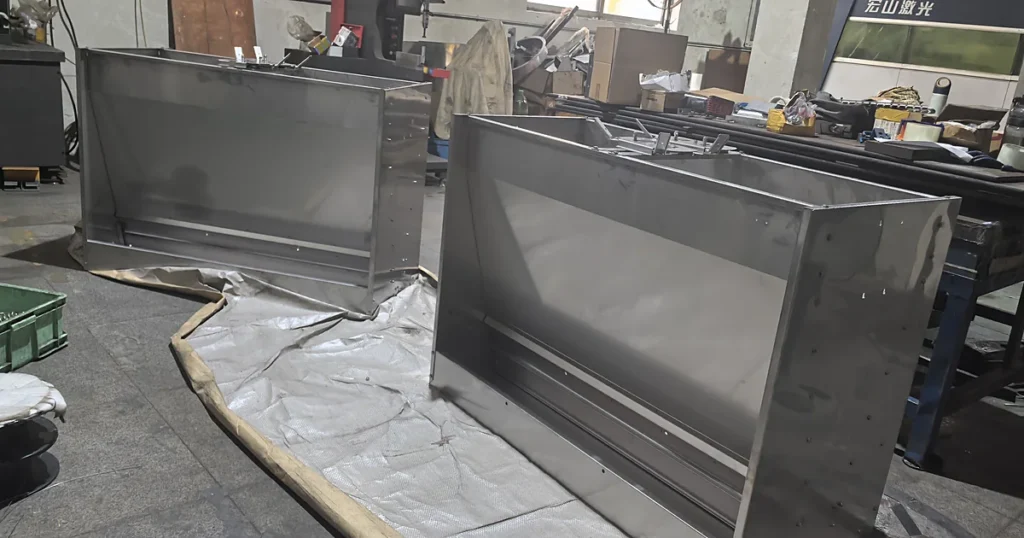
Wet, dirty and corrosive environments destroy trolleys faster than heavy loads do. Moisture, feed residue, fertiliser, cleaning chemicals, outdoor storage and rough ground attack a trolley from every direction at once — and a trolley that would last a decade in a dry warehouse can fail inside a season in a barn, a greenhouse, a washdown area or a yard. The design answer is not simply “make it heavier”; it is choosing the right material, finish, wheel and details for the specific exposure.
What makes these environments hard
Five factors usually act together, and the combination is what catches people out:
- Moisture and condensation. Standing water, humidity, and the condensation that forms inside hollow sections when a trolley moves between cold and warm spaces.
- Corrosive contact. Feed, fertiliser, manure, silage acids, salt, cleaning agents and disinfectants all accelerate corrosion, and some are far more aggressive than buyers expect.
- Frequent washing. Pressure washing forces water into joints, crevices and tube ends, and it strips coatings that were never specified for it.
- Rough ground. Uneven concrete, gravel, mud, grass, kerbs and slopes — all of which multiply the load on individual wheels.
- Outdoor storage. UV and rain on a trolley that is parked outside between uses, which is when most corrosion actually happens.
Material and finish: choose for the exposure
This is the decision that dominates service life, and it should follow the cleaning method rather than the purchase price.
Carbon steel with powder coating
Cost-effective and perfectly adequate for protected indoor use — a covered shed, a dry store, a feed room that is swept rather than washed. Powder coat gives a tough film over properly prepared steel. Its weakness is the chip: once the film is breached, corrosion starts underneath and spreads. Where a trolley gets hit regularly, coated carbon steel needs realistic expectations.
Hot-dip galvanizing
The standard answer where moisture, outdoor storage or washdown is routine. The zinc layer protects sacrificially, so scratches and cut edges are far less critical than with paint. Two things to design around: coating thickness changes the fit of threads, holes and moving parts, and the bath is hot, so thin sheet assemblies and long welded frames need assessing for distortion before galvanizing.
Stainless steel
Specified where cleaning is aggressive, where contamination cannot be tolerated, or where rust staining is unacceptable — food handling areas, clean rooms, laboratories and some livestock housing. Grade matters: 304 for general clean and food-contact use, 316 where chlorides, salt or aggressive disinfectants are present. Post-weld cleaning and passivation are essential; without them, corrosion appears at the weld heat-affected zone, which is the classic stainless trolley failure.
Duplex and mixed approaches
Where both appearance and corrosion life matter, galvanize then powder coat. Where only part of the trolley is exposed — a deck that holds wet material, for example — it is sometimes sensible to specify stainless for that surface and coated steel elsewhere, which controls cost without compromising the vulnerable area.
Detail design: where these trolleys actually fail
Most premature failures are design issues, not material issues. The repeat offenders:
- Open tube ends. Hollow sections draw water in and rust from the inside out, where nobody sees it until it is too late. Cap or seal every open end.
- Crevices and lap joints. Overlapping plates trap water, feed residue and cleaning fluid. Design drain paths, avoid blind crevices, and seal what cannot be drained.
- Mixed metals. Stainless in contact with carbon steel or aluminium creates galvanic corrosion in wet service. Consider isolation where dissimilar metals must meet.
- Fasteners. A galvanized frame with plain steel bolts fails at the bolts. Fastener material should match the corrosion strategy.
- Sharp edges before coating. Coating pulls back from a sharp edge, and that edge is usually the first place rust appears.
- Drainage. A solid deck that holds water becomes a standing corrosion bath. Perforated or drained decks suit wet duty better.
Wheels and structure for rough ground
Rough ground changes the wheel specification completely, and this is where most farm and yard trolleys are under-specified.
- Larger diameters. Small wheels sink into soft ground, catch on cracks, and make thresholds and kerbs a two-person job. Larger wheels roll over obstacles instead of into them.
- Softer treads or pneumatic. Rubber absorbs vibration and cushions impact; pneumatic wheels handle genuinely rough ground, gravel and grass, at the cost of puncture maintenance.
- Bearing protection. Sealed bearings are essential where there is dust, mud, water and pressure washing. Unsealed bearings fail quickly in this duty.
- Reinforced decks and mounting. Uneven ground means the load is rarely shared evenly between four wheels. Caster plates and the frame around them need to be designed for that.
- Containment. Side rails, mesh guards and end stops matter far more when the ground is uneven and loads shift during movement.
Handles and daily handling
These trolleys are used in cold, wet conditions, often with gloves on, several times a day. Small details matter more than usual:
- Handle diameter and position. Large enough to grip with gloves, positioned so the trolley can be pushed without stooping.
- Cold-touch surfaces. Steel handles outdoors in winter are unpleasant; consider a coated grip or a sleeve.
- Brake access. Brake pedals must be operable with boots and gloves, and reachable when the trolley is loaded.
- Cleanability. Smooth surfaces, no unnecessary recesses, and drain paths so washing does not leave residue behind.
Frequently asked questions
Powder coat or galvanizing for outdoor use?
Galvanizing, generally. Powder coat alone outdoors will chip, and every chip becomes a rust point. If appearance also matters, specify a duplex system — galvanize, then coat.
Is stainless worth the cost?
It depends on the cleaning regime. With mild cleaning and drying after use, galvanized steel lasts well. With hot, frequent or chlorinated cleaning, stainless usually pays for itself.
What wheels for mixed indoor and outdoor routes?
A large soft-tread wheel with sealed bearings. Move to pneumatic only if the ground is genuinely rough — gravel, grass, mud or deep cracks.
Can the trolley be pressure washed?
Yes, if it is designed for it: sealed tube ends, sealed bearings, drain paths, and a finish specified for washdown. Say so in the enquiry, because it changes the design.
RFQ details
- Indoor, outdoor, barn, greenhouse, washdown area, or mixed use.
- Floor or ground condition, including slope, gravel, cracks and thresholds.
- Moisture, cleaning method and frequency, and chemical exposure.
- Cargo size, weight, and containment requirement.
- Material and finish preference: coated steel, galvanized, stainless, or duplex.
- Wheel type, diameter, bearing sealing and brake requirement.
- Quantity, packing method and destination country.
These are the hardest environments a trolley works in, and the design has to be matched to the exposure rather than to a photograph. Send the use conditions with your requirements, or see the surface treatment page for how finishes compare.
Related pages: livestock and agriculture applications and surface treatment.
Have a Similar Trolley Project? Send It for Review
Send your trolley type, load capacity, size, wheel requirement, quantity, and drawings or reference photos. Our team will review the structure and reply within 24 hours on business days.
Urgent project? Email gao@doingmetal.com or WhatsApp +86 18158549983.