
November 6, 2026
From a One-Line Brief to a 300 kg Trolley
A fresh-produce wholesaler once sent us the shortest brief we have seen: a strong trolley, able to hold up to 300 kg, about 600 mm wide and up to 1,600 mm long. No drawing, no bill of materials, just a line of requirements and a note that the supplier should engineer and validate the final construction. That is not unusual in distribution and logistics, where the person placing the order runs the warehouse, not a drawing office. Our role is to take the line and turn it into a safe, repeatable, heavy-duty trolley.
- Load rating built to 80-1,000 kg by frame design; this brief called for a 300 kg working load.
- Frame tube: O20-50 mm outer diameter, wall 1.2-3.0 mm; deck and supports in plate 0.8-3.0 mm.
- Casters: 75-200 mm diameter in PU, rubber, nylon or pneumatic; four heavy-duty swivel casters, at least two braked.
- Business terms: MOQ 50 units, sample in 7-15 days, mass production 25-35 days, tooling and fixtures quoted separately.
- Engineering service: simple parts drawn free (PDF + rendered view only, no CAD source released); complex parts from USD 200, quoted before we start.
- Certification: we hold a Bureau Veritas factory audit, report MIC-ASR263630 (2026-10-09). We cannot provide ISO 9001, CE, UKCA, UL, EN 1090, ISO 3834 or EN 10204 3.1 in our name, and we issue no food-contact statement.
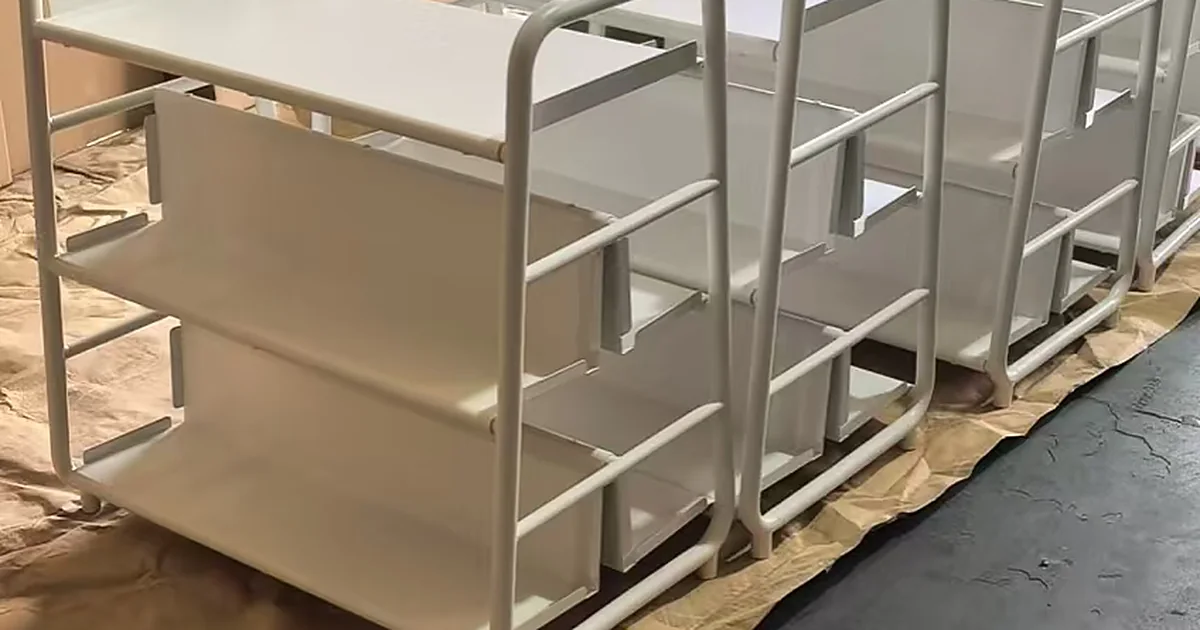
A fleet of platform trolleys built in our Ningbo workshop.
Read the brief, then challenge it
A one-line requirement hides decisions. “Up to 300 kg” tells us the frame must be rated for that load with margin, but it does not say whether the load is a single dense box or many loose crates – and that changes how the deck is supported. “Up to 1,600 mm long” means we must control deflection across the span so the trolley does not sag or tip. We confirm the floor type, the door widths and whether the trolley is pushed by one person or towed, because those answers decide the caster and handle design more than the length does.
Building on the platform-trolley baseline
For a flat, heavy load the platform trolley format is the right starting point: a low deck for a low centre of gravity, a perimeter edge to stop loads sliding, and a handle at a comfortable push height. We sized the deck at roughly 600 x 1,600 mm and specified a welded steel frame using tube in the O20-50 mm range with 1.2-3.0 mm walls, braced so the 300 kg rating had comfortable margin rather than merely meeting it.
Deck and load spread
A 300 kg point load and a 300 kg spread load are different problems. For a wholesaler moving mixed crates we assumed a spread load and used 0.8-3.0 mm plate with transverse under-deck supports so the deck stayed flat under weight. The powder coat was specified at 60-80 um to survive the scraping and washing a distribution centre dishes out. Where the buyer later wanted a flush, easy-clean top, we offered a folded pan deck instead of a flat plate.
Casters that earn their place
At 300 kg the casters do real work. We specified four heavy-duty swivel casters in the 125-150 mm range, at least two with brakes, in PU for quiet rolling on sealed floors or rubber where the route includes the loading bay. A 75 mm wheel would have overloaded each caster; a 200 mm pneumatic wheel would have been overkill and raised the deck. The choice is a calculation, not a guess, and we document the rating per caster in the drawing.
Engineering the drawing yourself
Because the buyer had no file, we produced the concept. Our engineering service returns a dimensioned PDF and a rendered view for approval, with no CAD source released – you get a buildable drawing, not the editable model. For a standard trolley the drawing was included; had the wholesaler needed a custom folded enclosure or fixturing we would have quoted from USD 200 before starting.
Tolerances you can actually build to
Heavy trolleys are forgiving on exact numbers but unforgiving on the ones that matter: caster mounting centres, handle height and deck flatness. We hold practical sheet-metal tolerances and explain them plainly on our tolerances and dimensions page, so the buyer knows what to expect on a welded-and-folded product and where tighter numbers would add cost without adding function.
How we rate the load and build in margin
A 300 kg rating is not the same as a 300 kg limit. We design the frame and deck to a working load with a safety margin, then confirm it with a sample loaded to or beyond the target before sign-off. The weak points are rarely where buyers expect: a deck plate is usually fine, but the caster mounts and the handle brackets see the highest stress when the trolley is dragged or bumped. We reinforce those junctions explicitly rather than relying on the tube alone, which is why a trolley built to our drawing outlasts one copied from a photograph.
Price follows from these choices. A wider tube, thicker plate, braked casters and a folded pan deck each add cost, and we lay them out line by line so the buyer can trade cost against durability. For a wholesaler running the trolley all day, the stronger version usually pays for itself in fewer repairs.
Sample, then volume
We built a sample within the standard 7-15 day window and shipped it for a real shift in the warehouse. After approval, production of 50 or more units runs 25-35 days, with tooling – where any is needed – quoted separately rather than buried in the unit price. The wholesaler moved from a one-line email to a documented 300 kg trolley without ever opening a CAD program.
If your requirement is a sentence rather than a specification, send it. We will engineer the rest.
Have a Similar Trolley Project? Send It for Review
Send your trolley type, load capacity, size, wheel requirement, quantity, and drawings or reference photos. Our team will review the structure and reply within 24 hours on business days.
Urgent project? Email gao@doingmetal.com or WhatsApp +86 18158549983.